Barcelona With Kids: The Honest 2026 Family Guide
Barcelona with kids works, and it works because the rules that matter are specific, not vague. Sagrada Família charges nothing for children under eleven, as of September 2026, while L'Aquàrium's free…

Photo: Barcelona's Eixample from above by Logan Armstrong, via Unsplash, Unsplash License
Barcelona works with children, and it works because the rules that matter are specific rather than vague. Every venue sets its own age cutoff: Sagrada Família is free under eleven, L'Aquàrium charges from three, CosmoCaixa is free under sixteen. A citywide "kids go free" assumption is what trips families up at the counter.
This guide covers the decisions families actually have to make before Barcelona: which tickets children need, how to move around with a stroller, when a child seat is required, what to book ahead, and how to pace three days without exhausting everyone.
Quick Answer
Children under four travel free on the metro, tram and TMB buses. Attraction age bands differ sharply: Sagrada Família is free under 11, CosmoCaixa free under 16 (ticket still required), L'Aquàrium free only under 3 — so a three-year-old pays there and nowhere else. Spain requires an approved child restraint for anyone 135 cm or shorter — but Barcelona taxis have a legal urban exception for a child in a rear seat, which hire cars do not get. Three days is enough if you build each day around one fixed booking.
Key Takeaways
- Under-fours ride free on metro, tram and TMB buses. Everyone else needs a ticket, and which one depends on how many of you are paying.
- CosmoCaixa is free for under-16s but they still need a ticket, and an adult must accompany them.
- L'Aquàrium has the tightest bands: free only under 3, then €15 at 3–4, €23 at 5–10, €30 from 11.
- Hire cars follow the 135 cm child-restraint rule without exception. Taxis have an urban one, for rear seats only.
- Barcelona-El Prat lends baggage trolleys fitted with child seats. They are airport mobility aids, not car seats for your onward journey.
- Hola Barcelona includes the airport metro. It does not include the Aerobús, which is a separate product.
In This Article

Does Barcelona Actually Work With Children?
Yes, and for structural reasons rather than charm. The things you want are close together: a beach, a basilica, an aquarium and a hands-on science museum sit within a compact metro network, so a day rarely costs you more than twenty minutes of travel in each direction. Meals run late, which sounds like a problem and mostly is not — kitchens are used to children at nine in the evening, and an afternoon back at the apartment stops being a wasted hour and becomes the thing that makes the evening possible.
The honest caveats are two. July and August are hot enough that midday outdoors stops being pleasant, which is why the indoor, air-conditioned options in this guide carry more weight than they would in a temperate city. And the central sights are genuinely crowded in season, so the difference between a 9:30 slot and a 13:00 one is larger with children than without.
What Children Actually Pay
There is no citywide children's rate. Each venue sets its own band, and they are far enough apart that a nine-year-old can be free at one attraction and full price at the next. This is the table worth screenshotting before you book.
| Where | What children pay | Typical visit | Booking note |
|---|---|---|---|
| Metro, tram, TMB bus | Free under 4; from 4 they need a ticket like everyone else | — | No child ticket exists for visitors; the free under-16 T-16 is for registered residents only |
| Sagrada Família | Free under 11. Adult €26, or €36 with the towers | 1–1.5 hours | Timed entry, book well ahead; the audioguide app is included and covers the Basilica only |
| L'Aquàrium | Free 0–2 (no ticket needed), €15 at 3–4, €23 at 5–10, €30 from 11 | 1.5–2 hours | A family pack of 2 adults + 2 children is €88, against €106 bought separately |
| CosmoCaixa | Free under 16 — but a ticket is still required, and an adult must come too. Adult €8 | 2–3 hours | Open 10:00–20:00 daily; some activities are ticketed separately |
Two of those deserve emphasis because they change what a day costs. CosmoCaixa is the outlier: a family of two adults and two children pays €16 in total, and the free-under-16 rule covers ages the other venues charge full price for. And L'Aquàrium's free cutoff is age two, not three — a three-year-old pays.
A nine-year-old is free at the basilica, free at the science museum, and €23 at the aquarium. There is no such thing as the children's price in Barcelona.

Getting Around: Which Ticket Your Family Needs
Children under four travel free across the integrated network — metro, tram and TMB buses — and need no ticket at all. From four, they pay like an adult. That single fact does most of the work in deciding what to buy.
For everyone else, the choice is not automatic. Hola Barcelona gives unlimited travel for one to five consecutive days and includes the airport metro on L9, with an outbound and a return journey between the airport and the city. It suits families making frequent journeys who also want the airport leg covered. T-familiar is a different shape entirely: a multi-person card of eight journeys, shareable across your group, valid for 30 days. For a family making a handful of rides rather than criss-crossing the city, it can cost considerably less.
So do the arithmetic on paying passengers rather than people. Two adults and a three-year-old is two fares, not three. Two adults and two school-age children is four, and at four fares a pass stops being obviously right.
The Aerobús is not included in the standard Hola Barcelona card. It is a separate airport bus, sold separately — there is a distinct Hola Barcelona Aerobús product that bundles it. If your plan assumes the airport bus is covered, check which of the two you actually bought.
One thing to ignore: the T-16 is free for children aged four to sixteen, and it is not available to you. It requires the child to be officially registered as a resident in a municipality of the Barcelona metropolitan transport area, evidenced with ID. It is a residents' entitlement, not a tourist children's pass, and it is tied to the fare zone of the child's registered municipality.
My advice: check the actual station and lift route before you commit to a stroller-heavy day. Barcelona's metro accessibility is not uniform — plenty of older stations have no lift, and finding that out at the bottom of a staircase with a sleeping toddler and a folded pushchair is a specific kind of misery. TMB publishes accessibility per station; two minutes on it while planning the route saves the afternoon. On the hillier routes, Park Güell and Gràcia especially, a lightweight carrier often beats a stroller outright in summer.
Car Seats: Taxis and Hire Cars Are Not the Same
This is the point most family guides get wrong, and the distinction is in the regulation itself.
The general rule is height, not age. Under Article 117 of the Reglamento General de Circulación, minors measuring 135 cm or less must use an approved child restraint system. Measure your child before you travel rather than counting birthdays.
Hire cars follow that rule with no exception. If you are renting, you need an appropriate seat, whether you bring it or hire it with the car.
Taxis are treated differently. Article 119 provides that when taxis are circulating in urban traffic or in the urban areas of large cities, they may carry people under 135 cm without a restraint adapted to their height and weight, provided the passenger occupies a rear seat. The June 2026 amendment to the regulation, which takes effect on 1 October 2026, re-enacts that sentence word for word, so the exception is not going away.
Two things that exception is not. It is not a guarantee that a taxi will have a child seat — arranging one in advance with the operator remains the safer choice, and availability varies. And it is not a safety recommendation: a legal exemption for short urban trips is a licensing decision, not advice about what protects a child in a collision. Spain's traffic authority separately recommends keeping children restrained beyond the legal minimum height.
What the Airport Actually Provides
Barcelona-El Prat carries more family infrastructure than most single-airport stops, and it is worth knowing precisely what it is.
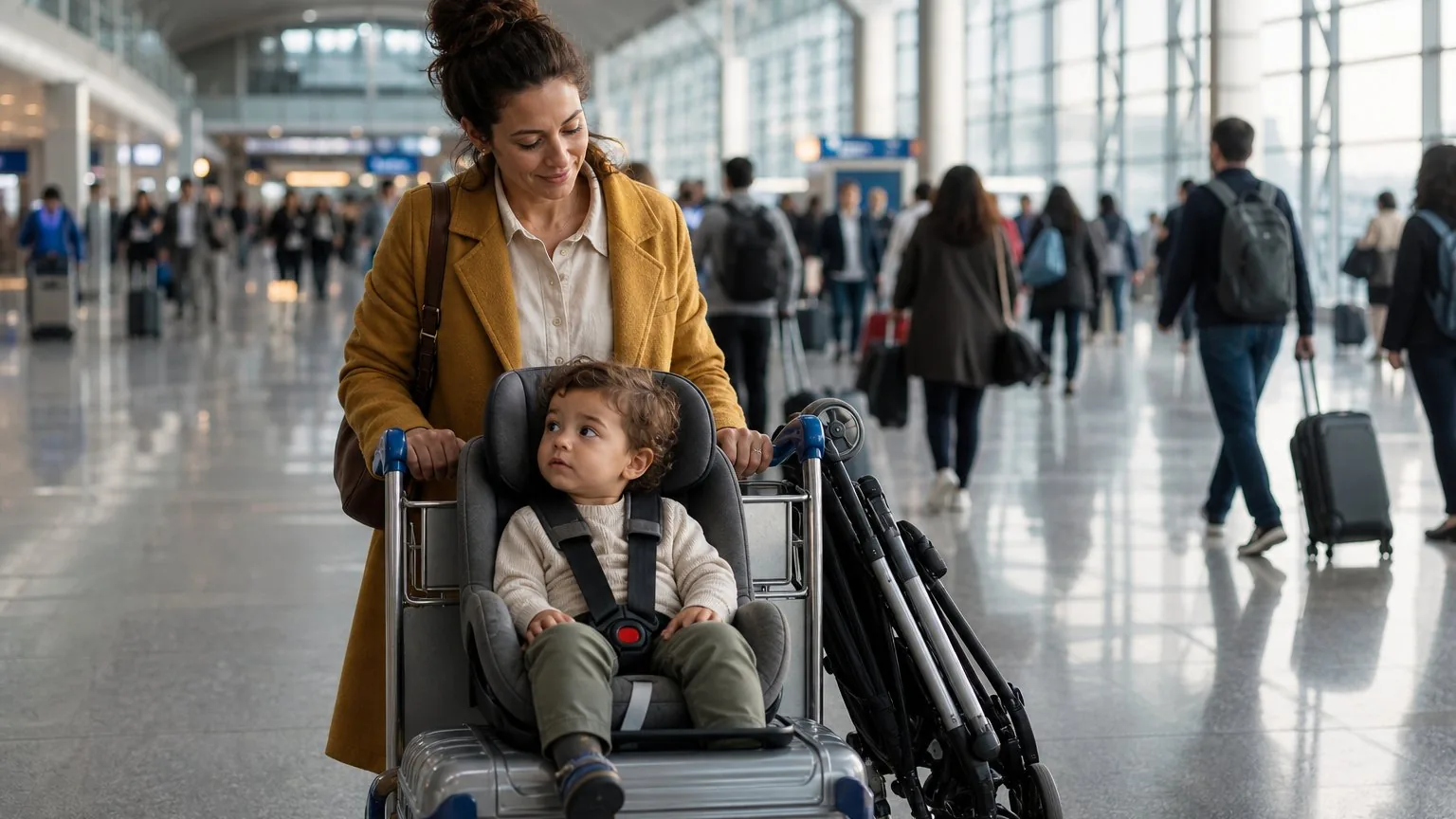
Aena runs a free loan of baggage trolleys fitted with a Maxi-Cosi or child seat in both terminals, subject to availability. You ask for one at a staffed information point, or use the telephone on an unstaffed counter. There are breastfeeding rooms with comfort chairs, changing tables and microwaves, children's play areas, and preferential access for passengers with children at security, free of charge.
The important clarification: these are airport mobility aids, not car seats to take with you. A trolley with a Maxi-Cosi attachment moves a baby and your luggage through the terminal together. It is not lent for a taxi or a hire car, and no part of your onward road journey should depend on it. If you need a restraint for the road, bring it or arrange it with the rental company or taxi operator.
Three Days, Realistically
The principle underneath this itinerary matters more than the stops: one fixed, timed attraction per half-day, and nothing else booked. Stacking two advance reservations into one day is what turns a family holiday into a logistics exercise, because the second booking removes the option of responding to how the first one went.
Day 1 — arrival and nothing ambitious. Land, get into the city, find food near where you are staying. A child under four rides the metro free; check whether your pass covers the airport leg or whether you bought the Aerobús separately. Resist the urge to add an attraction because the afternoon looks free.
Day 2 — Sagrada Família, then a choice. Take an early timed slot, when queues and heat are both lower. For the afternoon, pick one, not both: Park Güell if your children are older, mobile and up for a hill, and Gaudí is the thread you want to follow; or CosmoCaixa if they are younger, if it is hot or raining, or if the morning was enough and you want a low-pressure afternoon where they can touch things. CosmoCaixa also opens until 20:00, which means it absorbs a late start without penalty.
Day 3 — L'Aquàrium and the water. A compact 1.5 to 2 hours at the aquarium in the morning, then the beach or the waterfront for the afternoon. The aquarium is indoors and air-conditioned, which makes it the right call on the hottest morning of the trip rather than an automatic one.
My advice: with young children, build each half-day around one fixed booking and leave the rest genuinely open. The trips that go wrong are rarely the under-planned ones. They are the ones where a 10:00 slot and a 15:00 slot were both non-refundable, the nap arrived at 13:00, and the second ticket turned a good day into a forced march across the city.
Before You Book
- Have you checked each attraction's own age band rather than assuming one cutoff?
- Have you counted paying passengers — under-fours are free — before choosing a transport pass?
- If you are hiring a car, is an approved child seat arranged?
- If you plan to use taxis, have you asked the operator about a seat, rather than relying on the urban exception?
- Do you know whether your pass covers the airport metro, or whether you need the Aerobús separately?
- Have you checked lift availability at the stations on your stroller routes?
- Is there exactly one timed booking per half-day?
Check the metro before you book the family room
A great hotel in the wrong spot can cost you an extra hour of travel with kids every day.
Frequently Asked Questions: Barcelona With Kids

Do toddlers ride the metro free in Barcelona?
Yes. Children under four travel free on the metro, tram and TMB buses across the integrated network, and need no ticket at all. From their fourth birthday they pay a normal fare.
At what age do Barcelona attractions charge children?
It depends entirely on the venue, which is the single biggest planning trap. Sagrada Família is free under 11. CosmoCaixa is free under 16, though a ticket is still required. L'Aquàrium is free only to age 2, then charges €15 for ages 3–4 and €23 for 5–10.
Do children need a car seat in a Barcelona taxi?
Not always, legally. Spain requires an approved restraint for anyone 135 cm or shorter, but the regulation allows taxis circulating in urban traffic or the urban areas of large cities to carry a child under 135 cm without one, provided the child sits in a rear seat. That exception does not apply to hire cars, it does not extend beyond urban driving, and it is not a safety recommendation. If you want a seat, arrange it with the operator in advance.
Should I buy Hola Barcelona for my family?
Only after counting paying passengers. Under-fours are free, so a couple with a toddler is two fares. Hola Barcelona is strong when you expect frequent journeys and want the airport metro included. A T-familiar — eight journeys shared across your group over 30 days — often costs less for a family making a handful of rides. The T-16 is not an option: it is free for residents' children only.
Is Barcelona stroller friendly?
Mostly, with one real caveat. The seafront, the Eixample grid and most main attractions are easy going. Metro accessibility is not uniform, though: older stations can lack lifts, and Gràcia and the approach to Park Güell are genuinely hilly. Check the station you actually need, and consider a carrier for the hill days.
How many days do you need in Barcelona with kids?
Three is enough for the headline sights at a humane pace, if you keep to one fixed booking per half-day. Four or five lets you add a second neighbourhood, a proper beach day, or simply a morning where nothing is booked.
Is CosmoCaixa good for young children?
It is the strongest value in this guide for families. Admission is €8 for an adult and free for under-16s, it is hands-on rather than look-only, and it stays open until 20:00 — which makes it the reliable answer to heat, rain, or an afternoon that needs to be low-pressure. Children under 16 must be accompanied by an adult, and some activities are ticketed separately.
What should I book ahead?
Sagrada Família, because it runs on timed entry and the good morning slots go first. L'Aquàrium is worth booking for a specific morning in high season. CosmoCaixa needs a ticket even for the free under-16s, so include them in the booking rather than turning up and explaining at the desk.
Further Reading
Sources and References
- Reglamento General de Circulación (Real Decreto 1428/2003), consolidated text at the BOE. Article 117 for the 135 cm child-restraint rule; Article 119 for the urban taxi exception, re-enacted by Real Decreto 518/2026 with effect from 1 October 2026.
- Sagrada Família, official prices page: base €26, with towers €36, under-11s €0.
- L'Aquàrium de Barcelona, official prices page: age bands, family pack and free admission to age 2.
- CosmoCaixa official ticketing: general admission €8, free for under-16s with a ticket still required, daily 10:00–20:00 with published exceptions.
- Transports Metropolitans de Barcelona for under-four travel, Hola Barcelona, T-familiar and the residents-only T-16.
- Aena, family services at Josep Tarradellas Barcelona-El Prat.

Part of Destinations & Itineraries.


