Best Things to Do in Santorini: A 2026 Traveller's Guide
Santorini's famous half-dozen earn their reputation, and this guide tells you which deserve your limited days. But the island most people enjoy more is the quieter one behind them: museums, fortified villages, basket-trained vines and a lunar coast.

Santorini's famous half-dozen — the Oia sunset, a caldera cruise, Akrotiri, the cable car, the black-sand beaches, the Fira-to-Oia walk — earn their reputation. Every one of them is worth doing, and this guide tells you which ones deserve your limited days. But a list that stops there describes a very small island, and misses the one most people actually enjoy more once they find it.
Because the island has another half: a renovated archaeological museum most guides predate, a tomato cannery turned cultural space beside the strangest beach on Santorini, fortified medieval lanes ten minutes inland, vines trained into ground-level baskets found almost nowhere else on earth, and an open-air cinema that is the best thing to do on your second evening. This guide covers both halves, and tells you how to time the famous half so you are not sharing it with four cruise ships.
Quick Answer
The essential Santorini is one caldera sunset, one boat trip, and Akrotiri (€20). Beyond that, the island's best experiences are quieter: the renovated Archaeological Museum of Thera in Fira (€10), the Tomato Industrial Museum at Vlychada (€12) paired with its lunar beach, the inland villages of Pyrgos and Emporio, a vineyard that shows you the kouloura vine baskets, and the short Skaros Rock walk from Imerovigli instead of the full Fira–Oia hike. Before you fix your Oia day, check the Municipal Port Fund's cruise-arrival calendar for your dates.
Key Takeaways
- The Municipal Port Fund publishes a public cruise-arrival calendar with estimated passenger numbers per ship. Check your own dates before deciding which day you give to Oia.
- Fira's two museums close on different days: the Archaeological Museum of Thera on Mondays, the Museum of Prehistoric Thera on Tuesdays. Pairing them needs the right day.
- Akrotiri has no visitor cap and no timed-entry system, whatever other guides say — the Ephorate publishes no such rule.
- Skaros Rock from Imerovigli is roughly 650 m to the chapel, but about 280 steps down and back up: short, not effortless.
- Thirassia does not work as an independent day trip on the local ferry, which is timed for islanders coming the other way. Go by excursion or stay the night.
- Red Beach's cliffs are actively unstable and the path has closed repeatedly after rockfalls. Seeing it from a boat is the safe version.
In This Article
- What Should You Actually Do
- The Famous Santorini, Honestly Assessed
- Sunset Without Joining the Oia Scrum
- Akrotiri and the Three Museums
- The Santorini Most Visitors Miss
- Wine, and Why the Vines Look Like That
- Walking, Beaches and Volcanic Coast
- Planning Around the Cruise Ships
- Couples, Budget and Families
- Getting Around
- Frequently Asked Questions
What Should You Actually Do
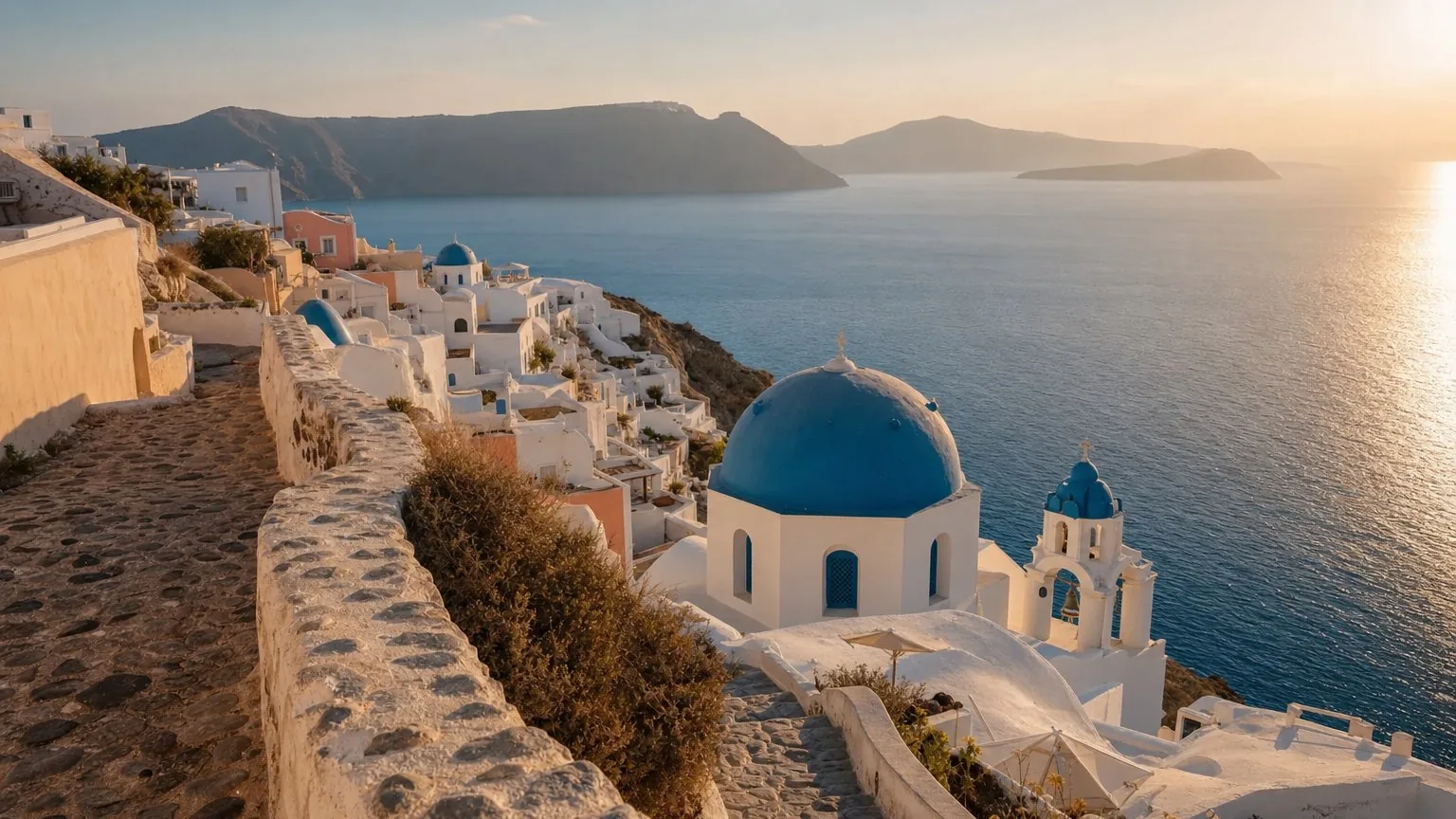
Most people have three or four days here, which is enough for roughly two things a day before the island stops being enjoyable. Find the row that matches why you came, and treat the rest as optional.
| If you want… | Do this | Why | Time needed |
|---|---|---|---|
| The first-time wow | A caldera boat trip | The cliffs only make sense from sea level | Half to full day |
| History that sticks | Akrotiri + Museum of Prehistoric Thera | The city, then the art that explains it | Half day |
| Something new for 2026 | Archaeological Museum of Thera | Renovated display, and the Kore of Thera | 1–2 hours |
| Quieter caldera scenery | Skaros Rock from Imerovigli | Same view, a fraction of the crowd | 1–2 hours |
| Santorini beyond the postcard | Pyrgos or Emporio | Fortified lanes, ten minutes inland | Half day |
| An unusual half-day | Tomato Museum + Vlychada beach | Industrial history beside a lunar coastline | Half day |
| Wine worth the money | A vineyard that shows you the kouloura | The vines are the story, not the terrace | 2–3 hours |
| An easy second evening | Cine Kamari, open-air cinema | After you have watched one sunset | Evening |
| A different island entirely | Thirassia, by excursion | Santorini's population minus the crowds | Half day, see below |
The Famous Santorini, Honestly Assessed
Do the famous things. Just do them once, and do them at the right hour.
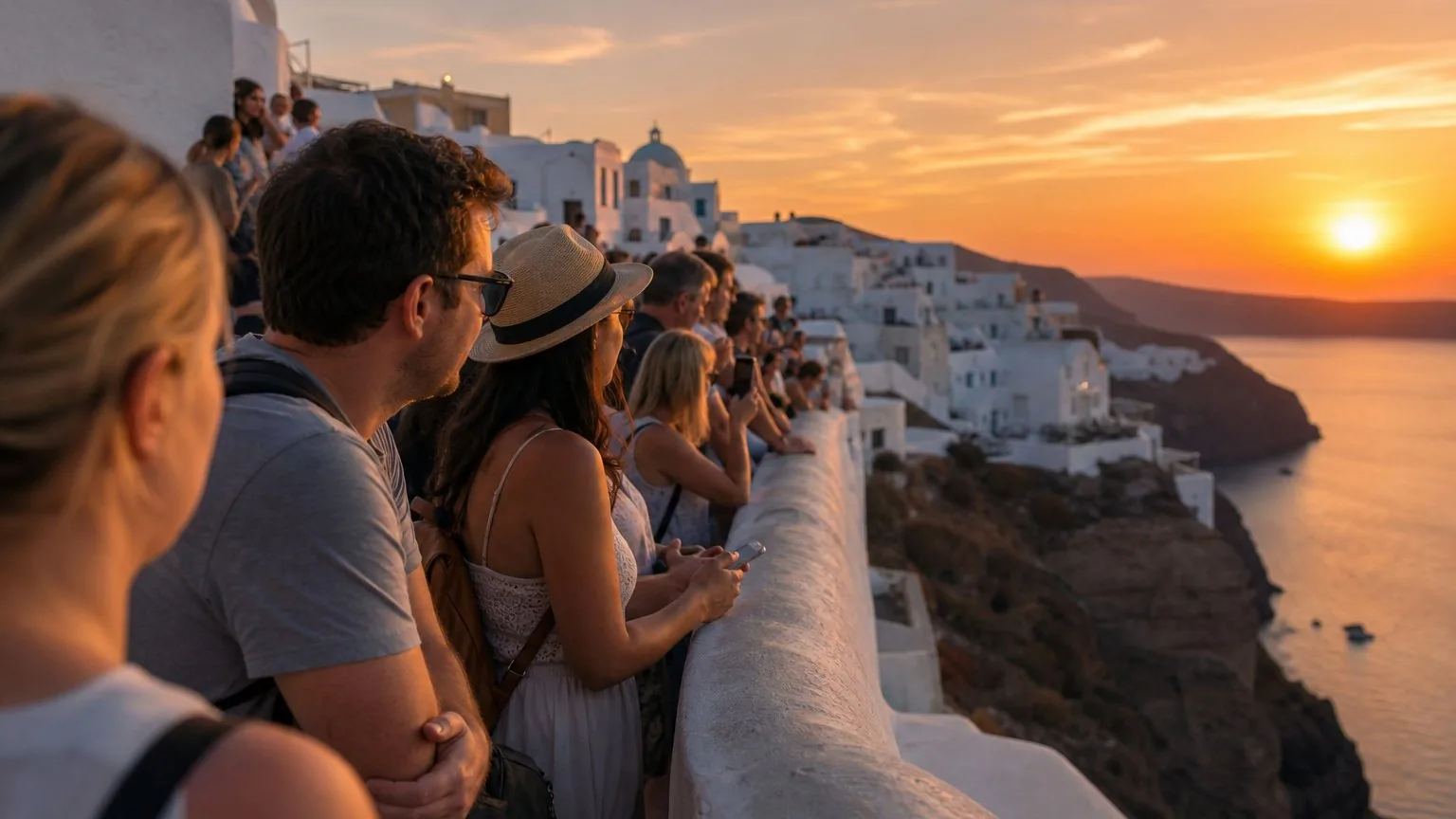
The caldera sunset is free. Public viewpoints along the rim in Oia and Fira cost nothing, and only restaurant and bar terraces charge, usually as a minimum spend rather than an entry fee. In high season, arriving at the Oia castle viewpoint 60 to 90 minutes early is the price of a front position. Whether that is a good use of ninety minutes is a separate question, and the section below gives you five alternatives.
A caldera boat trip is the one paid experience almost everyone should keep. The cliffs are 300 metres of layered volcanic rock and you cannot read them from the top. Pricing splits into clear tiers: shared day cruises from about €100, shared sunset seats around €120, and private three-to-four-hour sunset charters from roughly €720, per Santorini Yachting Club's published offers. Book earlier for prime sunset departures in July and August, when demand concentrates on one time slot — though no operator we checked publishes a specific lead time, so treat "weeks ahead" as caution rather than a rule.
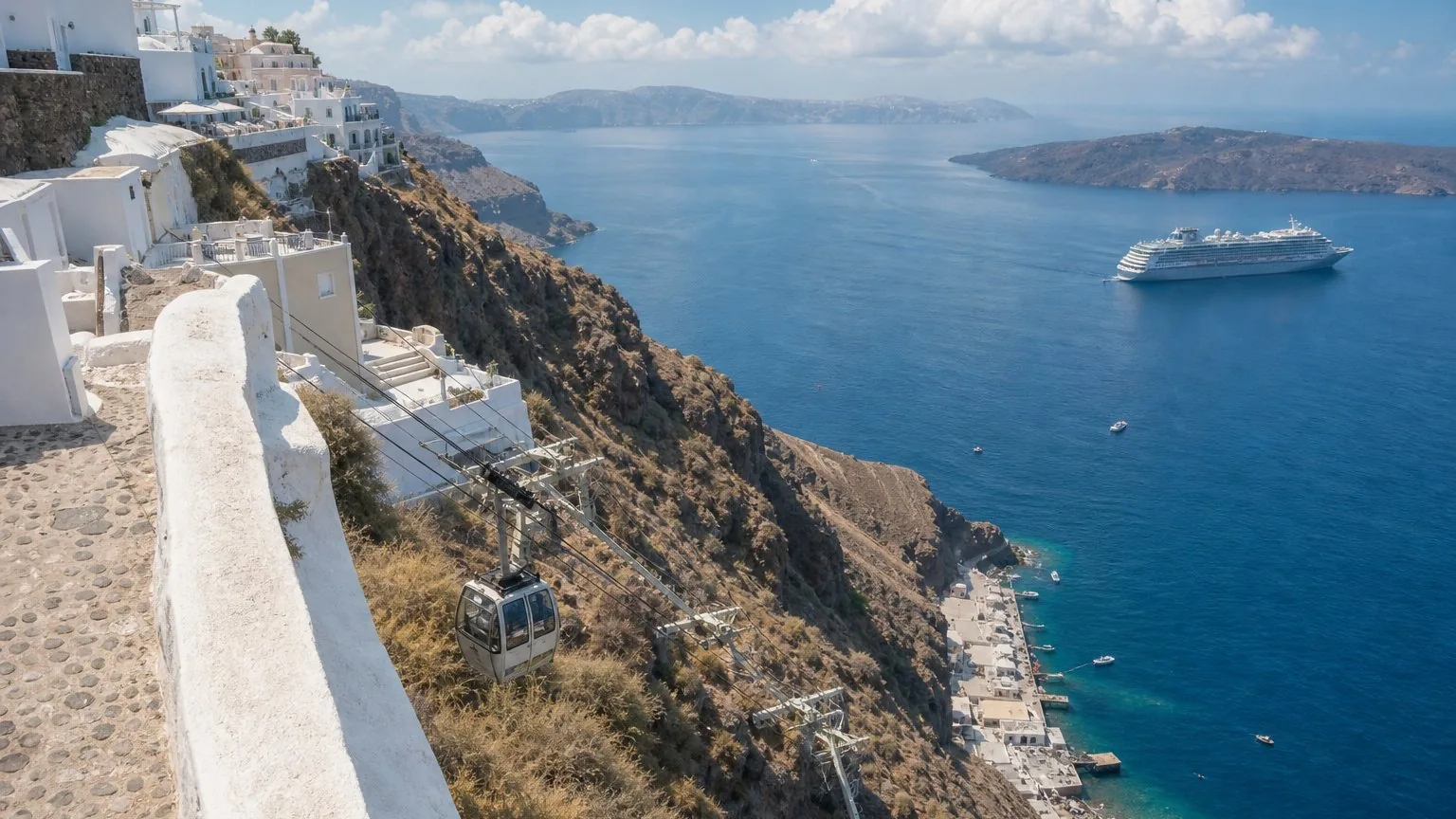
The cable car runs between Fira and the old port below. The operator's own price list sets general admission at €10 one way, reduced €5, and — the detail that catches cruise passengers — €5 for each item of luggage. Tickets are one-way and non-refundable, cash or card. The stepped Karavolades path is the free alternative, 500-odd steps shared with donkeys; it closed in late July 2026 after a wall collapse and reopened on 3 August 2026.
Sunset Without Joining the Oia Scrum
Oia's castle is not the only answer, and on a heavy cruise day it is close to the worst one. Nothing here is a secret; they are simply spread out, which is the entire point.
| Spot | Best for | Crowd and friction | Trade-off |
|---|---|---|---|
| Oia castle | The photograph you came for | Heaviest on the island; arrive 60–90 min early | You will queue for a wall |
| Imerovigli / Skaros | The same caldera, far fewer people | Moderate; a short walk keeps numbers down | Stairs, and carry a light |
| Pyrgos Kastelli | Seeing the whole island at once | Light | Inland, so the sun sets over land |
| Akrotiri lighthouse | Open sea horizon, space to stand | Light to moderate | Needs a car; little shelter |
| Fira rim walkway | Doing nothing special, pleasantly | Moderate | Town lights rather than drama |
| Vlychada | A completely different landscape | Light | Not a caldera sunset at all |
One practical note that costs nothing: central Oia is a far better place early in the morning than at any point after lunch. The lanes photograph better, the shops are opening, and the cruise tenders have not landed.
Akrotiri and the Three Museums
Akrotiri is a Bronze Age town buried by eruption and excavated under a modern shelter — described by the Ephorate as a "bioclimatic shelter designed by architect N. Fintikakis", which also makes it the coolest place to stand on a hot afternoon. Adult admission is €20, reduced €10. Opening hours are unusual and worth checking: Mondays and Thursdays it closes at 15:30, while other days run later on a seasonal scale (in early October, 08:00–18:30 with last entry at 18:00).
There is no visitor cap and no timed-entry system. The Ephorate publishes nothing of the kind, so ignore any guide telling you that tickets sell out because numbers are limited.
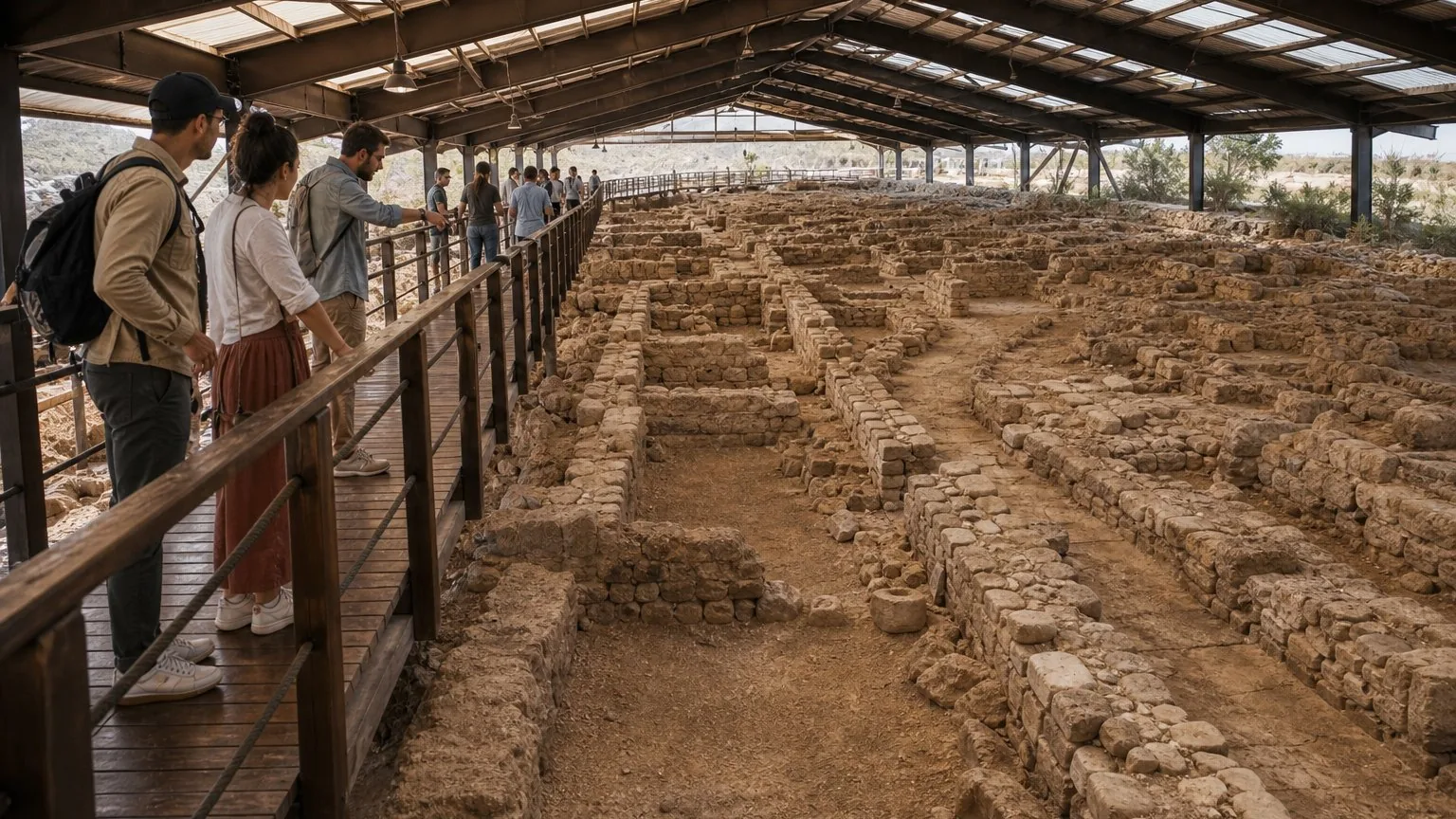
Akrotiri on its own is a walk through empty rooms. The objects that explain it — the frescoes, the pottery, the furniture casts — are in Fira at the Museum of Prehistoric Thera. If the Bronze Age genuinely interests you, do both and treat Akrotiri as half of an exhibit rather than a sixty-minute photo stop.
Fira's other museum is the Archaeological Museum of Thera, covering the later, classical island rather than the prehistoric one. Its centrepiece is the Kore of Thera, a monumental Archaic marble figure. It also keeps the most useful opening hours on the island: 09:00–21:00 every Saturday, which makes it the one museum you can visit after a beach day.
The museum-day trap
- Archaeological Museum of Thera — closed Mondays. Open 08:30–15:30, and 09:00–21:00 on Saturdays.
- Museum of Prehistoric Thera — closed Tuesdays. Open 08:30–15:30.
- They are a few minutes apart in Fira but shut on different days, so a Monday or Tuesday museum plan only ever gets you one of them.
- All three state museums — these two and Ancient Thera — are €10 full, €5 reduced.
Ancient Thera, the classical city high on Mesa Vouno, is currently listed as open by the Ephorate, closed Wednesdays, checked September 2026. It has had at least one interruption this year, so confirm on the Ephorate's own opening-hours page before you drive up.
The Santorini Most Visitors Miss
The Tomato Industrial Museum at Vlychada is the island's best unexpected half-day. It occupies a tomato-processing factory that ran from 1945 to 1981, and it is open Tuesday to Sunday, April to November, 10:00–18:00, at €12 (€10 reduced), closed Mondays. It is genuinely interesting on the industrial history of an island everyone assumes only ever did tourism — and it sits beside Vlychada beach, where pale wind-carved cliffs sit above dark sand and look nothing whatsoever like the caldera. Museum plus beach plus lunch is a complete, unhurried day, and almost nobody on a three-day itinerary does it.
It also solves the cooking-class question. Plenty of operators will teach you Greek salad; the museum runs its own workshops built around the island's own crop, including making and canning tomato paste. If you book a class anywhere, book it because it teaches Santorini ingredients — fava, tomatokeftedes, white aubergine, capers, the small intense local tomatoes — rather than because it teaches Greek food generally.
Inland villages. Ten minutes from the rim the island stops performing. If you only choose one:
- Pyrgos — the best all-round choice and the former capital. A hill town wrapped around a Venetian kastelli, with views across the whole island from the top, and the Ecclesiastical Collection of the Holy Trinity (€5) if you want something ticketed to aim at. It is also a genuine sunset alternative.
- Emporio — the best medieval lanes. The Kasteli is a dense fortified warren built as protection against raiders, and walking it is the closest Santorini comes to feeling secretive without anybody pretending it is undiscovered.
- Vothonas — the best cave architecture, with houses dug into the ravine walls. Worth a stop rather than a morning.
Cine Kamari is the correct answer to "what do we do on our second evening". An open-air cinema in a garden at Kamari, films in their original English with Greek subtitles, doors at 20:30 and the film at 21:30, and it does not take reservations. It is not culturally profound. It is simply a very pleasant way to spend an evening once you have already watched a sunset, and it works for couples and for older children. Being open-air, it cancels for rain — the operator posts that on its own front page on the night.
Thirassia is the island across the water, with Manolas above and the small ports of Korfos and Riva below, and it holds what Santorini looked like before the hotels. It is also the item where most guides will get you into trouble, so here is the actual position.
The published local ferry is not designed for you. It leaves Thirassia in the morning and returns in the afternoon, because it exists to bring islanders to Santorini and take them home — on Tuesdays and Fridays it departs Korfos at 08:00 and comes back from Fira at 15:50; on Mondays, Wednesdays, Thursdays and Saturdays it leaves Korfos at 13:45 and returns from Athinios at 15:30. Travelling from Santorini, you would arrive on Thirassia in the late afternoon with no boat back until the next morning. An independent same-day round trip on that ferry is not possible. Go on a caldera excursion that includes a Thirassia stop, arrange a private boat from Ammoudi, or book a night there and let the island be the point rather than a stop.
And check what the island is actually doing while you are there. The municipality and the village cultural associations run a steady programme through the season — music evenings, feast-day panigyria at the village churches, exhibitions, the occasional volcano-themed spectacle. None of it is aimed at visitors, which is exactly why it is worth finding. A village feast you happened to be there for will outlast another viewpoint in the memory, so look up the municipality's current events listing for your dates rather than trusting any calendar printed in a guide, including this one.
Wine, and Why the Vines Look Like That
Santorini's wine is genuinely distinctive rather than merely local, and the reason is visible from any roadside. Vines here are not trained upward on wires. They are woven along the ground into a coiled basket, the kouloura, with the grapes growing on the inside — a system developed to shelter fruit from relentless wind and sun, and to catch what little moisture the island gets. The result looks less like a vineyard than a field of grey wreaths.
That is the thing to optimise for. Plenty of wine experiences here amount to three glasses on a terrace with a caldera view, which is pleasant and tells you nothing. Choose one that gets you out among the vines and explains the kouloura, the volcanic soil and why Assyrtiko tastes the way it does. If you want an indoor, weather-proof version, the Koutsogiannopoulos Wine Museum outside Fira is built into a cave and covers the island's winemaking history with a tasting attached; travellers who arrived indifferent to wine routinely come out having enjoyed it more than they expected.
Walking, Beaches and Volcanic Coast
The Fira to Oia rim walk is about 10 km along the cliff edge and takes most walkers three to five hours with stops. It is the island's signature walk and deserves the reputation, but it is exposed almost the entire way, with very little shade and no shortcut once committed.
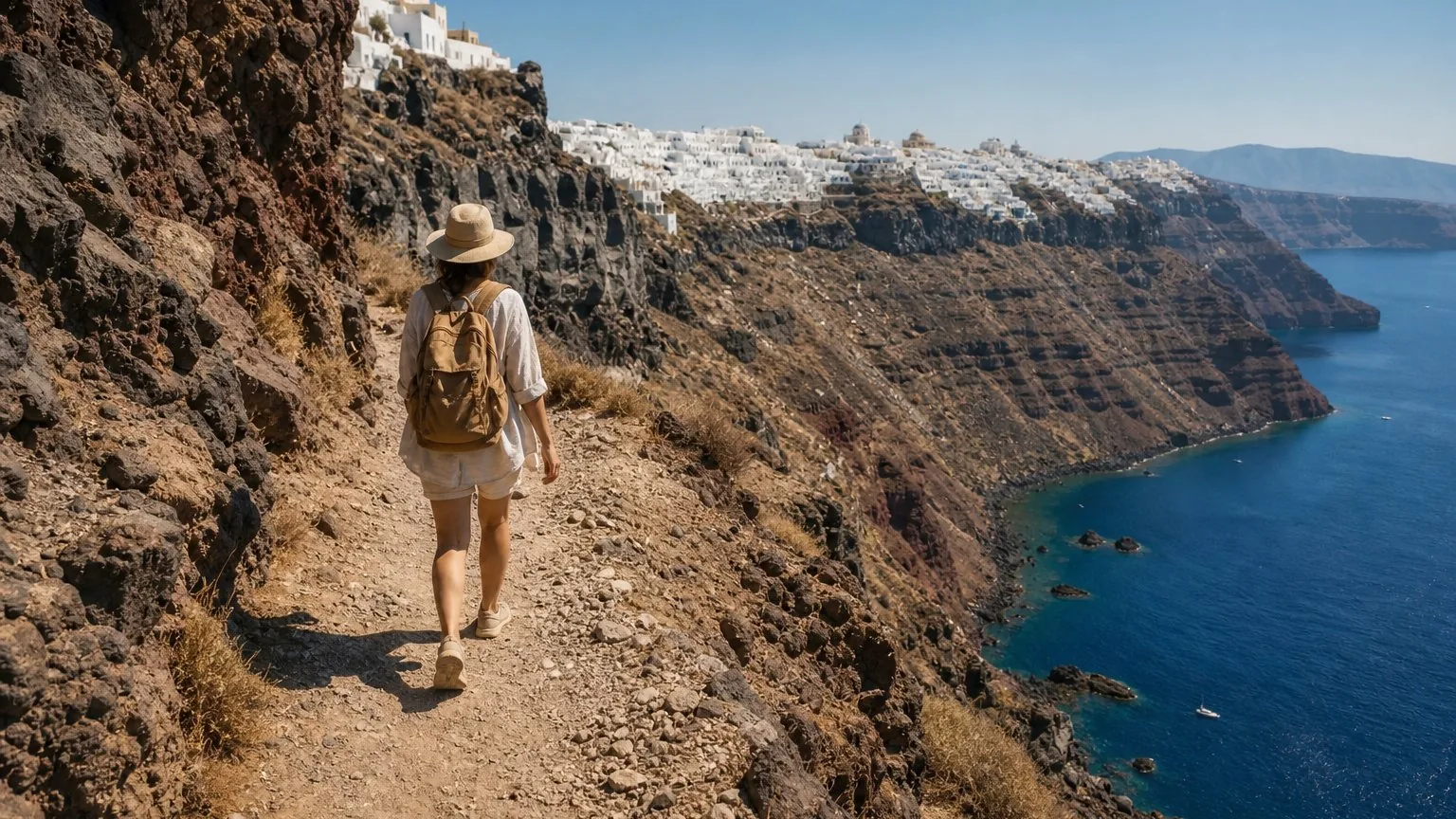
Skaros Rock from Imerovigli is the alternative if that sounds like too much, and it is the better outing for most people. It is only about 650 metres to the chapel of Panagia Theoskepasti, tucked under the rock on the caldera side and easy to miss entirely if you walk to the viewpoint and turn back. But short does not mean easy: it is roughly 280 steps down to the base of the rock and another 200 or so down to the chapel, all of which you climb again, on an exposed path with loose gravel and almost no shade. Allow an hour or two, take water, and do not attempt to walk around the northern side of the rock, where the path narrows badly.
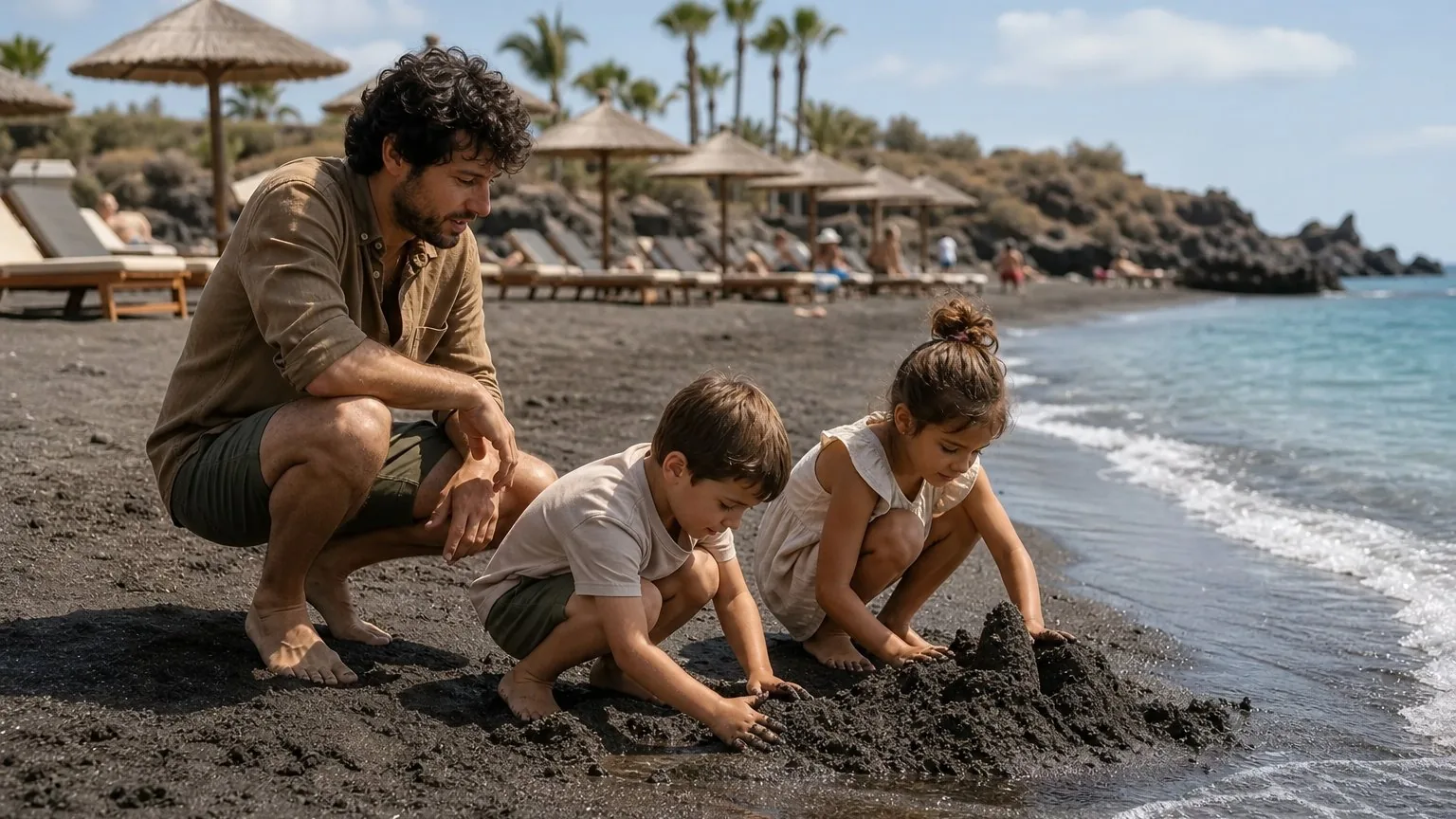
The beaches are volcanic and dark, and Kamari and Perissa are the two that work as actual beach days — long, organised, easy with children, with buses from Fira. Public access is free; sunbeds and umbrellas are not.
Red Beach needs a warning rather than a recommendation. Its cliffs are actively unstable. The access path has been closed repeatedly after rockfalls, including during the 2025 seismic sequence, when a landslide closed the beach and left boat access as the only route in. Rockfalls have also been recorded in 2018, 2023 and December 2025. Current reporting suggests parts remain restricted and that local operators discourage the cliff path. Look at it from a boat, which is how most cruises show it anyway, and if you do go by land, obey the signage rather than the blog post that told you to ignore it.
Planning Around the Cruise Ships
This is the single most useful thing on this page, and almost nobody does it.
The Municipal Port Fund of Thira publishes a public cruise-arrival calendar, month by month, in English. For every ship it lists the vessel name, the arrival and departure times, and an estimated passenger count. It is a municipal table, not a prediction, and it is free to read the night before you decide anything.
The point is not any particular number — it is that the days differ enormously, and you can see which ones are yours. To take one dated example, 1 October 2026 lists four ships arriving, with estimated passenger counts of 3,069, 1,265, 756 and 238. Other days in the same month carry a single small vessel. Look up your own dates rather than borrowing anyone else's threshold.
What to do with it is simple. If your Oia day coincides with several large morning arrivals, flip it: spend the middle of the day at Akrotiri, the Tomato Museum, an inland village, a winery or a beach, and take the rim in the early morning or the late evening instead. You are not avoiding people entirely on Santorini. You are avoiding the three-hour window where everyone is in the same 400 metres of lane.
My advice: check the cruise calendar before you decide which day you give to Oia, and treat it as the first decision of the trip rather than the last. Everything else on a Santorini itinerary is moveable — museums, beaches, villages, wineries all work on any day of the week except their closing day. Oia is the only thing whose quality swings this sharply on the hour you pick, so build the week around it and let the rest fall where it falls.
Couples, Budget and Families
Couples. One sunset, but not necessarily from the castle — Imerovigli gives you the same caldera with room to stand. A shared sunset cruise seat at around €120 does what the €720 private charter does unless privacy itself is the point. Then a winery in the afternoon, dinner in Pyrgos or Emporio rather than on the rim, and Cine Kamari on the evening you cannot face another crowd.
On a budget. A great deal of the best of Santorini is free or nearly so: the public sunset viewpoints, the rim walk, Skaros, the inland villages, public beach access at Kamari and Perissa, and early-morning Oia. Add a KTEL bus fare and the cable car and your transport is covered for the day. The three state museums are the cheap paid tier; Akrotiri and a shared cruise are the two real costs, and both are worth budgeting for rather than skipping.
Families. Kamari and Perissa are the easy beach days. The Tomato Museum works better with children than it sounds, because it is a factory with machinery rather than a room of cases. The Museum of Prehistoric Thera suits children already interested in the ancient world and will bore those who are not. Keep the walk short — Fira to Imerovigli rather than all the way to Oia — and Cine Kamari is a good evening for older children, though the 21:30 start rules out younger ones.
My advice: Santorini rewards doing less. The island is small and slow, buses fill, the roads clog when ships are in, and every transfer costs more of the day than the map suggests. If you have three days, do not schedule three sunsets, two cruises, five villages and both ends of the island. Pick one headline experience a day, add one small thing near it, and leave the evening unplanned. The trip people remember here is not the one with the most entries in it.
Getting Around
KTEL buses are by far the cheapest way to move, running from the central station in Fira, with single fares of about €2.70 between Fira and Athinios port or Fira and Perissa, and €2.20 between Perissa and Athinios, per KTEL Santorini's published pricelist. They are reliable but they fill, and on heavy cruise days the roads slow down noticeably. Confirm timetables the day before rather than relying on a printed schedule.
One last thing, which residents raise more often than any transport complaint. The whitewashed houses along the rim are homes, not a film set. A low wall or an open terrace is not permission to walk in, sit down or climb up for a photograph, and people live behind those doors year-round. The Ephorate applies the same rule to the archaeological sites, where climbing on the monuments is explicitly prohibited.
Before You Book
- Check the Port Fund cruise calendar for your dates, then choose your Oia morning.
- Check which day your Fira museums close before planning a museum afternoon.
- If you want Thirassia independently, plan an overnight — the day ferry runs the wrong way.
- Budget €5 per item of luggage on the cable car if you are arriving by sea.
- Take water and expect stairs on Skaros, even though it is a short walk.
- Treat Red Beach as a view from a boat unless local signage says otherwise.
Once you have settled what to do, the remaining question is where to sleep, and on this island that decision quietly shapes every day of the trip.
Check the location before you pay for the caldera postcode
Rim addresses carry a premium, and a room three streets back can charge it without the view. Two minutes of arithmetic tells you whether the location is doing the work.
Frequently Asked Questions: Best Things to Do in Santorini
What are the must-do experiences in Santorini?
One caldera sunset, one boat trip and Akrotiri cover the essentials. If you have longer, add the Museum of Prehistoric Thera to make sense of Akrotiri, an inland village such as Pyrgos, and either the Fira–Oia walk or the shorter Skaros Rock outing.
What is there to do in Santorini besides Oia and the sunset?
More than most itineraries allow for: three state museums, the Tomato Industrial Museum at Vlychada, the fortified villages of Pyrgos and Emporio, vineyards growing vines in ground-level baskets, an open-air cinema at Kamari, and the volcanic coast at Vlychada, which looks nothing like the caldera.
How much does it cost to visit Akrotiri?
€20 for an adult and €10 reduced, per the Ephorate of Antiquities of the Cyclades. There is no visitor cap or timed-entry system. Note that it closes at 15:30 on Mondays and Thursdays, while other days run later on a seasonal schedule.
Which Santorini museum is worth visiting?
If you are doing Akrotiri, the Museum of Prehistoric Thera holds the frescoes and objects from the site and makes the visit far more meaningful. The Archaeological Museum of Thera covers the later classical island and has the Kore of Thera. Both are €10 full and €5 reduced, and they close on different days — Monday and Tuesday respectively.
Can you do a day trip to Thirassia from Santorini?
Not independently on the local ferry, which is timed for islanders travelling into Santorini in the morning and home in the afternoon — you would arrive in the late afternoon with no return until the next day. Visit on a caldera excursion that stops there, arrange a private boat from Ammoudi, or stay overnight.
How do I avoid the crowds in Santorini?
Check the Municipal Port Fund's cruise-arrival calendar for your dates, which lists each ship with an estimated passenger count, and give Oia a morning that is not a heavy arrival morning. Central Oia is also far more pleasant early in the day than in the afternoon.
Is the Santorini Cable Car worth it, and what does it cost?
€10 one way, €5 reduced, and €5 for each item of luggage, per the operator's price list. It is the quick way between Fira and the old port. The stepped Karavolades path is the free alternative; it closed briefly after a wall collapse in July 2026 and reopened that August.
Is Red Beach safe to visit?
The cliffs are unstable and the access path has been closed repeatedly after rockfalls, including during the 2025 seismic sequence. Seeing it from a boat avoids the cliffs entirely and is how most cruises show it. If you go by land, follow the signage on the day.
Further Reading
Sources and References
- Ephorate of Antiquities of the Cyclades. Opening Hours & Admission 2026. cyclades.culture.gov.gr. Checked 27 September 2026.
- Ephorate of Antiquities of the Cyclades. Akrotiri Archaeological Site. cyclades.culture.gov.gr.
- Municipal Port Fund of Thira. Cruise ship arrivals calendar. santoriniports.gov.gr. Checked 27 September 2026.
- Santorini Cable Car. Official price list, 2026. santorinicablecar.gr.
- Tomato Industrial Museum "D. Nomikos". Visiting hours, tickets and location. tomatomuseum.gr. Checked 27 September 2026.
- Open Air Cinema Kamari. 2026 programme and screening times. santorinicinema.com. Checked 27 September 2026.
- Thirasia ferry schedule. thirasia.eu. Checked 27 September 2026.
- Greek National Tourism Organisation (VisitGreece). Santorini (Thera). visitgreece.gr.
- Santorini Yachting Club. Cruises and offers. santoriniyachtingclub.com.
- KTEL Santorini. Pricelist. ktel-santorini.gr.
- To Vima. Santorini's famous Red Beach closed after rockfall, 4 February 2025. tovima.com.
- Greek City Times / Cruise Industry News. Karavolades stairs closure and August 2026 reopening. Reported July–August 2026.
Part of Destinations & Itineraries.