France and Spain Itinerary: A Smart First Timer's Plan
Coherent 10, 14 and 21 day France and Spain routes, the two crossings that actually work, verified train times, budgets and the first-timer mistakes to avoid.

Planning a france and spain itinerary means answering one question before any other: how do you link two of Europe's biggest countries without losing half your trip to trains and transfers? The short answer is to pick three to five base cities, connect them by high speed rail wherever possible, cross the border once, and remember that the Pyrenees have two usable ends that sit 500 kilometres apart. Choose one.
This guide walks through the logistics that decide whether the trip feels smooth or exhausting: how many days you genuinely need, whether to start in France or Spain, how rail, driving and flying compare across the border, what a realistic budget looks like at three tiers, and the mistakes that trip up first timers every year. The 10, 14 and 21 day routes below are exact, with the nights adding up.
Quick Answer
A workable france and spain itinerary runs 10 to 21 days across three to seven base cities, linked by high speed rail (TGV in France, AVE in Spain) with one border crossing. For a first trip: Paris, Barcelona and Madrid in ten days, with the direct Barcelona to Paris train doing the crossing. Both countries share the Schengen Area and the euro, so entry logistics are simple; the real planning work is the shape of the route and the pace.
Key Takeaways
- Ten days is the practical minimum: three bases, one crossing. Fourteen adds the Atlantic coast, twenty-one adds Andalusia and Provence.
- France and Spain share the Schengen 90/180 day allowance. One shared clock, not 90 days per country.
- The direct Barcelona to Paris high speed train, about six and a half to seven hours, is the simplest crossing. Paris to Madrid has no direct train at all.
- The other crossing that works is the Atlantic one: Bordeaux or Biarritz to San Sebastián, under three hours. Nice to Bilbao is not a crossing, it's a week.
- Book high speed rail 60 to 90 days ahead. SNCF and Renfe price like airlines, and the Paris to Barcelona trains run only a few times a day.
- In August small Paris restaurants shut for weeks and Madrid empties; plan a summer trip around the coast and the north.
In This Article
- Why Combine France and Spain in One Trip
- How Many Days Do You Need?
- Schengen Rules, EES and ETIAS for 2026
- Currency and Payments
- Should You Start in France or Spain?
- Rail, Driving or Flying Between the Two
- Building a France and Spain Itinerary: 10, 14 and 21 Days
- Southern France and Northern Spain Itinerary
- Budget Breakdown and Saving Tips
- Common Itinerary Mistakes
- Best Time to Go
- Planning This Trip as a Couple
- Choosing Where to Stay
- FAQ
Why Combine France and Spain in One Trip
France and Spain work well together because they share a Schengen border and the same currency, and between them cover an enormous range of travel without adding visa complexity. There is normally no routine immigration control when you cross between them, although temporary internal checks can be introduced, so keep your passport with you. On a normal day the border is a sign on the motorway and a change of language on the train announcements.
The scale is what catches first timers out. Barcelona sits under 200 kilometres from the French border, but Paris to Madrid is closer to 1,270 kilometres by road, and the Mediterranean end of the Pyrenees is 500 kilometres from the Atlantic end. The shape of your route, a Mediterranean run, a Basque corridor, or a north to south sweep, changes the trip's rhythm entirely; trying to do two shapes in one trip is how people end up sleeping on trains.
The border itself is a non-event; the distance on either side of it is where the real planning happens.
How Many Days Do You Need for a France and Spain Itinerary?
Ten days is the practical minimum for a first france and spain itinerary: three base cities, one border crossing, no constant packing and unpacking. Fourteen days adds two more bases along one coherent line, and twenty-one is comfortable for a full loop through the south, provided you fly into one country and out of the other.
Anything shorter than ten days means cutting a country, not trimming each stop, and the result is a trip that remembers airports better than cities. The rule I apply to every route on this site is the same one that runs through our first-time Europe itinerary: at least two nights in every base, three where you can, and the number of bases follows from that, not from the map.
Schengen 90/180 Day Rule, EES and ETIAS for 2026
Non EU visitors travelling visa free, including US, UK, Canadian and Australian passport holders, can stay across the entire Schengen Area for a maximum of 90 days within any rolling 180 day period, and the allowance is shared, not doubled by visiting two countries. A three week france and spain itinerary counts fully against the same 90 day total as any other Schengen travel in that window, as set out in the European Commission's Schengen guidance.
Two systems matter for 2026. The Entry/Exit System (EES) has been fully operational at Schengen external borders since 10 April 2026: instead of a passport stamp, non EU visitors are registered digitally, with fingerprints and a facial image taken at first entry, according to the European Commission's EES pages. Allow extra time at the first airport you land at; there is no second registration when you cross from France to Spain. ETIAS, the travel authorisation that will eventually sit alongside it, is not currently operational: no applications are being accepted and no action is required now. Its start date will be announced officially, so recheck the official EU ETIAS portal before you travel, and ignore any site that offers to take your application in the meantime.
Currency and Payments
Both France and Spain use the euro: no exchange at the border, no budgeting in two systems. Contactless and chip and PIN payment is standard in the cities of both countries; small towns, markets and family run cafes still lean toward cash, so carry some small notes outside the hubs.
Should You Start in France or Spain?
There is no single correct answer, and it's mostly a flight decision. The practical driver is which open jaw ticket, flying into one country and out of the other, is cheaper or more convenient from your home airport. An open jaw saves you a full travel day of backtracking.
Starting in France suits travellers who want Paris as a soft landing, with strong direct flights from most of the world and a gentler entry into European rhythm before heading south. Starting in Spain suits travellers who want warmer weather early, or who find better connections into Madrid or Barcelona. Either way, fix the entry city first and build the route outward from it, rather than bending the route around a return flight you've already bought.
Border Crossing Transport Options Compared: Rail, Driving and Flying
The simplest crossing is the direct high speed service between Barcelona and Paris, run jointly by Renfe and SNCF: about six and a half hours on the fastest trains, closer to seven on most, and only a few departures a day, so it sells out in summer. Flying takes about two hours in the air, but airport transfers, check-in and security narrow the door to door advantage. Paris to Madrid has no direct train; by rail it's a change in Barcelona and ten hours plus, so for that pair fly, or don't make it a pair.
The other crossing that works is the Atlantic one. Bordeaux to San Sebastián is under three hours: a TGV or regional train to Hendaye on the border, then the Euskotren local line to San Sebastián in about 40 minutes. Biarritz or Bayonne to San Sebastián is a one hour bus. Driving suits travellers who want the Pyrenean villages and the countryside, but it's slow for the long north to south hops and adds tolls and fuel that rail avoids. Regional buses handle short hops inside one region. Our Europe by train itineraries cover the wider network if you're joining this trip to somewhere else.
| Option | Best for | Verdict |
|---|---|---|
| Direct high speed rail (Barcelona to Paris, about 6.5 to 7 hours) | First timers wanting one seamless crossing | Simplest option; book 60 to 90 days ahead, few trains a day |
| Atlantic crossing (Bordeaux or Biarritz to San Sebastián, under 3 hours) | Routes built around the Basque coast | Shortest crossing; a local train or bus, no reservation stress |
| Rail with a connection (Paris to Madrid via Barcelona, 10 hours plus) | Rail purists with a day to spare | Works, but a flight is the honest answer for this pair |
| Driving via the Pyrenees | Road trip itineraries with village stops | Flexible but slow for long distances; one way cross border rentals cost extra |
| Flying (Paris to Madrid or Barcelona, about 2 hours) | Time limited trips, first or last leg only | Fast in the air, less so door to door |
My advice: Both operators sell the Paris to Barcelona train, and both sites will try to sell you a Ouigo that isn't the same Ouigo: Ouigo France and Ouigo Spain are separate networks with separate tickets. Book the international train on either SNCF Connect or Renfe, then book Spanish legs on Renfe, Iryo or Ouigo Spain, and French legs on SNCF Connect. The Hendaye to San Sebastián local train isn't bookable in advance at all; you buy it at the station like a metro ticket.
Building a France and Spain Itinerary: Sample Structures for 10, 14 and 21 Days
Every route below runs in one direction along one line. The Paris, Barcelona, Basque coast, Madrid zigzag in a lot of ten day plans crosses Spain twice and spends two of ten days on trains. The versions here don't.
10 days: the first-timer line (9 nights)
- Days 1 to 3, Paris (3 nights): the city over two full days. Base in the Marais or around Saint-Germain; book the Louvre and the Eiffel Tower before you fly.
- Days 4 to 6, Barcelona (3 nights): the direct train on day 4, about six and a half hours, lands you in time for dinner. Base in the Eixample or Gràcia rather than on the Ramblas. Sagrada Família is a timed ticket; book it with the train.
- Days 7 to 9, Madrid (3 nights): AVE in about two and a half hours on day 7. Prado, Royal Palace, a day trip to Toledo on day 9 if you want one. Base in Centro or Huertas.
- Day 10: fly home from Madrid.
That's nine nights across ten days: Paris 3, Barcelona 3, Madrid 3, one crossing, one long train and one short one. Swap: run it in reverse if Madrid flights are cheaper. Or trade the Toledo day for Girona from Barcelona; the count stays at nine.
14 days: Paris to Barcelona the long way round (13 nights)
Two weeks lets you take the Atlantic crossing and still finish on the Mediterranean, along a single arc, at the rhythm of our realistic 2 week Europe itinerary: fewer moves, longer stays.
- Days 1 to 3, Paris (3 nights).
- Days 4 to 5, Bordeaux (2 nights): TGV in about two hours. Wine, the riverfront, and a lunch that stretches.
- Days 6 to 7, San Sebastián (2 nights): under three hours via Hendaye. Pintxos in the old town, La Concha at dusk. Base in the Parte Vieja or by the beach.
- Days 8 to 10, Madrid (3 nights): the one long leg, a direct Alvia of about five and a half hours, or a one hour flight from Bilbao if you'd rather. Toledo day trip on day 10.
- Days 11 to 13, Barcelona (3 nights): AVE in two and a half hours.
- Day 14: fly home from Barcelona.
Thirteen nights across fourteen days: Paris 3, Bordeaux 2, San Sebastián 2, Madrid 3, Barcelona 3. Fly into Paris and out of Barcelona. Swap: Bilbao for San Sebastián if the Guggenheim matters more than the beach; the crossing and the count don't change.
21 days: the full loop (20 nights)
Three weeks is where the south earns its place. This runs Paris to the Atlantic, down through Spain, and back up the Mediterranean into Provence, so you cross the border twice but never backtrack.
- Days 1 to 4, Paris (4 nights): a fourth night buys Versailles or a slow Sunday.
- Days 5 to 6, Bordeaux (2 nights).
- Days 7 to 8, San Sebastián (2 nights): the Atlantic crossing.
- Days 9 to 11, Madrid (3 nights): Alvia or a short flight, Toledo on day 11.
- Days 12 to 14, Seville (3 nights): AVE in about two and a half hours. The Alcázar is a timed ticket; book it early. Granada is a day too far from here, so it's a swap, not an add.
- Days 15 to 17, Barcelona (3 nights): the direct Seville to Barcelona AVE, about five and a half hours, is the second long leg.
- Days 18 to 20, Provence (3 nights): the direct Renfe train from Barcelona to Marseille or Avignon in about five hours. Base in Avignon or Aix and rent a car for one day of villages.
- Day 21: fly home from Marseille.
Twenty nights across twenty-one days: Paris 4, Bordeaux 2, San Sebastián 2, Madrid 3, Seville 3, Barcelona 3, Provence 3. Swap: trade Seville for Granada (Madrid to Granada is a direct high speed train of a little over three hours, and the Alhambra wants booking months ahead), or trade Provence for Nice at the cost of two and a half more hours on the train. Both keep twenty nights. If Seville and Granada both matter, our Spain and Portugal itinerary runs the Andalusia leg properly.
Southern France and Northern Spain Itinerary
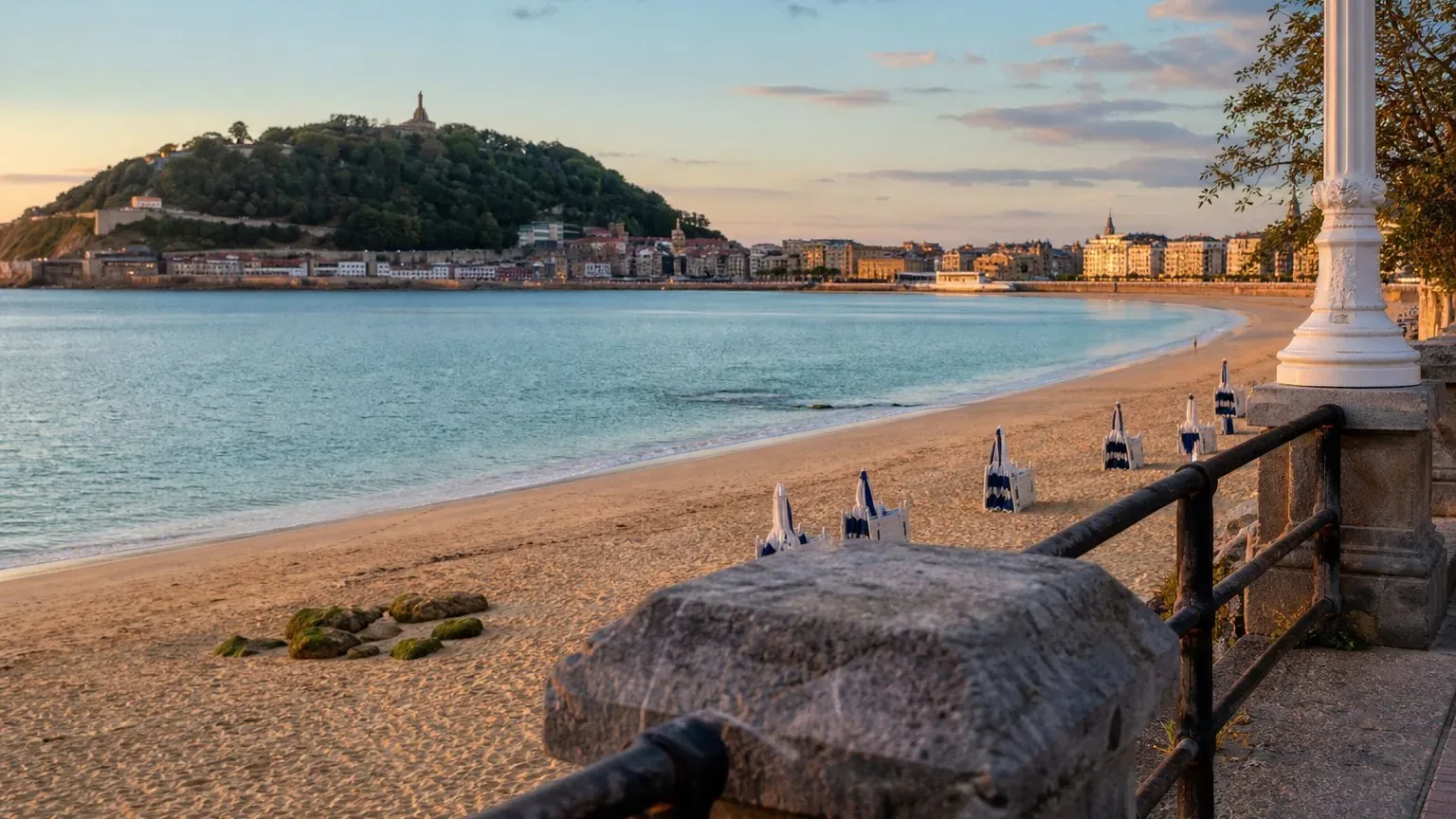
The Pyrenees have two ends you can cross easily by public transport, and they are not near each other. The Atlantic end, Bordeaux and the Basque coast, is the shortest realistic crossing on the whole border: Bordeaux to San Sebastián in under three hours via Hendaye, Biarritz to San Sebastián in an hour by bus. The Mediterranean end is the direct Renfe line from Marseille or Avignon to Barcelona, about five hours. Nice, Carcassonne and Bilbao do not belong in the same week.
The version that works for 8 to 10 nights is the Atlantic one. Bordeaux for two or three nights, then the regional train south to Biarritz or Bayonne for one or two, the bus over the border to San Sebastián for three, and Bilbao for two, flying home from Bilbao. It skips Paris and Madrid entirely, which feels counterintuitive and delivers a tighter, better fed trip for a similar budget, with every leg under two hours. If it's the Mediterranean you want instead, build the other end: Provence or Nice, then the direct train to Barcelona, and stop there.
Budget Breakdown and Cost Saving Tips
A france and spain itinerary can be genuinely budget friendly, because both countries share the euro and both have deep budget lodging and fixed price lunch traditions. Three tiers hold up as planning estimates, excluding flights and varying by city, season and how far ahead you book. Paris and Barcelona sit at the top of every range; Bordeaux, San Sebastián and Madrid a little under.
The budget tier runs roughly €60 to €90 per person per day: hostel dorms or budget hotels, self catered or fixed menu lunches, public transport. Mid range runs roughly €120 to €180: three star hotels, sit down dinners, some paid attractions. The comfort or couples tier is €200 or more: boutique hotels, tasting menus, taxis. Spain comes in a little under France for the same standard, so weighting nights south quietly helps a tight budget.
Four things move the needle most. Book high speed rail 60 to 90 days ahead: Paris to Barcelona starts around €40 booked early and climbs well past €100 close to departure, and Barcelona to Madrid runs from under €20 on Ouigo Spain and Iryo to several times that on the day. Eat the fixed price lunch in both countries: Spain's menú del día averaged around €14 in 2026 for three courses with a drink, and France's lunchtime formule does a similar job for a few euros more. Don't put short regional hops on high speed trains priced for the whole corridor. And budget for per night tourist taxes in Paris and Barcelona, which have risen more than once and are easy to forget until checkout.
A budget trip through France and Spain is entirely possible; a budget trip through France and Spain booked two weeks out is a different, pricier animal.
Common Itinerary Mistakes First Timers Make
The biggest mistake is packing too many cities into too few days, which forces one night stops that eat whole days in transit. Close behind is treating the two ends of the Pyrenees as one place: Nice to Barcelona is around 500 kilometres and there's no direct train, so it's a change in Marseille and the best part of eight hours. Treating Barcelona to Madrid as a day trip is another: two and a half hours by AVE is fast, but not a same day return if you want to see either city.
Then there's August: many small Paris restaurants and shops close for two to four weeks, Madrid empties into the coast, and the coast hits peak prices. Finally, longer trips stacking countries sometimes miscount the Schengen 90 day cap by treating each country separately rather than as one shared clock.
Before You Book
- Have you allowed at least two nights per base, three where you can, along one line with one crossing?
- High speed rail: booked 60 to 90 days out? The direct Paris to Barcelona trains run only a few times a day and sell out in summer.
- Timed attractions: Louvre and Eiffel Tower roughly two months ahead, Sagrada Família a few weeks, Seville's Alcázar and Granada's Alhambra as soon as your dates are fixed?
- Have you checked the official EU portal on ETIAS and allowed extra time for EES registration at your first airport?
- Have you added your total Schengen days across this and any other European trips in the same six months?
- Travelling in August: have you moved the nights away from the capitals and toward the coast and the north?
Best Time to Go
Spring, April to June, and early autumn, September to October, are the windows that work across both countries: warm but not extreme from the French interior to the Spanish south, and fewer crowds than July and August. Midsummer in Seville and Madrid regularly passes 38°C, which makes midday sightseeing genuinely unpleasant. If summer is your only window, run the 14 day route and give Madrid's nights to San Sebastián.
Winter works well for Paris, Madrid and the Basque coast, and prices drop, but it thins out the Mediterranean stops, where much of the outdoor dining and beach culture that makes those cities enjoyable closes down until spring.
Planning This Trip as a Couple
A france and spain itinerary for couples differs from a first timer route in pacing and stop selection, not logistics. Fewer cities, more nights per stop, and San Sebastián, Bordeaux and Provence ahead of a third capital. The 14 day route above is already the couples' version; the only change I'd make is to take a night from Madrid and give it to San Sebastián.
San Sebastián has more Michelin stars per head than almost anywhere in Europe, which makes it the natural splurge inside an otherwise sensible budget: one tasting menu, and pintxos the rest of the time. Bordeaux does the same for wine. Couples who trade a capital day for an extra night somewhere quieter come home happier than couples who add another big city.
Choosing Where to Stay
Where you stay matters more than which hotel you pick, because a badly placed hotel adds half an hour of transit to every day. In Paris that means inside the ring, ideally the Marais, Saint-Germain or the Latin Quarter, near a metro line that goes where you're going. In Barcelona it means the Eixample or Gràcia, not the Ramblas. In Madrid, Centro or Huertas. In San Sebastián, the old town or along the beach.
Before you commit to a booking anywhere on the route, run it through the free Hotel Check: it scores a hotel's actual location against what you want nearby, in about two minutes, no email required. For deeper trip planning beyond location, including budgeting calculators and itinerary templates, the tools we actually use are worth a browse once your route is roughly set.
My advice: Paris hotels near a big station look convenient on the map and feel like it for exactly one morning. Stay where you'll spend your evenings and take a taxi to the station on the day you leave.
Not sure your hotel is in the right area?
A wrongly placed hotel can quietly cost you hours of transit on every leg of a France and Spain trip.
Score your hotel's location in 2 minutes →Frequently Asked Questions: France and Spain Itinerary

How many days do I need for France and Spain?
Ten days is the practical minimum for three base cities and one border crossing. Fourteen adds the Atlantic coast along the same line, and twenty-one comfortably covers Paris, the Basque coast, Madrid, Andalusia, Barcelona and Provence if you fly into one country and out of the other.
Is it better to start in France or Spain?
It's a flight decision. Fly into whichever country is cheaper from home and out of the other, so the route runs in one direction with no backtracking. Paris makes a gentler first city; Spain gives you the warmer weather first.
What's the fastest way between Barcelona and Paris?
The direct Renfe and SNCF high speed train takes about six and a half hours on the fastest services and closer to seven on most, city centre to city centre. Flying is two hours in the air, but with airport transfers and security the door to door difference is small.
Can I do France and Spain without a car?
Yes. The TGV and AVE networks connect every city on these routes, the Basque crossing is a local train or a bus, and Provence's direct train to Barcelona runs from Marseille and Avignon. A car only earns its keep for a day of villages in Provence, the Dordogne or inland Andalusia.
Do I need a visa for France and Spain?
Visa exempt travellers, including US, UK, Canadian and Australian passport holders, don't need one for short stays, but the shared Schengen 90/180 day limit applies. Since April 2026 you're registered digitally under EES at your first entry. ETIAS is not currently operational and no applications are being accepted, so check the official EU portal before you travel.
What does a 10 day France and Spain itinerary look like?
Paris for three nights, the direct train to Barcelona for three, the AVE to Madrid for three, and fly home from Madrid: nine nights, one crossing, two train legs. Adding the Basque coast to ten days means crossing Spain twice, which is why it waits for the 14 day version.
Is this trip budget-friendly?
Relative to most two country European trips, yes: shared euro, strong budget lodging and fixed price lunches in both countries. The condition is booking high speed rail 60 to 90 days ahead, because late fares on the international train and the AVE can cost several times the advance price.
What is the best time to visit France and Spain together?
April to June and September to October: warm across both countries, fewer crowds, and none of the August closures in Paris or the 38°C afternoons in Madrid and Seville. Winter suits the capitals and the Basque coast but empties the Mediterranean stops.
Sources and References
- European Commission. Schengen Area and the 90/180 day rule. home-affairs.ec.europa.eu
- European Commission. Entry/Exit System (EES), fully operational 10 April 2026. home-affairs.ec.europa.eu
- European Union. ETIAS official travel portal. travel-europe.europa.eu
- SNCF Connect and Renfe. Paris to Barcelona high speed service, timetables and fares. sncf-connect.com / renfe.com
- Renfe. AVE and Alvia timetables: Barcelona to Madrid, Madrid to Seville, Seville to Barcelona, San Sebastián to Madrid, Barcelona to Marseille. renfe.com
- SNCF. TGV Paris to Bordeaux and Paris to Hendaye timetables. sncf-connect.com
- Euskotren. Hendaye to San Sebastián local line. euskotren.eus
- ALSA and PESA. Biarritz to San Sebastián and Bilbao to San Sebastián coach timetables. alsa.com / pesa.net