Greece 10 Day Itinerary: 5 Realistic Routes for Your First Trip
So you have ten days and a growing list of Greek islands you would like to see all at once. A workable greece 10 day itinerary does not try to do everything: it picks one flight leg, one direct ferry…

There is no single best 10-day Greece itinerary. Athens, Mykonos and Santorini is the classic first trip and it deserves its reputation — but a traveller who cares more about food, beaches, archaeology or simply changing hotels less often is better served by a completely different route.
So this guide gives you five complete ten-day routes rather than one. Each is a real sequence with the nights counted, the transfers named and the trade-off stated. The job is not to see as much of Greece as possible in ten days. It is to pick the right shape of trip.
Quick Answer
Ten days comfortably covers Athens plus two islands, or Athens plus one large island, or a mainland loop. It does not comfortably cover four islands. The five routes below are: the classic icons (Mykonos and Santorini), the balanced Cyclades (Naxos and Paros), the quieter Cyclades (Sifnos and Milos), the mainland history loop (Nafplio, Delphi and Meteora), and the fewer-bases route (Santorini and Crete). All five are nine nights across ten calendar days.
Key Takeaways
- Think two or three bases after Athens, not four or five island stops. Every extra island costs most of a day.
- The classic Mykonos–Santorini route is one good option, not the answer. It is also the most expensive and most crowded.
- Naxos deserves choosing on its own terms — beaches, mountain villages, food and history — not as a cheaper Mykonos.
- Crete replaces islands rather than joining them. If it is in a ten-day trip, give it five nights and drop the small stops.
- The mainland loop is the route most first-timers never consider and the one with the deepest historical range.
- EES has been operational across the Schengen area since April 2026. ETIAS is not yet running.
In This Article

Which Route Fits You
Start from what you want rather than from a map. The routes below are genuinely different trips, not variations on one.
| If you want… | Choose |
|---|---|
| The iconic first trip, and you have seen the photographs | Route 1 — Athens, Mykonos, Santorini |
| Beaches, food and villages, without building the trip around two famous islands | Route 2 — Athens, Naxos, Paros |
| Quieter islands and dramatic coastline | Route 3 — Athens, Sifnos, Milos |
| Archaeology and landscape rather than beaches | Route 4 — Athens, Nafplio, Delphi, Meteora |
| To unpack once and stay put | Route 5 — Athens, Santorini, Crete |
The biggest mistake in a ten-day Greece trip is not picking the wrong island. It is picking too many of them.
My advice: choose a route family, not an island wish list. The single most common way a ten-day Greece trip goes wrong is that it starts as a list — Santorini, Mykonos, Naxos, Milos, maybe Crete — and every name on it sounds unmissable. But islands are not evenly connected, and the ones people name are often on different ferry lines. Pick the shape first, then the islands inside it, and you get a trip where the boats are short and the days are yours. Pick the islands first and you get a trip built around departure times.
The Five Routes Compared
Relative cost, not a daily budget: $$ is the cheaper end of a mid-range trip, $$$$ the most expensive of the five in peak season. Every route below is nine nights across ten calendar days.
| Route | Best for | Bases | Transport | Cost | Main trade-off |
|---|---|---|---|---|---|
| 1. Athens · Mykonos · Santorini | Iconic first trip, couples, nightlife | 3 | Flight or ferry, then ferry | $$$$ | The priciest and most crowded of the five |
| 2. Athens · Naxos · Paros | Beaches, food, villages, balance | 3 | Flight or ferry, then a 25-minute hop | $$–$$$ | Less bucket-list drama |
| 3. Athens · Sifnos · Milos | Slower islands, volcanic coast, boat days | 3 | Ferry throughout | $$–$$$ | Fewer sailings; schedules shape the days |
| 4. Athens · Nafplio · Delphi · Meteora | History, landscape, shoulder season | 4 | Hire car | $$ | Real road hours; no beach week |
| 5. Athens · Santorini · Crete | Depth, fewer hotel changes | 3 | Flight, then ferry | $$$ | You see one region of Crete, not Crete |
The Two Athens Nights Every Route Shares
All five routes open with two nights in Athens, and that is a deliberate minimum rather than a formality. One night means arriving tired and leaving before you have seen anything; three starts eating into the part of the trip you came for.
Two nights buys you one proper day, and the way to spend it is to go to the Acropolis at opening and the Acropolis Museum afterwards, in that order — the site is brutal in afternoon heat and the museum makes far more sense once you have stood on the rock. That leaves an afternoon for the Ancient Agora or the National Archaeological Museum, and an evening in Plaka, Koukaki or Psyrri.
Stay somewhere you can walk from. Athens is a city where the difference between a hotel ten minutes from the Acropolis and one twenty minutes by metro is the difference between wandering out after dinner and not bothering. If your flight lands late, count it as half a night and keep the second day soft.
Route 1 — The Icons: Athens, Mykonos, Santorini
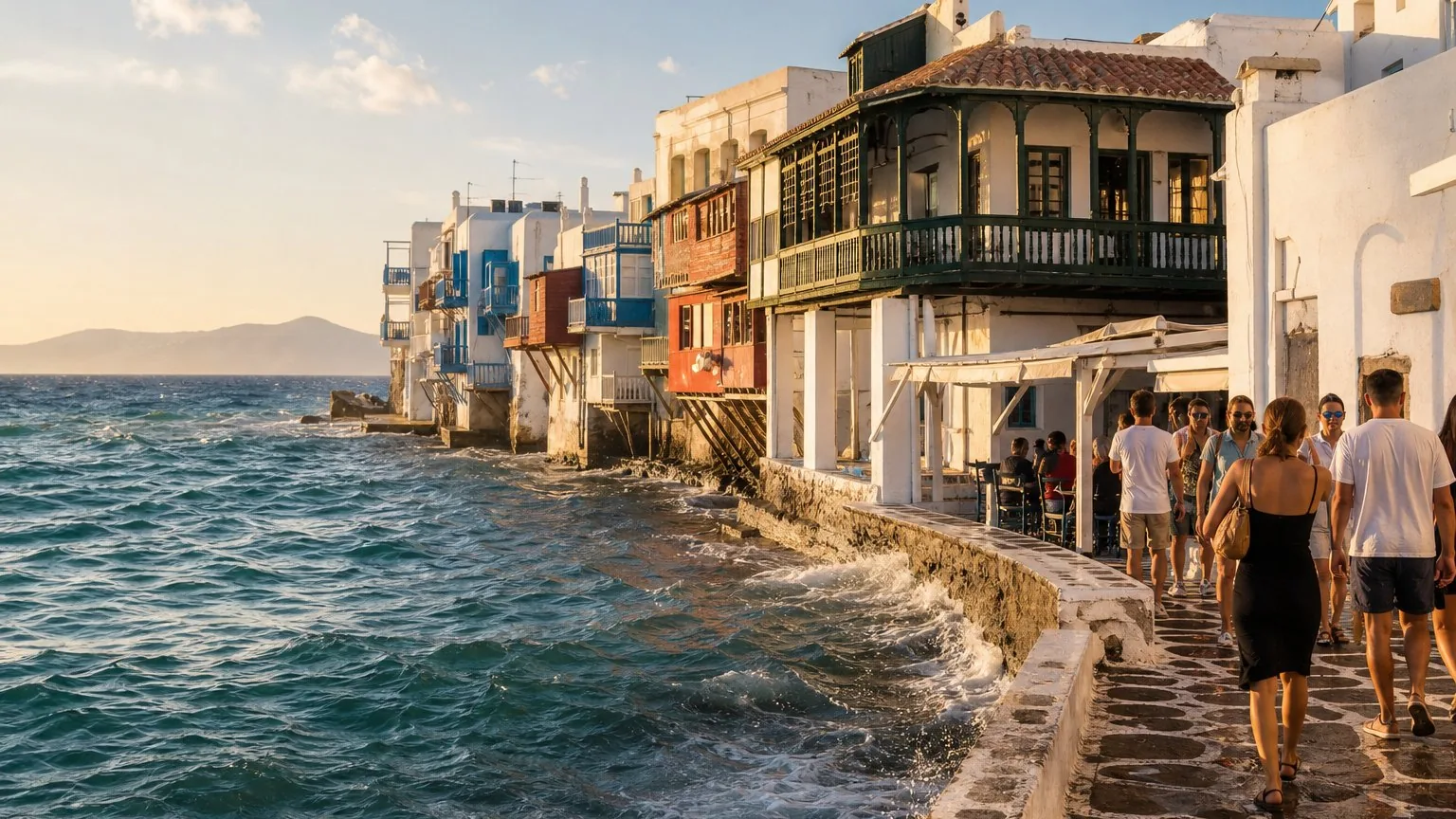
The famous one, and genuinely worth doing if it is your first trip and the Cycladic postcard is what you came for. Mykonos and Santorini are busy and expensive because they are extraordinary, not despite it.
| Day | Base | Plan |
|---|---|---|
| 1 | Athens | Arrive, settle, evening in Plaka or Koukaki |
| 2 | Athens | Acropolis early, Acropolis Museum, Ancient Agora |
| 3 | Mykonos | Morning flight (about 40 minutes) or ferry; afternoon in town |
| 4–5 | Mykonos | Beaches, Little Venice, a day trip to Delos |
| 6 | Santorini | Ferry across, roughly 2–3 hours depending on vessel |
| 7–9 | Santorini | Oia and Fira, caldera boat trip, Akrotiri, a slow last day |
| 10 | — | Depart |
Nights: Athens 2, Mykonos 3, Santorini 4 — nine nights, ten days. Best for first-timers, couples and anyone who wants the scenery they have already seen photographed. Trade-off: this is the most expensive and most crowded route of the five, and in July and August both islands are at capacity. Skip it if crowds or cost would sour it — Route 2 gives you Cycladic island life for meaningfully less.
If you are weighing the two islands against each other rather than doing both, our comparison of Mykonos versus Santorini goes through the differences properly.
Route 2 — Balanced Cyclades: Athens, Naxos, Paros
The strongest all-round island route, and the one most likely to be undersold to you. Naxos is the largest of the Cyclades and the most self-sufficient: long sandy beaches on the west coast, mountain villages like Apiranthos and Halki inland, Venetian and ancient remains, hiking, and a genuine agricultural economy that shows up on the plate — Naxos has its own cheeses, potatoes and citrus liqueur. It is not a budget substitute for anywhere.
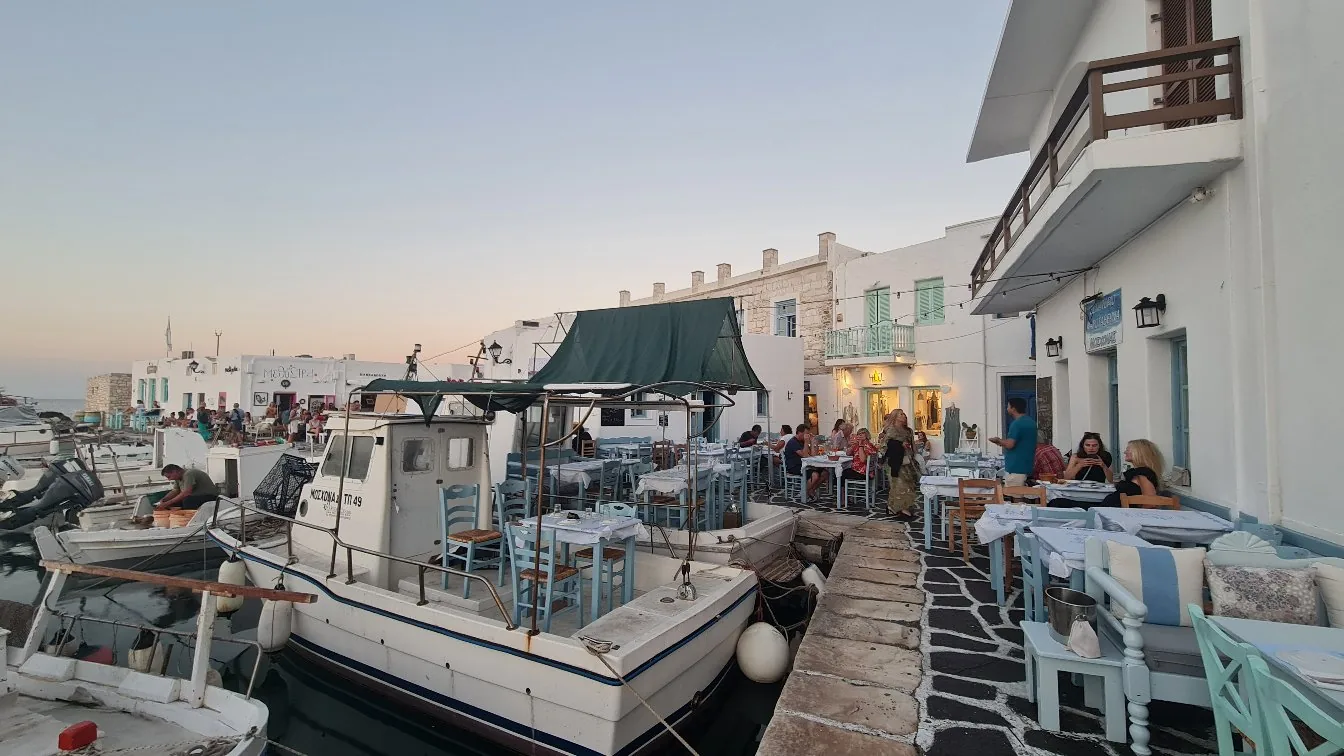
Paros pairs with it almost perfectly. Parikia and Naoussa give you harbour-town evenings, the beaches are excellent, and the crossing between the two islands is the shortest useful hop in the Cyclades: four operators run it, high-speed boats take about 25 minutes, and there are up to ten daily crossings in high season. You can move islands after breakfast and be swimming by lunch.
| Day | Base | Plan |
|---|---|---|
| 1 | Athens | Arrive, evening walk |
| 2 | Athens | Acropolis and museum |
| 3 | Naxos | Flight (around 45 minutes) or ferry; Chora and the Portara at sunset |
| 4–6 | Naxos | West-coast beaches, a mountain-village day, Mount Zas or the kouros walk |
| 7 | Paros | Fast ferry, about 25 minutes; afternoon in Naoussa |
| 8–9 | Paros | Beaches, Lefkes, Parikia old town |
| 10 | — | Depart from Paros by air or ferry |
Nights: Athens 2, Naxos 4, Paros 3 — nine nights, ten days. Best for beaches, food and village life with real variety, and for travellers who want island Greece without organising the trip around two famous names. Trade-off: no single view here has Santorini's drama. Skip it if the caldera photograph is the reason you are going.
Route 3 — Quieter Cyclades: Athens, Sifnos, Milos
The western Cyclades run on their own ferry line, and these two sit close together on it. Sifnos is known within Greece for its food — it is the home island of the country's most famous cookery writer, and the pottery and the slow-cooked chickpea tradition are not marketing. It is a walking-and-eating island of stone paths and small villages.
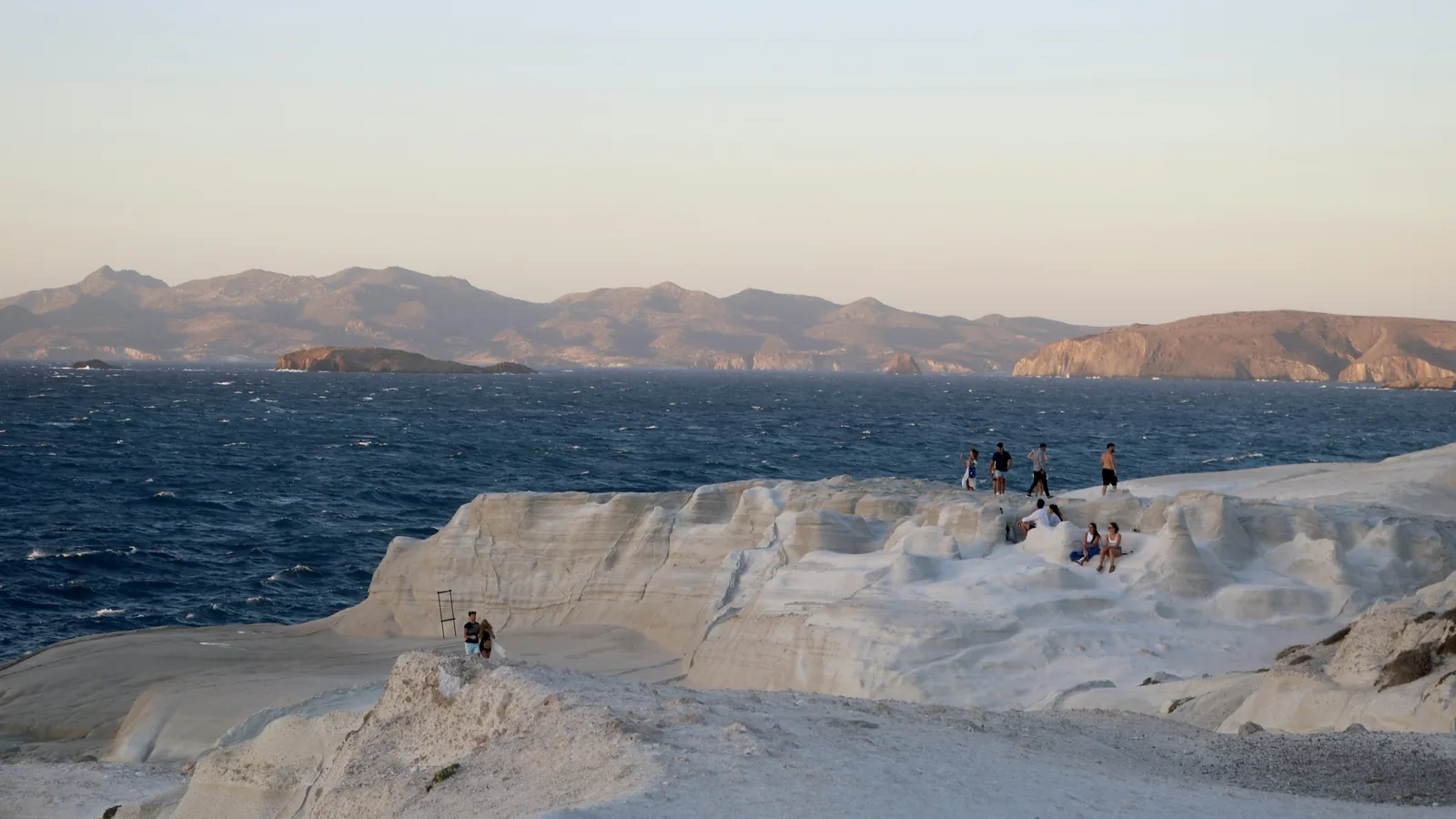
Milos is the visual opposite: a volcanic island of extraordinary coastline, the white lunar rock of Sarakiniko, the sea caves at Kleftiko reachable only by boat, and dozens of beaches of genuinely different character. The crossing between the two is about 45 minutes, with up to six daily sailings in summer, year-round service, and four operators on the route.
| Day | Base | Plan |
|---|---|---|
| 1 | Athens | Arrive |
| 2 | Athens | Acropolis and museum |
| 3 | Sifnos | Ferry from Piraeus; Apollonia in the evening |
| 4–5 | Sifnos | Kastro, the stone footpaths, Chrysopigi, a long lunch |
| 6 | Milos | Ferry, about 45 minutes; Adamantas and Plaka |
| 7–9 | Milos | Kleftiko boat day, Sarakiniko, southern beaches, catacombs |
| 10 | — | Depart from Milos by air or ferry |
Nights: Athens 2, Sifnos 3, Milos 4 — nine nights, ten days. Best for couples and slower travellers who want beaches and food without nightlife. Trade-off: the western line has fewer sailings than the Mykonos–Santorini corridor, so the timetable shapes your days more. Skip it if you need maximum flexibility to change plans.
Naxos or Milos, if you are choosing one
These two come up against each other constantly, and they are not competing for the same traveller. Choose Naxos if you want an island you could live on for a week without a plan: long sandy beaches, mountain villages an hour inland, real food from real farms, walking, and enough history to fill a rainy morning. Choose Milos if the coast is the reason you are going: the volcanic rock formations, the boat day out to the sea caves at Kleftiko, and beaches that look nothing like each other from one bay to the next. Naxos is the more rounded island; Milos is the more photogenic one. Neither is a consolation prize for the other.
Route 4 — Mainland History: Athens, Nafplio, Delphi, Meteora
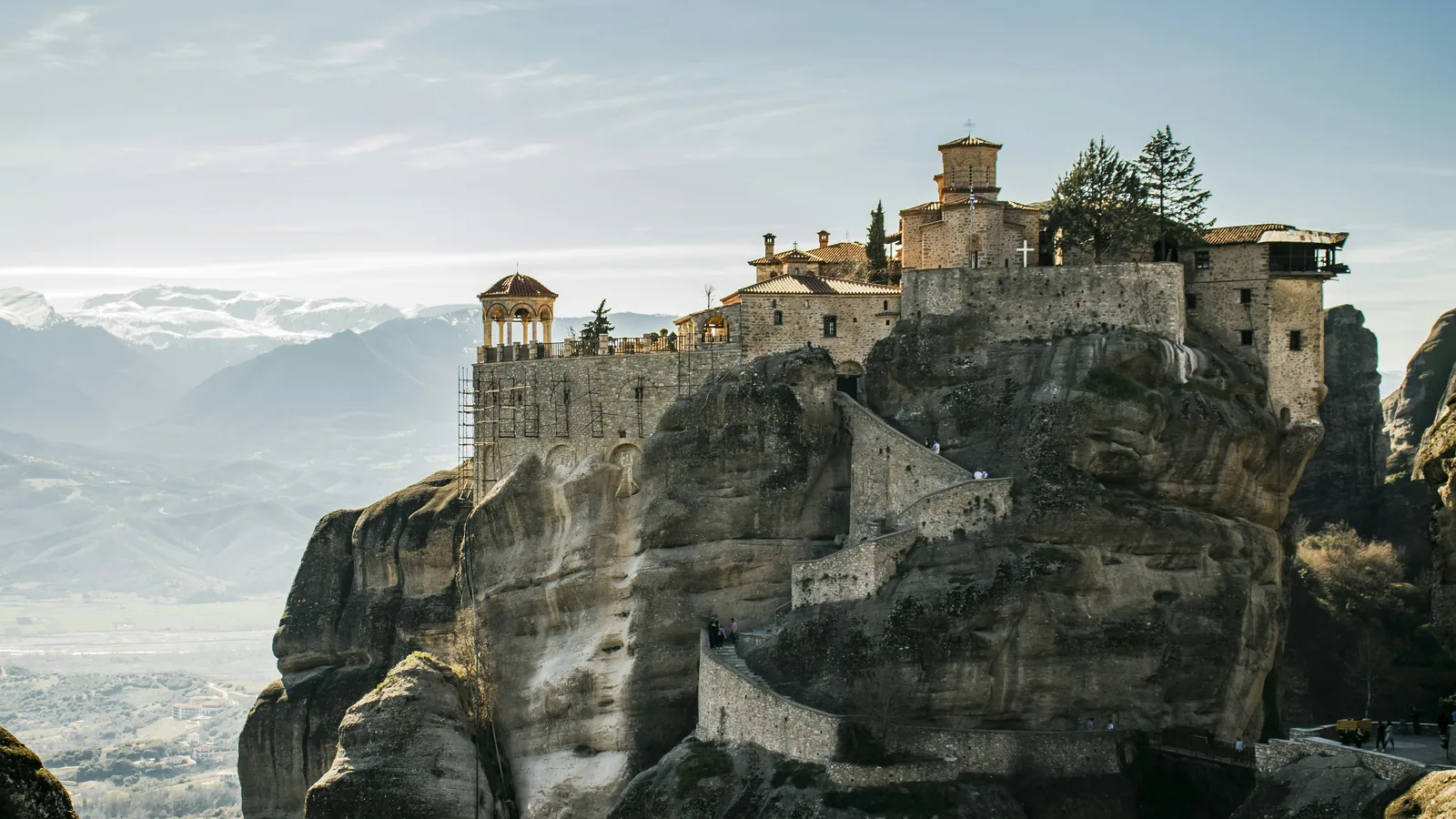
The route almost no first-timer considers, and the one that changes how people think about Greece. Island itineraries leave out most of the country's archaeology, and this loop puts a classical theatre, an oracle and a set of monasteries on rock pillars into the same ten days.
This one needs a hire car. There is no tidy public-transport version, and pretending otherwise would waste your week — the sites sit on three different roads out of Athens. Greek driving times also run longer than the map suggests, because the good roads end where the interesting places begin.
| Day | Base | Plan |
|---|---|---|
| 1 | Athens | Arrive |
| 2 | Athens | Acropolis and museum; collect the car late or next morning |
| 3 | Nafplio | Drive via the Corinth Canal and Ancient Corinth, about 2 hours plus stops |
| 4 | Nafplio | Mycenae and the theatre at Epidaurus, both within an hour |
| 5 | Delphi | Drive up, roughly 3 hours; evening in the village |
| 6 | Meteora | Delphi site early, then about 3.5 hours over the mountains to Kalambaka |
| 7 | Meteora | The monasteries, and sunset from the rocks |
| 8 | Athens | Return, about 4.5 hours on the E65 |
| 9 | Athens | What you missed on day 2; drop the car |
| 10 | — | Depart |
Nights: Athens 2, Nafplio 2, Delphi 1, Meteora 2, Athens 2 — nine nights, ten days. Best for history, landscape and shoulder-season travel; this route is better in May or October than in August. Trade-off: several genuine driving days and no beach week. Skip it if you want to swim every afternoon.
Route 5 — Fewer Bases: Athens, Santorini, Crete
For travellers who find packing and unpacking the worst part of a holiday. Three bases in ten days, one of them for five nights, and a genuinely short crossing in the middle: Seajets' high-speed service from Santorini to Heraklion takes around an hour and thirty-five minutes, with conventional ferries taking roughly three to four and a half hours, and two to three daily crossings through the main season.
The discipline this route needs is about Crete. It is the largest Greek island by a long way, and five nights will not cover it. Pick one end. Heraklion and the centre-east gives you Knossos, the archaeological museum and easy access to the Lasithi plateau. Chania and the west gives you the loveliest old town in Greece, the Samaria gorge and the west-coast beaches — but Chania is about a three-hour drive from Heraklion's port, so if you choose west, fly into Chania at the end rather than crossing the island twice.
| Day | Base | Plan |
|---|---|---|
| 1 | Athens | Arrive |
| 2 | Athens | Acropolis and museum |
| 3 | Santorini | Flight, about 45 minutes; caldera evening |
| 4 | Santorini | Oia, Akrotiri, a boat trip |
| 5 | Crete | High-speed ferry to Heraklion, about 1h35 |
| 6–9 | Crete | Knossos and the museum, then beaches, gorges or villages at your own pace |
| 10 | — | Depart from Heraklion or Chania |
Nights: Athens 2, Santorini 2, Crete 5 — nine nights, ten days. Best for travellers who want depth and dislike moving. Trade-off: two nights is a short Santorini, and five nights is one region of Crete. Skip it if you want to compare several islands.
My advice: if Crete is in your ten days, it replaces islands rather than joining them. The common version of this trip adds Crete to Santorini and Mykonos and Naxos, and it does not work — Crete is not a stop, it is a destination that happens to be reachable by ferry. Give it five nights and accept that you are seeing one end of it, or leave it for a trip of its own. A day and a half in Heraklion is not Crete; it is a long way to go for a museum.
Which Route for Which Traveller
Short version, if you would rather be told.
An iconic couples trip or honeymoon: Route 1. It is expensive and busy and it is also genuinely spectacular, and a first trip is the right time to do it.
A quieter couples trip: Route 3. Sifnos and Milos give you long dinners, empty footpaths and a boat day, without a nightlife scene to opt out of.
Beaches and food above all: Route 2. Naxos and Paros between them cover more kinds of good day than any other pairing here.
Families: Route 2 or Route 5. Naxos has the shallow, sandy, wadeable beaches; Crete has the space and the fewest hotel changes.
History: Route 4, without hesitation, and preferably in spring or autumn.
Best value: Route 4 again — mainland hotels and a hire car undercut island accommodation and ferries — with Route 3 the cheapest of the island options.
How to Move Around Greece in Ten Days

Four principles do most of the work, and they matter more than any individual fare.
Fly when the distance is long, sail when it is short. Athens to Santorini, Naxos or Crete by air takes around 45 minutes against five to eight hours at sea, and in a ten-day trip that difference is most of a day. But between neighbouring islands a ferry is faster door to door than any flight could be — Paros to Naxos is 25 minutes on a fast boat, Sifnos to Milos about 45.
Group your islands by ferry line, not by fame. The Cyclades are not one network. Mykonos, Paros, Naxos and Santorini sit on the central line with heavy traffic between them; Sifnos and Milos sit on the western line. Two islands that both look central on a map can require a return to Piraeus.
Published sailing time is not transfer time. A two-hour crossing is a four-hour afternoon once you add getting to the port, checking in ahead of departure, disembarking into a crowd, and reaching a hotel that may be half an hour from the harbour. Plan the day around the journey, not the timetable.
Travellers consistently underestimate what an island change costs, and it is worth being concrete. A mid-morning boat means breakfast, checking out, getting to the port, waiting, sailing, landing among several hundred other people, finding the transfer and reaching the next hotel — and then it is mid-afternoon, you have not swum, and you are hungry. That is a whole day of the nine, spent on a crossing that the timetable called two hours. Two islands in ten days costs you one of these. Four islands costs you three, which is a third of the trip.
Do not connect a ferry to an international flight on the same day. This is the one piece of advice here that is ours rather than an operator's, and it is the one worth following hardest. Ferries are weather-dependent and can be delayed or cancelled outright; a missed long-haul flight costs more than an extra night near the airport. Fly back to Athens the day before you leave, or fly home from the island itself. As a working rule we leave 45 to 90 minutes between connections we control — again, our advice and not a published rule — and we do not build anything irreversible on the far side of a boat.
What Ten Days Actually Costs
Two commonly quoted figures need handling carefully, because both are real and both are routinely misused.
Short-term rental rates. AirDNA's market data puts Mykonos's average daily rate around $769. That is a genuine figure and a useful signal of how expensive the island is relative to others — but it is a market-wide average across booked short-term rental nights, pulled upward by villas and high-end stock. It is not a hotel quote and not what a couple should expect to pay for a normal double room. Read it as a relative marker: Mykonos and Santorini sit at the top of the Greek market, Naxos, Paros, Sifnos and Milos meaningfully below, and the mainland below that again.
Daily spend averages. BudgetYourTrip's Greece figures, around €216 a day per person at mid-range, are built from reported traveller spending and their framework already includes transport categories. So do not take a daily average and then add every ferry and flight on top — that double-counts. Use it as broad context for food, lodging and local movement, and price the big legs separately if you want a real number for your route.
Which is why the table above gives relative bands rather than totals. Route 1 is the most expensive of the five in peak season; Route 4 is the cheapest, because mainland hotels and a hire car cost less than island accommodation and ferries.
Entry Rules in 2026
Two EU systems, at different stages, and it is worth thirty seconds to get them straight.
EES, the Entry/Exit System, has been fully operational across the Schengen countries since 10 April 2026. It replaces passport stamping for non-EU travellers with a digital record of entries and exits, including biometrics, which means your first crossing after it launched may take a little longer at the border.
ETIAS is a separate thing and is not yet running. It is a travel authorisation rather than a visa, expected to start at a date the EU has not yet announced, and no applications are being collected before then. When it does launch the fee is set at €20 for applicants who are required to pay.
Requirements differ by nationality, so check your own government's advice and the EU's official travel pages rather than assuming a friend's experience applies to your passport.
Before You Book
- Have you picked a route shape before picking islands?
- Are your islands on the same ferry line?
- Does every base get at least three nights, apart from a deliberate one-night stop?
- Is your last night somewhere you can reach the airport from without a boat?
- If Crete is in the plan, have you chosen one end of it?
- Have you checked EES and ETIAS status for your nationality close to departure?
Check the base before you lock the route
The right route still fails if the hotel is forty minutes from the port with a suitcase.
Frequently Asked Questions
Is 10 days enough for Greece?
Comfortably, for Athens plus two islands, or Athens plus one large island, or a mainland loop. It is not enough for four islands, and trying is the most common way these trips go wrong. Ten calendar days is nine nights once you account for arrival and departure.
How many Greek islands should I visit in 10 days?
Two, in almost every case. Each island change costs most of a day once you add packing, port transfers, check-in and getting to the next hotel — and that is on a good day with a short crossing. Three is possible only if all three sit on the same ferry line with frequent sailings.
Is Mykonos or Naxos better for a first trip?
Different trips. Mykonos is the more glamorous and by far the busier, with the best nightlife in the Cyclades and the prices to match. Naxos is larger and more rounded — beaches, mountain villages, food, hiking and archaeology — and costs meaningfully less. Choose Mykonos for the scene; choose Naxos if you want an island you could spend a week in.
Is Milos or Naxos better?
Choose Milos if the coastline is the point: volcanic rock, Sarakiniko, boat days out to Kleftiko, beaches of genuinely different character. Choose Naxos if you want a more rounded island with villages, food, hiking and long sandy beaches. Milos is the more dramatic; Naxos is the more liveable.
Can I combine Santorini and Crete in 10 days?
Yes, and it is Route 5 above. The high-speed ferry runs about an hour and thirty-five minutes. The condition is that Crete gets five nights and you pick one end of it — Heraklion and the east, or Chania and the west. Crete replaces smaller islands rather than joining them.
Is mainland Greece worth including?
For anyone interested in archaeology, very much. Delphi, Mycenae, Epidaurus and Meteora are among the country's most extraordinary places and none of them is on an island. The mainland loop is also the cheapest of the five routes and the best one for spring or autumn.
Should I fly or take the ferry from Athens to the islands?
Fly for the long legs, sail for the short ones. Athens to Santorini, Naxos or Crete is about 45 minutes by air against five to eight hours by sea. Between neighbouring islands the ferry wins outright — Paros to Naxos is 25 minutes on a fast boat.
Do I need a car for a 10-day Greece itinerary?
Only for the mainland route, where you do. On the islands a car for two or three days is useful on the larger ones — Naxos, Milos and especially Crete — and unnecessary on Santorini and Mykonos, where parking is difficult and buses and taxis cover most of it.
How much should I budget for 10 days?
It depends more on the route than on your habits. Mykonos and Santorini sit at the top of the Greek accommodation market, Naxos, Paros, Sifnos and Milos meaningfully below, and the mainland lower again. Price your flights and ferries separately from your daily spending rather than using a single per-day average, which usually already includes some transport.
Further Reading
Sources and References
- European Commission, Migration and Home Affairs, and the EU's official Travel to Europe pages: EES fully operational across Schengen since 10 April 2026; ETIAS not in operation, with its launch window carried here as a shared fact rather than a hardcoded date, fee €20 for those required to pay.
- Ferry operator and aggregator schedules for 2026 crossings: Paros–Naxos (four operators, fast services about 25 minutes, up to ten daily in season), Sifnos–Milos (about 45 minutes, up to six daily in summer, year-round), Santorini–Heraklion (Seajets high-speed about 1h35, conventional roughly 3–4.5 hours, two to three daily in the main season).
- AirDNA market data for Mykonos short-term rental average daily rate, used here as a relative market signal and described as a market-wide STR average rather than a hotel price.
- BudgetYourTrip Greece daily averages, used as broad context only; their framework already includes transport categories, so route legs are priced separately rather than added on top.
- Driving times for the mainland loop are indicative and run longer than map estimates: Athens–Delphi about 3 hours, Delphi–Kalambaka about 3.5 hours over the mountains, Kalambaka–Athens about 4.5 hours on the E65.

Part of Europe Itineraries, in Destinations & Itineraries.


