Europe by Train: 3 Realistic Itineraries for First-Timers
“Europe by train” can mean a fortnight through the Alps or a long weekend between three capitals, which is why this guide gives three complete, bookable itineraries rather than one vague suggestion — each with fixed nights, real
By Cyrielle · Travel planner & private-aviation professional · Updated 28 July 2026 · 34 min read
“Europe by train” can mean a fortnight through the Alps or a long weekend between three capitals, which is why this guide gives three complete, bookable itineraries rather than one vague suggestion — each with fixed nights, real journey times and an honest note on where it gets harder.
Every route has fixed nights, journey times checked against current operator timetables, and an honest note on where the plan gets harder. Pick the one that matches your budget, trip length and how you feel about platforms, then use the general sections below for tickets, luggage, delays and costs.
Quick Answer
On routes like these, the principal stations are usually central or closely connected to the city centre, and most continental train journeys involve far less security and waiting than flying. Your luggage stays with you throughout, which usually means a more usable arrival afternoon. Three routes cover most budgets and confidence levels: Paris → Strasbourg → Lucerne → Milan → Florence (14 days, the most varied and priciest), Munich → Salzburg → Vienna → Prague (12 days, straightforward mid-range rail), and Amsterdam → Brussels → Paris (10 days, the shortest journeys and easiest introduction). For two people sharing, excluding international flights, expect roughly €2,000 to €5,200 depending on route and comfort level. Checked 28 July 2026.
Key Takeaways
- Three complete beginner routes with fixed nights and no internal flights: Route 1 (France, Switzerland, Italy) 14 days/13 nights; Route 2 (Germany, Austria, Czechia) 12 days/11 nights; Route 3 (Netherlands, Belgium, France) 10 days/9 nights.
- Train beats flying on this scale mainly through central stations, lighter security and less dead time — not necessarily price.
- A scheduled train time is not a hotel-to-hotel time. Add 60 to 90 minutes either side for checkout, buffers and check-in.
- Route 1 is the most varied and most expensive; Route 3 is the shortest and simplest; Route 2 sits between them on cost and complexity.
- Reservation rules differ by country — treat each border as a new rulebook.
- A Eurail or Interrail pass is not automatically cheaper than point-to-point tickets on any of these fixed routes. Price both.
In This Article
- Why Travel Europe by Train?
- Is Train Travel Easy for First-Timers?
- How Many Cities and Countries Should You Choose?
- Compare the Three Routes
- Route 1: France, Switzerland and Italy
- Route 2: Germany, Austria and Czechia
- Route 3: Netherlands, Belgium and France
- Train Time Versus Hotel-to-Hotel Time
- Tickets and Reservations
- Eurail, Interrail or Point-to-Point Tickets?
- Luggage and Station Confidence
- Hotel-Location Strategy
- Cost Comparison
- Best Route for Couples
- Best Route on a Budget
- Delays and Backup Planning
- What to Book First
- Entry Requirements
- Best Time to Travel
- Common Mistakes
- Frequently Asked Questions
Why Travel Europe by Train?
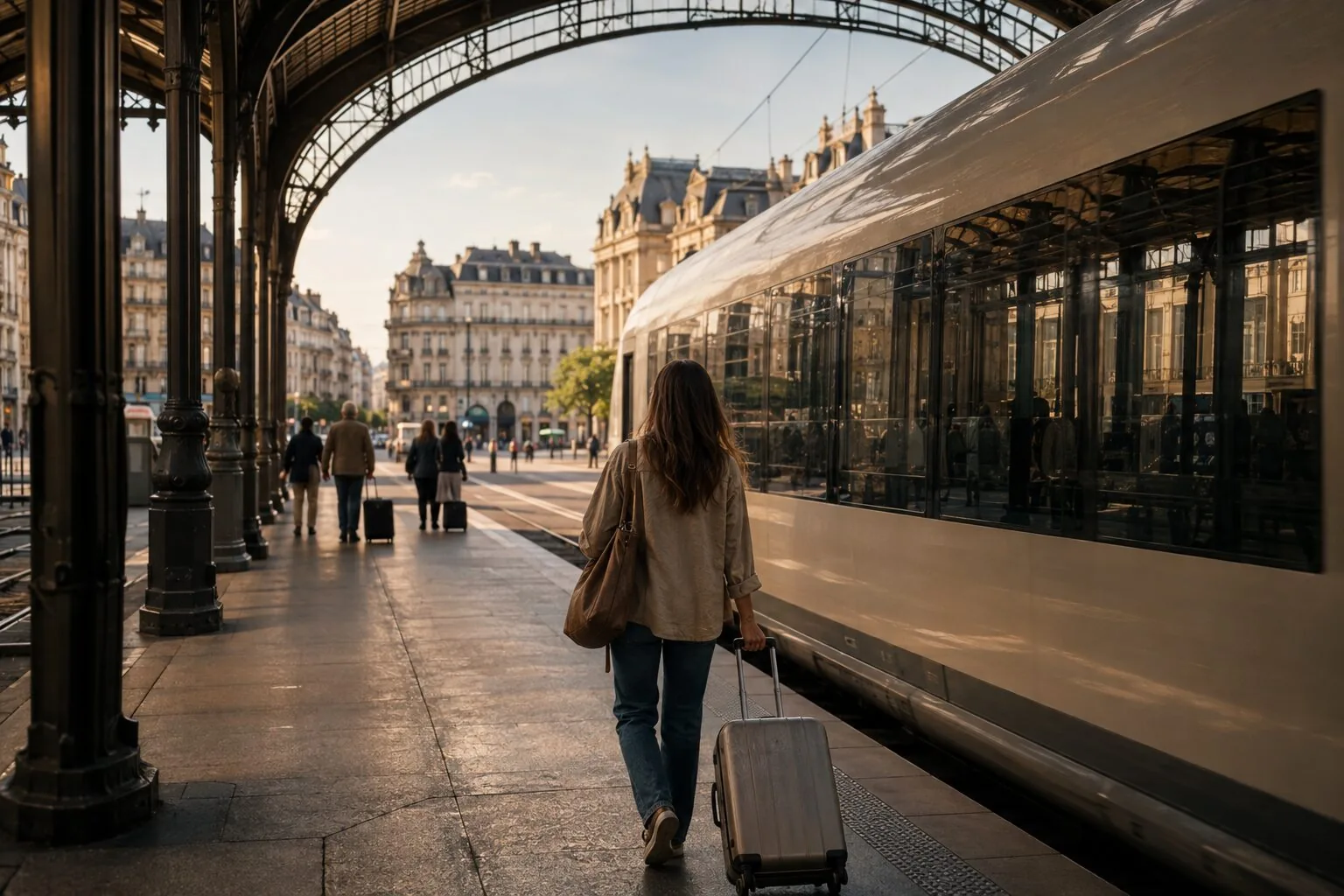
Trains solve the problem flying creates: the gap between the airport and the city you came to see. You step off already where you want to be — no distant boarding gate, no separate transfer once you land, and your luggage stays with you from platform to platform. Arrive at 11:00 and you generally have a usable afternoon. Multiply that across a multi-city trip and the trains quietly hand back the equivalent of an extra day or two of daylight compared with flying between the same cities.
None of this makes rail automatically cheap or stress-free. On genuinely long hops — one end of the continent to the other — a two-hour flight usually beats a full day on the train, and a last-minute rail ticket can cost more than the equivalent fare in the air. Reservation rules vary by country, and strikes and engineering works happen on every network here, most visibly in France. The three routes below are built to avoid those cases: every leg is short-to-medium, city centre to city centre, and cheapest booked ahead.
Is Train Travel Easy for First-Timers?
Yes, with a handful of habits that take about one trip to learn. Finding your platform is simpler than it looks: the departure board shows a train number and final destination, and that number — checked against your ticket — is the detail that matters, since a station sends several trains in roughly the same direction.
Give yourself a real station buffer rather than the tightest possible connection, keep your ticket and QR code downloaded (signal drops in tunnels), and install the operator app for your route — SNCF Connect, DB Navigator, ÖBB, SBB, Trenitalia, NS or SNCB — with notifications on. A ticket bought as one combined itinerary carries stronger rebooking protection than two separate tickets that merely connect.
Station signage is more consistent than it first looks: ‘binario’, ‘Gleis’, ‘voie’ and ‘quai’ all mean platform, and the number often appears only shortly before departure, so a late platform change is routine rather than a warning.
How Many Cities and Countries Should You Choose?
More stops do not make a better trip; they make a longer packing list. Between three and five bases is the range that lets you see a city rather than just its station. Route 1 uses five bases across 14 days, Route 2 four across 12, and Route 3 three across 10 — none backtracking, none asking you to repack more than once every two or three nights.
The discipline is simply to count transfer days honestly: a travel day that leaves you only an arrival afternoon is not a sightseeing day, and a route feels relaxed only when the maths of nights, transfers and full days is done before booking rather than discovered in transit.
For most first-timers, three or four bases across ten to fourteen days is the sweet spot: enough countries to feel like a real journey, few enough changes that no single day is swallowed by logistics.
If you want a broader framework before committing to a rail-specific plan, our First-Time Europe Itinerary: 3 Realistic Beginner Routes covers that decision more generally. This guide answers the narrower question: given that you want to travel by train, which route fits your time and nerve?
Compare the Three Routes
| Route | Duration | Countries | Bases | Longest leg | Budget level | Complexity | Best for |
|---|---|---|---|---|---|---|---|
| Route 1: Paris to Florence | 14 days/13 nights | France, Switzerland, Italy | 5 | Lucerne to Milan, about 3h30 | Higher | Medium (one connection) | Travellers who want mountains, cities and Italy in one trip |
| Route 2: Munich to Prague | 12 days/11 nights | Germany, Austria, Czechia | 4 | Vienna to Prague, about 4 hours | Mid-range | Low (all direct) | Travellers who want straightforward rail and strong architecture and history |
| Route 3: Amsterdam to Paris | 10 days/9 nights | Netherlands, Belgium, France | 3 | Amsterdam to Brussels, about 1h50 | Mid to higher | Lowest (fewest legs, all direct) | First-timers with less time or less confidence on trains |
Which route should you choose?
- Route 1 if you want cities, mountains and Italy in one trip, accept a higher budget and want the most varied route.
- Route 2 if you want straightforward, all-direct rail, prefer architecture, cafés and history over scenery, and want a balanced mid-range trip.
- Route 3 if you want shorter journeys, fewer moving parts, less time available, or the gentlest introduction to train travel.
Route 1: France, Switzerland and Italy
Route: Paris → Strasbourg → Lucerne → Milan → Florence. Duration: 14 days, 13 nights. Nights: Paris 3, Strasbourg 2, Lucerne 3, Milan 2, Florence 3.
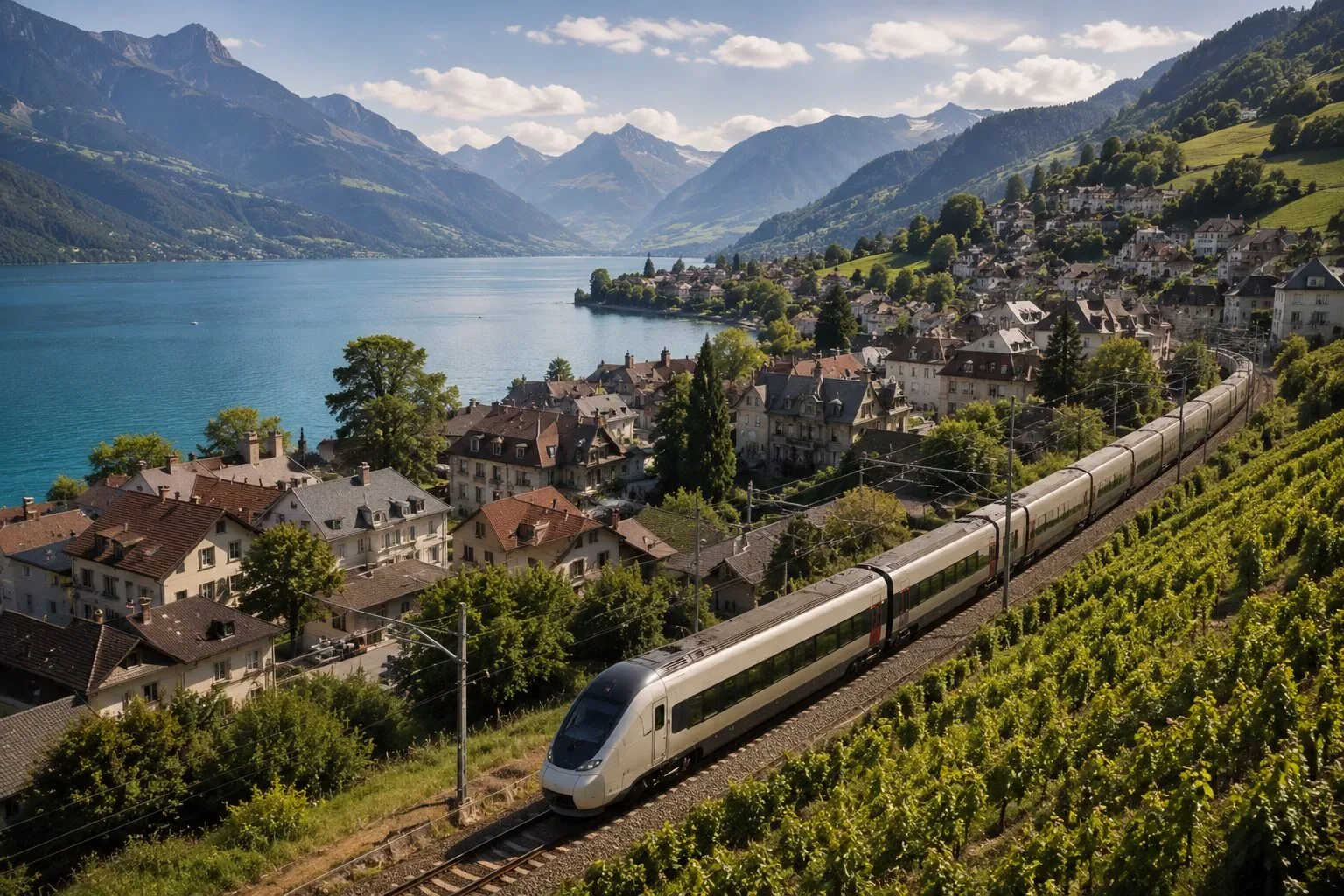
The most varied of the three: a grand capital, a small Alsatian city, Alpine lake scenery and two contrasting Italian bases, linked by four mostly direct trains that move in one direction — west to east across France, south into Switzerland, then down into Italy — with no leg longer than about three and a half hours in the seat. The crossing that worries most first-time planners, Switzerland into Italy, is also the most reassuring: the direct route uses the Gotthard Base Tunnel rather than a high mountain pass, so it runs year-round. The table below shows what each base is for; the day-by-day follows.
Each base earns its place by contrast rather than fame alone: Paris opens with a grand capital and easy flights, Strasbourg softens the pace, Lucerne swaps cities for lake and mountains, Milan brings back urban energy, and Florence closes on Renaissance density with three workable departure airports. That variety is the point — a route that keeps circling a map spends its best days on trains instead of in cities.
The rhythm matters as much as the sights: three busy Paris days, a gentler Strasbourg pause, a scenic Lucerne reset, then Italy’s energy to finish means you rarely hit two demanding transfer days back to back.
| Base | Nights | Arrive from | Scheduled train time | Why it earns its place | Main compromise |
|---|---|---|---|---|---|
| Paris | 3 | Flight in (start of trip) | N/A | Direct international flight access, sets the pace, two full days plus arrival to see the essentials | Highest accommodation and food costs on the route |
| Strasbourg | 2 | Paris | Approx. 1h45 to 2h, depending on service | Alsatian contrast, walkable old town, genuinely short and simple rail hop | Fewer headline sights than the other four bases |
| Lucerne | 3 | Strasbourg | Approx. 2h45 to 3h15, one well-chosen connection at Basel | Lake and mountain scenery, a real pacing reset, gateway to the Gotthard line | Highest daily costs on the route; one connection to manage |
| Milan | 2 | Lucerne | Around 3h30, direct EuroCity (confirm the direct service runs on your date) | Urban and design contrast after three quieter days, easy direct gateway into Italy | Fewer must-see landmarks than Florence or Paris |
| Florence | 3 | Milan | 1h40 to 1h55, direct high-speed | Renaissance density, two full sightseeing days, strong finish, three viable departure airports nearby | Even with three nights, rewards prioritising over seeing everything |
Full day-by-day itinerary
| Day | Sleeps in | Realistic plan | Train/transfer | Pace | Booking or luggage note |
|---|---|---|---|---|---|
| 1 | Paris | Check in, orientation walk near the hotel, simple bistro dinner | Airport to hotel | Arrival | Confirm late check-in if landing in the afternoon |
| 2 | Paris | Louvre or Musée d’Orsay, Seine walk, optional Eiffel Tower at dusk | None (metro) | Full sightseeing | Book timed museum entry in advance |
| 3 | Paris | Montmartre and Sacré-Coeur, Marais wandering, optional river cruise | None (metro) | Full sightseeing | Pack tonight; reconfirm tomorrow’s TGV reservation and platform |
| 4 | Strasbourg | Checkout, train to Strasbourg, walk through Petite France, simple dinner | Paris Gare de l’Est → Strasbourg-Ville, direct | Transfer | Arrive 20 to 30 min early; reservation compulsory and included |
| 5 | Strasbourg | Strasbourg Cathedral and old town, canal boat tour or European Quarter | None | Full sightseeing | Pack for tomorrow’s Basel connection |
| 6 | Lucerne | Checkout, train via Basel to Lucerne, lakeside walk to Chapel Bridge, simple dinner | Strasbourg → Basel SBB → Luzern, one change | Transfer | Keep a 30 to 45 min buffer at Basel; less convenient services may need a second change |
| 7 | Lucerne | Mount Pilatus or Rigi excursion (choose one), lake cruise | Cogwheel railway or cable car, booked separately | Full sightseeing | Book mountain excursion tickets ahead in high season |
| 8 | Lucerne | Old Town, Rosengart Collection or a lakeside café, pack in the afternoon | None | Flexible/light | Verify tomorrow’s direct Lucerne–Milan EuroCity runs on this date, then reconfirm the reservation |
| 9 | Milan | Checkout, EuroCity to Milano Centrale, orientation walk near the Duomo, aperitivo | Luzern → Milano Centrale, direct via the Gotthard Base Tunnel | Transfer | Book this EuroCity reservation a few days ahead in peak season |
| 10 | Milan | Duomo rooftop, Galleria Vittorio Emanuele II, Brera, or a pre-booked Last Supper visit | None | Full sightseeing | Last Supper tickets sell out weeks ahead; book early if it matters |
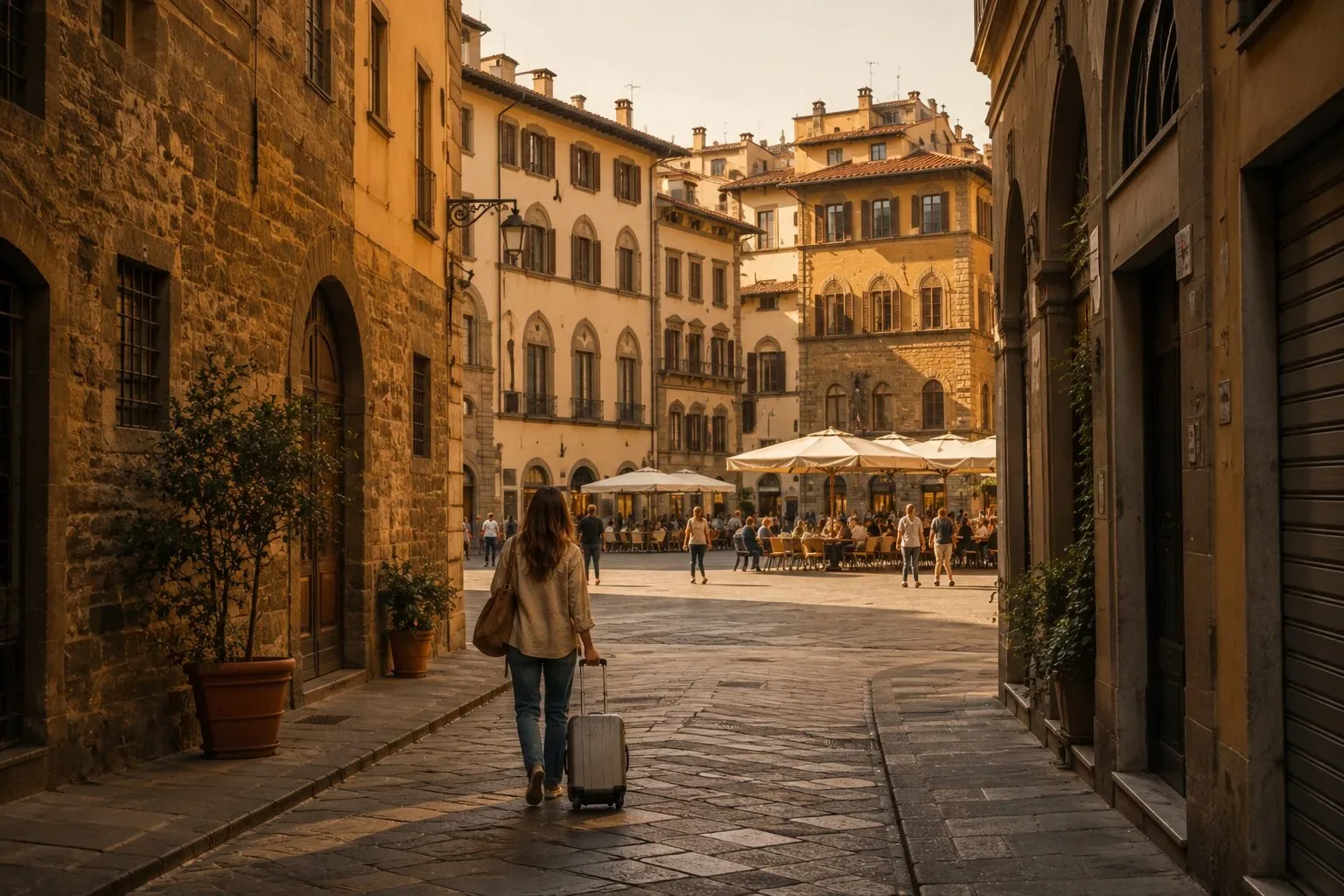
| 11 | Florence | Checkout, high-speed train to Florence, walk to Piazza della Signoria, trattoria dinner | Milano Centrale → Firenze Santa Maria Novella, direct | Transfer | Reservation compulsory and included |
| 12 | Florence | Uffizi or Accademia, Ponte Vecchio and Oltrarno, sunset at Piazzale Michelangelo | None | Full sightseeing | Book David or Uffizi timed entry weeks ahead in high season |
| 13 | Florence | Duomo dome or Boboli Gardens, San Lorenzo market, a slower Oltrarno afternoon | None | Full sightseeing | Reconfirm tomorrow’s airport transfer and train times |
| 14 | Departure | Checkout, transfer to your departure airport, fly out | Florence Airport, or train to Pisa (about 1h10) or Bologna (about 35 min) | Departure | Allow roughly 5 hours hotel-to-departure if connecting via Pisa or Bologna, or stay nearer the airport for an early flight |
Exact day accounting: 14 calendar days · 13 nights · 5 bases (3 + 2 + 3 + 2 + 3) · 4 hotel changes · 4 intercity legs · 0 internal flights.
| Type of day | Number | Which days |
|---|---|---|
| Arrival | 1 | Day 1 |
| Full sightseeing | 7 | Days 2, 3, 5, 7, 10, 12, 13 |
| Flexible/light | 1 | Day 8 |
| Transfer | 4 | Days 4, 6, 9, 11 |
| Departure | 1 | Day 14 |
No transfer day is treated as a full sightseeing day, and no headline attraction sits on the afternoon a train arrives. Day 8 is kept deliberately flexible — a flexible day is where the holiday catches up with you, not an empty one.
Door-to-door train times
Scheduled time is only part of the real transfer — see Train time versus hotel-to-hotel time for the method. For Route 1’s specific legs, the biggest time-sinks are the Basel change and the two roughly three-and-a-half-hour rides into and out of Milan:
| Leg | Stations | Changes | Scheduled time | Realistic hotel-to-hotel | Booking complexity | What remains of the day |
|---|---|---|---|---|---|---|
| Paris → Strasbourg | Gare de l’Est → Strasbourg-Ville | None | Approx. 1h45 to 2h | About 3 to 3.5 hours | Low: one ticket, reservation included | Full afternoon and evening free |
| Strasbourg → Lucerne | Strasbourg-Ville → Basel SBB → Luzern | One, at Basel SBB (occasionally two) | Approx. 2h45 to 3h15 combined | About 4.5 to 5 hours | Medium: two legs or one combined itinerary | A gentle lakeside walk, not much more |
| Lucerne → Milan | Luzern → Milano Centrale | None on the direct EuroCity | Around 3h30 | About 4.5 to 5 hours | Medium: reservation included; pass holders book it separately | Late-afternoon orientation walk only |
| Milan → Florence | Milano Centrale → Firenze S.M.N. | None | 1h40 to 1h55 | About 3 to 3.5 hours | Low: reservation included | Most of the afternoon and evening free |
Tickets on Route 1
| Part of route | Typical ticket | Reservation | Best booking source |
|---|---|---|---|
| Paris to Strasbourg | TGV inOui point-to-point fare | Compulsory, bundled into the price | SNCF Connect |
| Swiss domestic journeys | Standard SBB point-to-point ticket | Usually optional (small fee for scenic carriages) | SBB |
| Lucerne to Milan | International EuroCity ticket | Compulsory and included; pass holders book it separately | SBB or Trenitalia |
| Milan to Florence | Frecciarossa or Italo high-speed fare | Compulsory and included, date-and-seat specific | Trenitalia or Italo |
Where to base yourself on Route 1
Location first, hotel second. Base yourself near the Seine’s Right Bank or the Marais in Paris (walkable, short ride to Gare de l’Est for departure); anywhere central in Strasbourg (old town and station are 10–15 minutes apart); near the lake or Old Town in Lucerne, within walking distance of the station; between the Duomo and Milano Centrale in Milan; and between Santa Maria Novella and the historic centre in Florence, which keeps a Pisa or Bologna departure easy.
What Route 1 costs
The Wanderess Travels planning estimates for two people sharing the exact 13-night itinerary, international flights excluded, intercity trains and reservations, local transport, attractions, airport transfers and practical costs included. Shoulder-season, booked reasonably ahead, in euros, checked 28 July 2026.
| Category | Budget | Mid-range | Comfortable/smart-splurge |
|---|---|---|---|
| Accommodation (13 nights) | €1,050 to €1,300 | €1,850 to €2,250 | €3,100 to €3,800 |
| Food | €760 to €930 | €1,120 to €1,370 | €1,750 to €2,150 |
| Local transport | €100 to €140 | €140 to €180 | €180 to €220 |
| Intercity trains and reservations (4 legs, point-to-point) | €320 to €420 | €470 to €580 | €690 to €880 |
| Attractions | €260 to €340 | €400 to €500 | €600 to €750 |
| Airport transfers | €80 to €120 | €120 to €160 | €260 to €340 |
| eSIM/laundry/practical | €60 to €90 | €90 to €120 | €130 to €170 |
| Total (2 people, 13 nights) | €2,630 to €3,340 | €4,190 to €5,160 | €6,710 to €8,310 |
Totals are rounded from the component ranges for planning, not as exact quotes. Switzerland is the biggest cost driver — Lucerne’s hotel and food prices run well above the other four bases, which is why it is capped at three nights. Booking the four intercity trains as early as your dates allow keeps the trains row near the lower end.
Route 1 variations
For couples
ADD A FOURTH LUCERNE NIGHT
15 days / 14 nights
What changes: Paris 3, Strasbourg 2, Lucerne 4, Milan 2, Florence 3. A fourth Lucerne night buys one unscheduled scenic day and calmer evenings without shortening Paris or Florence. Budget: roughly €150–250 more per couple, since Swiss nights sit at the top of this route’s range.
On a budget
SWAP LUCERNE FOR BASEL
Same 14 days / 13 nights
What changes: Paris → Strasbourg → Basel → Milan → Florence. Basel is direct from Strasbourg (about 1h10, no change) and direct to Milan (about 3h45), removing one connection and often lowering hotel and food costs. Trade-off: no lake-and-mountain day; and Basel’s trade fairs can spike prices on specific dates, so check exact dates first.
If you would rather swap a base than a whole leg, these three keep the direction, the rail logic and a viable final airport intact:
| Replace | With | Why | Transport & budget impact | Main compromise |
|---|---|---|---|---|
| Strasbourg | Colmar | Smaller, quieter fairy-tale Alsace town on the same corridor | May add a connection — check the full Paris–Colmar–Lucerne sequence; generally cheaper | Fewer big-city amenities, smaller station |
| Lucerne | Zurich | Bigger city, more museums and nightlife, same corridor | Similar time, still one change via Basel; similar cost | Less lake scenery, more urban feel |
| Florence | Bologna | Cheaper, excellent food, stronger rail hub and airport | Milan–Bologna direct high-speed about 1h; Florence stays a 35-min day trip; noticeably cheaper | Trades Renaissance immersion for a shorter Florence visit |
Route 2: Germany, Austria and Czechia
Route: Munich → Salzburg → Vienna → Prague. Duration: 12 days, 11 nights. Nights: Munich 3, Salzburg 2, Vienna 3, Prague 3.
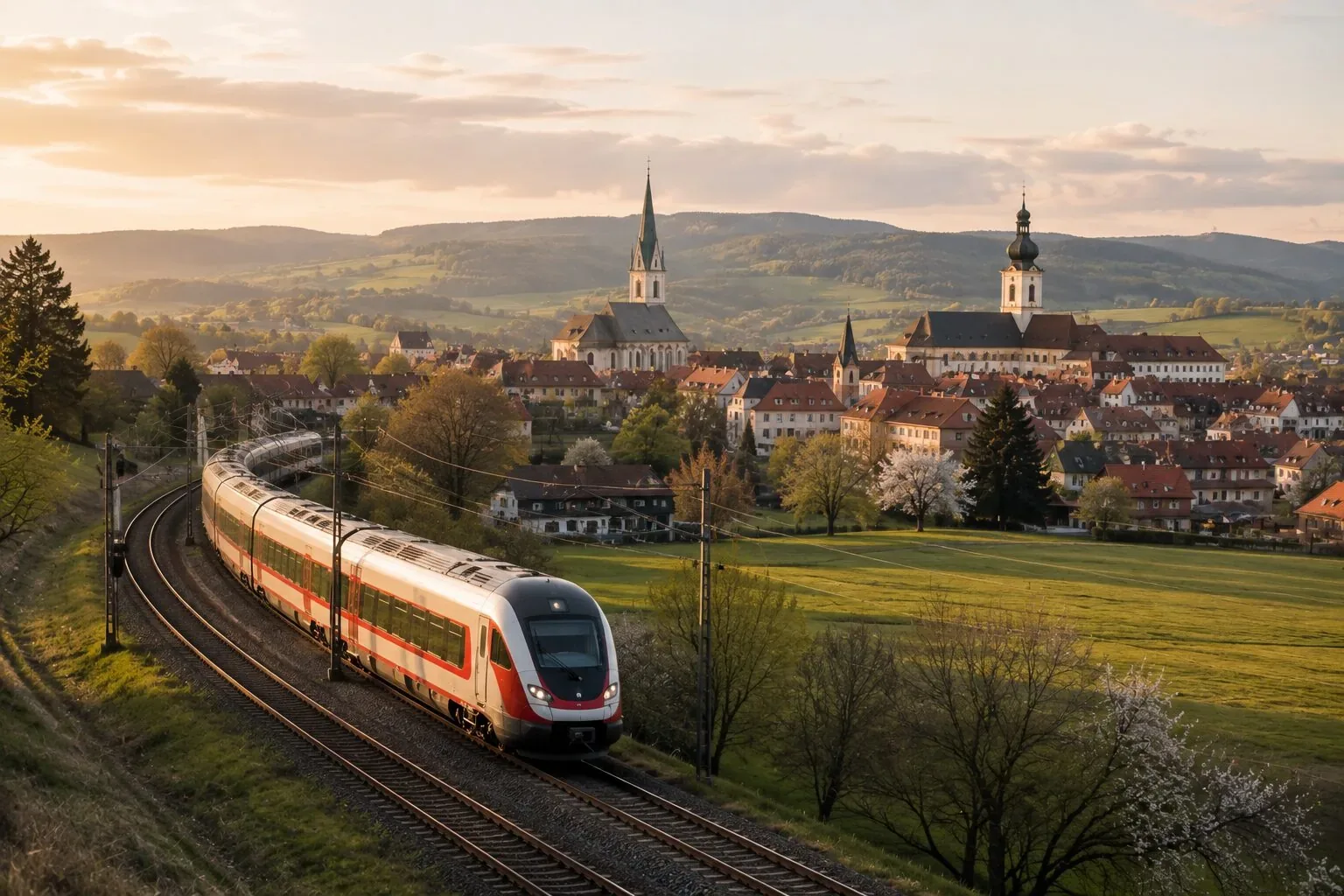
This route places less emphasis on mountain excursions and more on architecture, imperial history and coffee-house culture, and trades one connection for zero: every leg is a direct train, which makes it the simplest rail logistics of the three despite covering three countries. Fly into Munich and out of Prague — both major international airports, so no return flight or internal hop anywhere.
The appeal is coherence: four compact, walkable centres, a shared café-and-concert culture, and trains that turn up and go without a connection to plan.
| Day | Sleeps in | Plan | Train/transfer |
|---|---|---|---|
| 1 | Munich | Arrive, orientation walk near Marienplatz | Airport to hotel |
| 2 | Munich | Old town, Residenz, Viktualienmarkt | None |
| 3 | Munich | Museum of choice or a half-day at Nymphenburg Palace and its gardens. | None |
| 4 | Salzburg | Checkout, train to Salzburg, old town walk | München Hbf → Salzburg Hbf, direct |
| 5 | Salzburg | Hohensalzburg Fortress, Mirabell Gardens | None |
| 6 | Vienna | Checkout, train to Vienna, orientation walk near Stephansplatz | Salzburg Hbf → Wien Hbf, direct railjet |
| 7 | Vienna | Hofburg, St Stephen’s Cathedral, coffeehouse afternoon | None |
| 8 | Vienna | Schönbrunn Palace or the Belvedere | None |
| 9 | Prague | Checkout, train to Prague, walk to Old Town Square | Wien Hbf → Praha hl.n., direct railjet |
| 10 | Prague | Prague Castle, Charles Bridge | None |
| 11 | Prague | Jewish Quarter, second castle-district morning, or a slower day | None |
| 12 | Departure | Checkout, transfer to Václav Havel Airport, fly out | Prague Airport |
| Leg | Stations | Changes | Scheduled time | Reservation |
|---|---|---|---|---|
| Munich to Salzburg | München Hbf → Salzburg Hbf | None | About 1h30 to 2h, direct EC/railjet | Optional, recommended in peak season |
| Salzburg to Vienna | Salzburg Hbf → Wien Hbf | None | About 2h30 to 3h, direct railjet | Optional, recommended in peak season |
| Vienna to Prague | Wien Hbf → Praha hlavní nádraží | None | About 4 hours, direct railjet | Optional, worth booking ahead for a window seat |
Exact day accounting: 12 days · 11 nights · 4 bases (3 + 2 + 3 + 3) · 3 hotel changes · 3 direct legs · 0 internal flights · 1 arrival, 7 full sightseeing, 3 transfer, 1 departure day.
Main advantage: every leg is direct — the lowest-complexity three-country trip here. Main compromise: the Vienna–Prague leg is the longest single seated journey of all three routes at around four hours, so plan a slower arrival evening in Prague. Budget (2 people, excluding flights): roughly €2,000 to €2,600 on a budget, or €3,200 to €3,900 mid-range. Best for: travellers who want history, architecture and coffee-house culture without an Alpine detour, and would rather book four hotels and three direct trains than manage any connection.
Route 3: Netherlands, Belgium and France
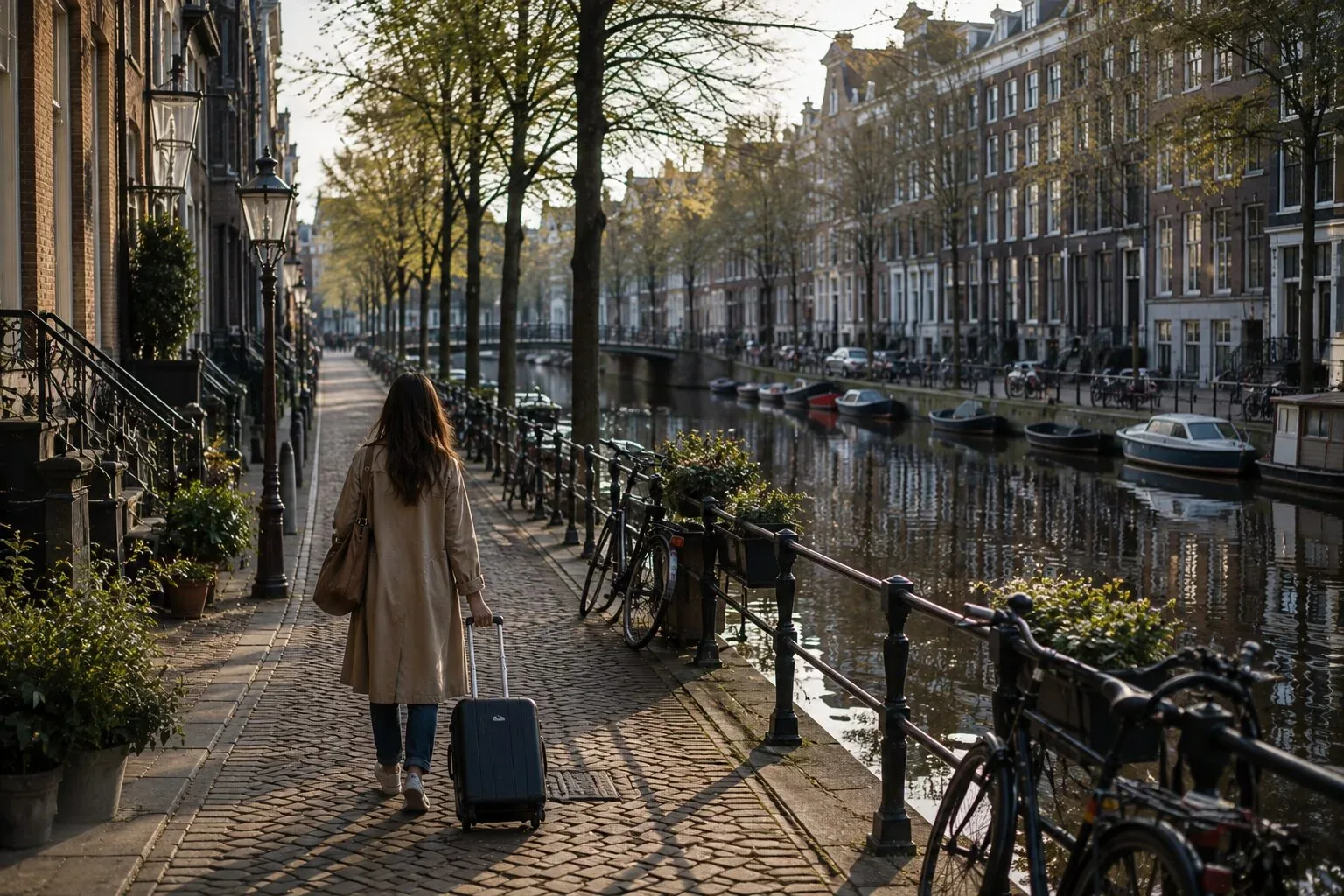
Route: Amsterdam → Brussels → Paris. Duration: 10 days, 9 nights. Nights: Amsterdam 3, Brussels 2, Paris 4.
The shortest and gentlest route: two direct legs, both under two hours, linking three of Europe’s most first-timer-friendly capitals. Ghent or Brussels? Both sit on the same corridor, but Brussels is the stronger first-timer choice — it has direct high-speed trains to both Amsterdam and Paris with no change either way, keeping a full-size suitcase easy to manage, and its hotel and food costs sit close to Ghent’s. Reaching Ghent generally means routing via Brussels or Antwerp anyway, adding the very change this route is designed to avoid.
With only two short legs, this is the route where the logistics almost disappear, leaving you to concentrate on the cities rather than the moves between them.
Brussels-Midi is a large through-station rather than the atmospheric centre of Brussels. Follow the signs carefully, then use the metro, tram or a short taxi to reach a hotel near Grand Place.
| Day | Sleeps in | Plan | Train/transfer |
|---|---|---|---|
| 1 | Amsterdam | Arrive, canal-side walk near the hotel | Airport to hotel |
| 2 | Amsterdam | Rijksmuseum or Van Gogh Museum, Jordaan walk | None |
| 3 | Amsterdam | Canal cruise, Anne Frank House (book ahead) | None |
| 4 | Brussels | Checkout, train to Brussels, Grand Place walk | Amsterdam Centraal → Bruxelles-Midi, direct |
| 5 | Brussels | EU quarter or comic-strip route, waffles, museum of choice | None |
| 6 | Paris | Checkout, train to Paris, Seine walk | Bruxelles-Midi → Paris Gare du Nord, direct |
| 7 | Paris | Louvre or Musée d’Orsay | None |
| 8 | Paris | Montmartre, Marais | None |
| 9 | Paris | Second gallery, river cruise, or a flexible day | None |
| 10 | Departure | Checkout, transfer to the airport, fly out | Charles de Gaulle or Orly |
| Leg | Stations | Changes | Scheduled time | Reservation |
|---|---|---|---|---|
| Amsterdam to Brussels | Amsterdam Centraal → Bruxelles-Midi/Brussel-Zuid | None | About 1h50 to 2h, direct high-speed | Compulsory on the high-speed service, included in the ticket |
| Brussels to Paris | Bruxelles-Midi → Paris Gare du Nord | None | About 1h25, direct high-speed | Compulsory, included in the ticket |
Exact day accounting: 10 days · 9 nights · 3 bases (3 + 2 + 4) · 2 hotel changes · 2 direct legs · 0 internal flights · 1 arrival, 6 full sightseeing, 2 transfer, 1 departure day.
Main advantage: two direct legs, both under two hours, with reservations built into the fare — nothing to route-plan beyond your departure times. Main compromise: three bases and two countries is a genuinely shorter trip, by design. Budget (2 people, excluding flights): roughly €2,100 to €2,700 on a budget, or €3,400 to €4,200 mid-range. Best for: first-timers with under two weeks, anyone nervous about connections, and travellers who would rather spend four settled nights in Paris than one night each in five cities.
Train Time Versus Hotel-to-Hotel Time
The train is direct; your journey from breakfast table to hotel room is not. The Wanderess equation for a rail leg is the same everywhere: hotel checkout, plus transport to the station, plus a station buffer, plus the scheduled train, plus arrival navigation, plus transport to the next hotel. Add those up and a ‘1h50 train’ quietly becomes a three-hour chunk of your day.
| Example leg | Route | Scheduled time | Realistic hotel-to-hotel |
|---|---|---|---|
| Paris to Strasbourg | Route 1 | 1h45 to 2h | About 3 to 3.5 hours |
| Munich to Salzburg | Route 2 | 1h30 to 2h | About 2.5 to 3 hours |
| Vienna to Prague | Route 2 | About 4 hours | About 5 to 5.5 hours |
| Amsterdam to Brussels | Route 3 | 1h50 to 2h | About 3 to 3.5 hours |
| Brussels to Paris | Route 3 | About 1h25 | About 2.5 to 3 hours |
Tickets and Reservations
The biggest planning trap is assuming one country’s rules apply to the whole trip. They do not. On Route 1, reservations are compulsory and bundled on French TGV and Italian high-speed trains, and generally optional on Swiss domestic trains. On Route 2, German and Austrian reservations are optional but recommended in peak season, with the Vienna–Prague leg worth booking early for a specific seat. On Route 3, the high-speed corridor treats reservations as compulsory and bundled on both legs.
On fares, the cheapest advance tickets are usually non-refundable and locked to one departure; miss that train and the ticket is typically forfeit. Flexible fares cost more but let you board the next service. The lowest fare is only a bargain if you are certain which train you are taking.
Book on the operator’s own site for the most reliable live pricing and delay information: SNCF Connect (France), SBB (Switzerland), Trenitalia or Italo (Italy), DB Navigator (Germany), ÖBB (Austria), Czech Railways or RegioJet (Czechia), NS (Netherlands), SNCB (Belgium). Whichever you use, download or screenshot your ticket before travel.
On timing, the cheapest advance fares tend to open a few weeks to a few months before travel and climb as seats sell, so the real savings sit in booking the date-specific high-speed legs early. Third-party booking sites can be convenient, but they sometimes add fees or apply different connection-protection conditions — worth comparing against the operator’s own price first.
Where a day involves a change, try to buy that day as a single combined ticket rather than two that merely connect — it is usually the same price and gives you far better standing if the first train runs late.
Eurail, Interrail or Point-to-Point Tickets?
Pass eligibility is based on residence, not nationality: non-European residents use a Eurail Pass, European residents use an Interrail Pass, and the product is otherwise the same. Many high-speed and international trains require pass holders to buy a separate reservation on top of the pass; with an ordinary point-to-point ticket, the reservation is generally already included.
A pass does not automatically make a fixed route cheaper, and all three routes here are fixed — four legs, three legs, two legs. With exact dates set, point-to-point advance fares booked a few weeks to a few months ahead are frequently cheaper than a multi-day pass plus separate reservation fees. Price the actual route first, then compare.
| Option | Advantages | Extra costs/limits | Verdict for these routes |
|---|---|---|---|
| Point-to-point advance fares | Cheapest when dates are fixed; simple, no pass admin | Usually non-refundable/non-changeable on the lowest tiers | Usually the strongest value for all three fixed routes |
| Point-to-point flexible fares | Changeable departures, still a one-ticket purchase | Noticeably more expensive than advance fares | Worth it only if your dates are genuinely unclear |
| Standard Eurail/Interrail Pass | Date flexibility within the validity window | A separate reservation charge applies on most legs here | Often more expensive for these fixed itineraries, but worth pricing when flexibility matters |
Luggage and Station Confidence
Pack luggage you can lift onto an overhead rack or an end-of-carriage stack without help; most European high-speed and intercity trains rely on one of those rather than hold storage, and there is rarely a guaranteed space for a full-size case. A carry-on-sized case or soft duffel is easier on every leg.
Your suitcase should not need its own boarding strategy.
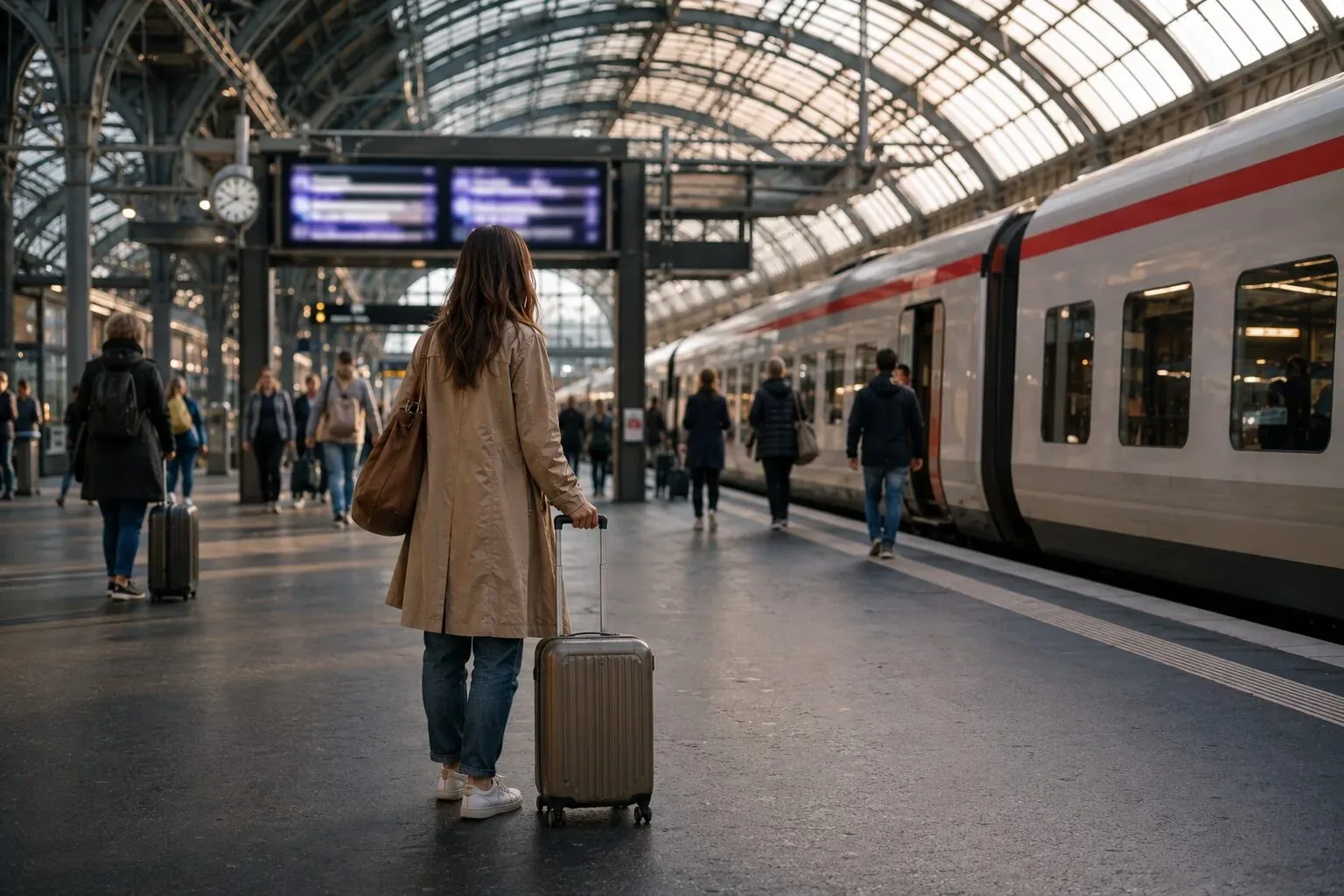
A few basics carry across all three routes: keep a downloaded copy of every ticket, carry a backup payment method separate from your primary card, save hotel addresses offline, and keep a small power bank for legs where signal drops. Left-luggage facilities exist at most major stations.
At the station itself, find your train by final destination and departure time; coach and seat numbers are marked on the platform in France, Germany, Switzerland and Austria, so you can stand roughly where your carriage stops. Stay quietly aware of your bag in crowds without tipping into fear — pickpockets rely on distraction, not stealth — and note that hotel check-in is usually mid-afternoon, so most will store your bag if an early train delivers you before your room is ready.
Hotel-Location Strategy
Location first, hotel second, on every route. A beautiful room a 40-minute tram ride from the old town costs you more time across a week than a plainer room five minutes’ walk from where you actually want to be.
On Route 1, base near the Seine’s Right Bank (Paris), the old town (Strasbourg), the lake (Lucerne), between the Duomo and Milano Centrale (Milan), and between Santa Maria Novella and the centre (Florence). On Route 2, stay within walking distance of Marienplatz (Munich), the old town (Salzburg), Stephansplatz (Vienna), and between the Old Town and the river (Prague). On Route 3, a canal-adjacent Amsterdam hotel, anything near Grand Place (Brussels), and a base between Gare du Nord and central Paris keep sightseeing on foot.
The principle is the same in every city: shrink the distance between your door and both your main sights and your next station. Where those pull in different directions — a museum cluster one way, the departure station the other — a central base near good transport usually beats being glued to either.
Check Your Hotel Location Before You Book
A great train route can still be undone by a hotel that adds a 40-minute transfer at both ends of the day. Score your hotel’s location in two minutes, free, no email required.
Cost Comparison
The Wanderess Travels planning estimates for two people sharing, excluding international flights, checked 28 July 2026. Each range assumes shoulder-season travel booked reasonably ahead and includes accommodation, food, local transport, intercity trains, attractions and airport transfers.
| Route | Budget (2 people) | Mid-range (2 people) | Main cost driver |
|---|---|---|---|
| Route 1: Paris to Florence (13 nights) | €2,630 to €3,340 | €4,190 to €5,160 | Switzerland: Lucerne’s hotel and food prices sit well above the other four bases |
| Route 2: Munich to Prague (11 nights) | €2,000 to €2,600 | €3,200 to €3,900 | Vienna and Munich accommodation; Prague brings the average back down |
| Route 3: Amsterdam to Paris (9 nights) | €2,100 to €2,700 | €3,400 to €4,200 | Amsterdam and Paris accommodation, the two priciest bases across all three routes |
What moves each total most is the same short list everywhere: your dates, how far ahead you book hotels and trains, whether a fair or festival collides with your stay, and how often you eat out versus self-cater. Use the ranges to sanity-check a plan, not to hold anyone to the euro.
Best Route for Couples
The best route for a couple depends less on romance than on how the two of you like to spend a day. All three work; they reward different temperaments.
Scenery & variety
THE SMART-SPLURGE TRIP
Route 1 — Paris to Florence
Best for: couples who want mountains, cities and Italy in one trip and will spend more for the range. Trade-off: the highest budget, driven by Switzerland and Paris.
Architecture & café culture
THE EASIEST LOGISTICS
Route 2 — Munich to Prague
Best for: couples who love historic centres, coffee houses and music and want every leg to be a direct train. Trade-off: less scenery, and one long four-hour final leg into Prague.
Settled & low-effort
THE GENTLEST PACE
Route 3 — Amsterdam to Paris
Best for: couples who want short journeys, few moving parts and four unhurried nights in Paris to end on. Trade-off: the shortest range, and the highest nightly costs.
Best Route on a Budget
The cheapest total is not automatically the best value, because the routes run for different lengths. A fairer comparison is roughly what a couple spends per night on the budget tier.
| Route | Budget total (2 people) | Nights | Approx. budget cost per night | Value read |
|---|---|---|---|---|
| Route 1: Paris to Florence | €2,630–3,340 | 13 | €200–255 | Middle — Switzerland and Paris lift the nightly rate |
| Route 2: Munich to Prague | €2,000–2,600 | 11 | €180–235 | Strongest overall value — Prague pulls the average down |
| Route 3: Amsterdam to Paris | €2,100–2,700 | 9 | €235–300 | Lowest-ish total, but the highest nightly cost |
Approximate nightly figures are calculated from the total planning ranges and rounded for comparison. Read this way, Route 2 is the strongest value: Prague sits well below Vienna and Munich, dragging the average down, and every leg is direct. Route 3 has a lower total only because it is the shortest trip; per night, Amsterdam and Paris keep it the priciest. A couple with a firm budget and no fixed length is usually best served by Route 2.
Delays and Backup Planning
Book each day’s journey as a single through-ticket from one operator where you can. When every leg sits on one protected through-ticket, the operator will generally reroute you after a missed connection caused by an earlier delay; separate tickets may not, so check the conditions before buying. This matters most at Route 1’s Basel change; the direct-only Routes 2 and 3 rarely raise it.
Strikes and engineering works are the two disruptions worth checking specifically. Strikes are most common in France and usually announced days ahead; engineering works are routine, often at weekends, and can lengthen or reroute a journey without cancelling it. Check the operator’s status page in the week before you travel and again the night before. On longer international delays, EU rail passenger-rights rules generally entitle you to rerouting or a refund, and to assistance such as meals or, where necessary, accommodation, depending on the length of the delay and the ticket held; confirm the current thresholds with the operator at the time.
If a strike or major works are announced for your date, the calm response is usually to move to an earlier or later train on the same ticket rather than abandon the day; operators typically relax change rules around planned disruption, so check what flexibility your fare allows before rebooking anything.
What to Book First
Booking order
- First: fix your dates and open-jaw flights — into the first city, out of the last.
- Second: confirm the route and exact night allocation.
- Third: check the longest or least-frequent international train (Lucerne–Milan on Route 1, Vienna–Prague on Route 2).
- Fourth: book all hotels, using flexible rates where reasonable.
- Fifth: book the date-specific high-speed trains once dates are firm, for lower advance fares.
- Sixth: compare point-to-point tickets against a Eurail or Interrail pass for your exact legs.
- Seventh: book high-demand attractions (Last Supper in Milan; Uffizi and Accademia in Florence).
- Finally: recheck strikes and engineering works in the week before departure, and again the night before.
Entry Requirements
All eight countries on these routes — France, Switzerland, Italy, Germany, Austria, Czechia, the Netherlands and Belgium — are part of the Schengen Area, which is what makes seamless overland travel between them possible. Switzerland is not an EU member but is a full Schengen member, so the same short-stay rules apply. Requirements still depend on your nationality and circumstances, so treat this as orientation, not advice, and confirm official rules before booking.
For visa-exempt short-stay travellers from outside the EU, passports generally need to have been issued within the previous 10 years and to remain valid at least three months beyond your intended departure from the Schengen Area. Where the visa-free allowance applies, short stays are limited to 90 days within any rolling 180-day period across all Schengen countries combined.
Because all eight are in Schengen, there are normally no routine immigration checks when you cross between them by train, though identity checks can occur and temporary internal controls are sometimes reintroduced. The Entry/Exit System (EES) became fully operational at participating external Schengen borders on 10 April 2026; it applies at the Schengen Area’s external borders and does not create a new immigration procedure when travelling by train between the Schengen countries included in these routes. ETIAS is not currently operational: no applications are being accepted and no action is required now, but its start date will be announced officially, so recheck before you travel.
Carry your passport or national ID even on the internal legs; checks are not routine, but they are legal, and non-EU nationals still clear Schengen entry on first arrival into the area.
Travel insurance is strongly recommended, and may be a formal requirement for travellers applying for a Schengen visa; it is not universally required for visa-exempt visitors. Checked 28 July 2026. Reconfirm through official EU and destination authorities before travel.
Best Time to Travel
There is no single best month; the right choice depends on your route. Spring (April to May) is a strong all-rounder — mild, lighter crowds, prices below peak, though Alpine excursions on Route 1 can still meet lingering snow early on. Summer brings the longest days and liveliest cities but the biggest crowds, the most heat in Milan, Florence and Vienna, and the highest reservation pressure. Early autumn (September to October) is many travellers’ favourite balance: warm enough, quieter, gentler on prices.
Winter is quietest and often cheapest, with two route notes: Route 2’s Christmas markets in Munich, Salzburg, Vienna and Prague are a December highlight, while Route 1’s mountain scenery is beautiful but daylight is short and some Alpine excursions run reduced schedules. Whichever season you choose, reservation pressure and seasonal pricing move together — the busier the dates, the earlier you should lock in the date-specific high-speed legs.
Reservation demand tracks the seasons, too: in peak summer, popular high-speed trains and Alpine excursions can sell out days ahead, while shoulder-season seats are usually available closer in. And because Route 1’s scenic value depends on seeing the mountains in daylight, its short winter days matter more there than on the city-focused routes.
Common Mistakes
- Choosing countries before checking whether a direct rail corridor actually links them.
- Counting scheduled train time instead of real door-to-door time, then over-scheduling the arrival afternoon.
- Stacking too many one-night stops, so the trip becomes a packing exercise.
- Assuming a rail pass is automatically cheaper, without pricing point-to-point fares for the exact legs.
- Applying one country’s ticket rules to the whole trip.
- Booking a hotel for station convenience alone, then commuting to everything you came to see.
- Carrying luggage you cannot lift onto an overhead rack.
- Leaving no buffer before the final flight, where a late train has the highest cost.
- Assuming reservations are optional everywhere, then finding a French or Italian high-speed train sold out at the counter.
- Not downloading tickets offline, then losing signal in a tunnel at the wrong moment.
Frequently Asked Questions
Is a Eurail or Interrail pass worth it?
Not automatically. All three routes are fixed, with only two to four legs each, so point-to-point advance fares booked ahead are frequently cheaper than a pass plus its separate reservation fees. Price the actual route first, then compare.
Do I need seat reservations?
It depends on the country. French TGV, Italian high-speed and the high-speed Amsterdam–Brussels–Paris services require compulsory reservations (included in the fare); Swiss domestic, German and Austrian trains are usually optional but worth booking in peak season.
Can I travel with a suitcase?
You can, but you’ll be happier with a case you can lift onto an overhead rack or end-of-carriage stack yourself. European trains rarely have guaranteed hold storage, so a carry-on-sized case or soft duffel is easier on every leg.
How early should I arrive at the station?
For most ordinary continental departures on these three routes, arriving 20 to 30 minutes early is comfortable. Allow more at an unfamiliar major station, if you need assistance, or when an operator specifies earlier arrival procedures.
What happens if I miss a connection?
On a single protected through-ticket, the operator will generally offer rerouting onto the next available service after a missed connection caused by an earlier delay. Separate tickets may not provide that protection, so check the conditions before buying — this matters most at Route 1’s Basel change.
Can I shorten the itineraries?
Yes. Route 2 has a workable 11-day version by trimming a Munich or Salzburg night, and any route can drop its shortest-stay base. Keep at least two nights in each remaining city so the trip does not become a series of transfers.
Sources and References
- SNCF Connect. Paris to Strasbourg train. Checked 28 July 2026. sncf-connect.com
- SBB (Swiss Federal Railways). International tickets: Italy. Checked 28 July 2026. sbb.ch
- Trenitalia. Frecciarossa connections and services. Checked 28 July 2026. trenitalia.com
- Italo (Italotreno). Train from Milan to Florence. Checked 28 July 2026. italotreno.com
- Deutsche Bahn. Travelling internationally by train. Checked 28 July 2026. int.bahn.de
- ÖBB. ÖBB Railjet. Checked 28 July 2026. oebb.at
- RegioJet. Vienna route. Checked 28 July 2026. regiojet.com
- NS International. Train Amsterdam–Paris. Checked 28 July 2026. nsinternational.com
- SNCB / Belgian Railways. International train travel. Checked 28 July 2026. belgiantrain.be
- Eurostar. Amsterdam to Paris train. Checked 28 July 2026. eurostar.com
- Eurostar. Brussels to Paris train. Checked 28 July 2026. eurostar.com
- Munich Airport. Public transport: bus and train connections. Checked 28 July 2026. munich-airport.com
- Amsterdam Schiphol. Travelling to and from Schiphol by train. Checked 28 July 2026. schiphol.nl
- Paris Aéroport. Charles de Gaulle — transport and access. Checked 28 July 2026. parisaeroport.fr
- Paris Aéroport. Paris-Orly — transport and access. Checked 28 July 2026. parisaeroport.fr
- Václav Havel Airport Prague. Public transport buses. Checked 28 July 2026. prg.aero
- Eurail. Do I need a Eurail or an Interrail Pass? Checked 28 July 2026. eurail.com
- Eurail. Securing seats: train reservations. Checked 28 July 2026. eurail.com
- European Commission. Entry/Exit System (EES). Checked 28 July 2026. travel-europe.europa.eu
- European Commission. ETIAS — official travel authorisation portal. Checked 28 July 2026. travel-europe.europa.eu
- European Commission. Schengen area. Checked 28 July 2026. home-affairs.ec.europa.eu
- Your Europe (European Commission). Rail passenger rights. Checked 28 July 2026. europa.eu
Further reading
- New to multi-country trips? Start with First-Time Europe Itinerary: 3 Realistic Beginner Routes.
- Only have a week? See the realistic 7-day Europe itinerary.
- Around two weeks? See the 2-week Europe itinerary.
- More time? Compare the 3-week and one-month Europe itineraries.
- Unsure whether a hotel is well placed? Run the free Hotel Location Check.
Want Your Europe Train Route Built Around Your Dates?
Use these three routes as a starting point, then get a custom day-by-day itinerary built around your dates, budget, pace and preferred train journeys.