First-Time Europe Itinerary: 3 Realistic Beginner Routes
Three realistic first-time Europe routes — London–Paris–Amsterdam, Rome–Florence–Venice and Prague–Vienna–Budapest — mapped day by day, with honest pacing, clear costs and advice for couples and budget travellers.
By Cyrielle · Travel planner & private-aviation professional · Updated 27 July 2026 · 26 min read
A first trip to Europe should feel like an adventure, not an entrance exam. The hard part is rarely the flights or the museums — it is the quiet fear of getting the plan wrong: too many cities, too many trains, a hotel in the wrong place, a border you did not expect. This guide removes that worry by doing something most itineraries avoid. Instead of one perfect route, it gives you three famous, genuinely beginner-friendly routes, each mapped day by day, so you can choose the one that fits your budget, your confidence and the kind of trip you actually want.
You do not need to visit five countries to have a “real” European holiday, and you do not need to decode a rail network the size of a continent before you have booked a single hotel. You need one sensible route, three calm bases and enough time in each city to enjoy it. Here are three routes that deliver exactly that — and an honest look at what each one asks of you in return.
Quick Answer
For a first trip to Europe, choose one of three routes: London → Paris → Amsterdam for the classic landmark experience, Rome → Florence → Venice for the simplest logistics, or Prague → Vienna → Budapest for better value. If you’d rather build a trip around one region, we have dedicated guides to a Western Europe itinerary and an Eastern Europe itinerary. Each uses three bases, direct trains and no internal flights, with enough nights in every city that the trip never turns into a luggage relay. There is no single “best” first-Europe route — the right one depends on your budget, how you feel about borders, how many countries you want, your trip length, your interests and your pace. This guide gives you the complete day-by-day plan, costs and trade-offs for all three so the decision is yours, made with open eyes.
Key Takeaways
- Three strong beginner routes, each using the trip length it genuinely needs: London–Paris–Amsterdam (12 days), Rome–Florence–Venice (11 days), Prague–Vienna–Budapest (12 days).
- Every route uses three hotel bases and two direct intercity trains — no internal flights, no backtracking, only two hotel changes.
- Italy is the easiest for logistics (one country, one currency); Western Europe is the classic but priciest; Central Europe is the best value but uses three currencies.
- For two people sharing, plan roughly €1,900–3,400 (Central Europe), €2,700–4,300 (Italy) or €3,400–5,100 (Western Europe) for 10–11 nights, excluding international flights.
- Book flights and hotels first, then high-demand timed attractions, then intercity trains once your dates are firm.
- Entry rules depend on your nationality; the Schengen area, the UK and the EES/ETIAS situation are all covered below. Always confirm official requirements before booking.
In This Article
- What a first Europe trip realistically gives you
- How many days, countries and cities to choose
- Choose your first-time Europe route
- Route 1: London, Paris and Amsterdam
- Route 2: Rome, Florence and Venice
- Route 3: Prague, Vienna and Budapest
- The First-Trip Friction Check
- Trains, flights, borders and open-jaw tickets
- How to choose hotel locations
- What a first Europe trip costs
- A first Europe trip for couples
- A first Europe trip on a budget
- Luggage and station confidence
- What to book first, what can stay flexible
- Entry requirements
- Best time for a first Europe trip
- Common first-trip mistakes
- Which route should you choose?
- Frequently asked questions
- Sources and references
What a First Europe Trip Realistically Gives You
Around eleven or twelve days does not become “more European” if you cram six cities into it. What it gives you, spent well, is three cities you actually get to know: a first morning finding your feet, a couple of unhurried days per base, and evenings that belong to you rather than to a suitcase and a station clock. Each of the three routes below is built on the same quiet principle — enough time in each place to enjoy it, and no more transfers than the trip genuinely needs.
The advantage of three well-chosen bases is that you see distinct, famous cities without turning the holiday into logistics. The compromise is honest too: three cities is not “all of Europe,” and that is entirely the point. A first trip is a first trip, not the last one you will ever take.
Missing one museum is a footnote. Missing the pleasure of the trip because you were always packing is the actual mistake.
How Many Days, Countries and Cities Should You Choose?
A useful rule of thumb, rather than an absolute: around seven days usually suits one or two bases; around ten to twelve days suits three bases; around fourteen days can support three or four, depending on the distances. Longer trips can hold more bases, but only if you keep counting transfer days honestly rather than pretending a travel day is a sightseeing day.
It helps to separate four things that often get blurred. Nights are where you sleep. Full sightseeing days are whole days in one city with no train to catch. Arrival and departure days are half-days at best, eaten by airports and check-in times. Transfer days move you between cities and give you, at most, an afternoon on arrival. Four nights in a city with an arrival day and a transfer day at each end is not four full days — it is two, plus two halves. Planning as if that were four whole days is the single most common way first trips end up feeling rushed.
First-time travellers also do not need to maximise borders. Three sensible hotel bases are far easier to enjoy than six bookings held together by optimism.
Your first trip does not become more European each time you add another border.
Choose Your First-Time Europe Route
All three routes share the same skeleton: three bases, two direct intercity trains, no internal flights and no doubling back. They differ in cost, in how many countries and currencies you juggle, and in how much border admin your nationality will meet. The table below is the fast comparison; the full day-by-day plans follow.
| Route | Suggested length | Countries | Bases | Main advantage | Main compromise | Best for |
|---|---|---|---|---|---|---|
| London → Paris → Amsterdam | 12 days / 11 nights | 3 (UK + 2 Schengen) | London, Paris, Amsterdam | Iconic cities, direct trains, familiar navigation | Highest cost; separate UK and Schengen entry | Classic first-trip sightseeing; couples; higher budget |
| Rome → Florence → Venice | 11 days / 10 nights | 1 (Italy) | Rome, Florence, Venice | One country, one currency, no internal borders | Timed-entry sights; Venice raises the budget | Nervous-about-borders first-timers; art, history, food |
| Prague → Vienna → Budapest | 12 days / 11 nights | 3 (all Schengen) | Prague, Vienna, Budapest | Three capitals, direct trains, better value | Three currencies; less familiar local systems | Budget-conscious first-timers; couples; architecture and cafés |
None of these is objectively “best.” Read them as three good answers to slightly different questions, and pick the question that sounds like yours.

Route 1: London, Paris and Amsterdam
The classic first-Europe route, and for good reason: three world-famous cities, joined by direct high-speed trains, with landmarks you already recognise before you arrive. It is the most expensive of the three and the only one that mixes a non-Schengen country (the UK) with the Schengen area, so it asks a little more of your planning — and rewards you with the most recognisable holiday of the three.
Route summary: Fly into London, take the Eurostar to Paris, then a direct train on to Amsterdam, and fly home from there. Twelve days, eleven nights, three bases, two trains, no internal flights.
Nights: London 4, Paris 4, Amsterdam 3.
| Day | Sleeps in | Realistic plan | Transfer | Pace | Booking / luggage note |
|---|---|---|---|---|---|
| 1 | London | Arrive, settle in, an easy first walk (Thames, a nearby neighbourhood) | Airport → hotel | Arrival | Don’t schedule a headline sight today |
| 2 | London | Westminster, the South Bank, a first museum | — | Full | Pre-book the Tower of London if it’s on your list |
| 3 | London | British Museum, Covent Garden, a park | — | Full | Each traveller should use their own contactless card or device consistently when tapping in and out. |
| 4 | London | Your choice: markets, galleries, a river trip | — | Full | Confirm tomorrow’s Eurostar and arrive early |
| 5 | Paris | Morning Eurostar; afternoon settling in near your base | London → Paris by train | Transfer | Be at St Pancras ~75 min before departure |
| 6 | Paris | Louvre or Orsay, Seine, Île de la Cité | — | Full | Book the Louvre timed entry in advance |
| 7 | Paris | Eiffel Tower area, Montmartre, a long lunch | — | Full | Single flat-fare metro tickets; load a Navigo Easy |
| 8 | Paris | Flexible: Versailles day trip or a slower city day | — | Flexible | Versailles is busy — pre-book if you go |
| 9 | Amsterdam | Direct train; afternoon canals and your neighbourhood | Paris → Amsterdam by train | Transfer | Reserved seats; check live status before travel |
| 10 | Amsterdam | Rijksmuseum or Van Gogh, canal-belt wandering | — | Full | Book the Van Gogh Museum ahead; it sells out |
| 11 | Amsterdam | Jordaan, a canal boat, last museum or market | — | Full | Tap in and out on trams or you’re overcharged |
| 12 | — | Train to Schiphol, fly home | Hotel → airport | Departure | Schiphol is ~15–20 min by train from Centraal |
Exact day accounting: 12 calendar days · 11 nights · 1 arrival day · 1 departure day · 2 transfer days · 8 sightseeing days (one of them flexible) · 3 bases · 2 hotel changes · 2 intercity trains · 0 internal flights. Every day and night is counted once.
Main advantage: three famous cities with direct transport and relatively familiar navigation — the most recognisable first trip you can take. Main compromise: the highest cost pressure of the three routes, plus two separate entry systems (UK, then Schengen). Best-suited traveller: a first-timer who wants the iconic landmarks, values strong transport links, and has a slightly higher budget to spend.
Route 2: Rome, Florence and Venice
The simplest single-country route, and the one to choose if borders make you nervous. One country, one currency, two direct high-speed trains and no internal frontier to cross — just art, history, food and three cities that need no introduction. Italy sits in the middle on price, with Venice as the one line item that can push a budget upward.
Route summary: Fly into Rome, high-speed train to Florence, then on to Venice, and fly home from Venice. Eleven days, ten nights, three bases, two trains, no internal flights.
Nights: Rome 4, Florence 3, Venice 3.
| Day | Sleeps in | Realistic plan | Transfer | Pace | Booking / luggage note |
|---|---|---|---|---|---|
| 1 | Rome | Arrive on the Leonardo Express, settle in, evening stroll | Airport → hotel | Arrival | Leonardo Express runs Fiumicino → Termini |
| 2 | Rome | Colosseum, Roman Forum, Palatine Hill | — | Full | Book the Colosseum the moment your date opens |
| 3 | Rome | Vatican Museums, St Peter’s, Trastevere evening | — | Full | Pre-book the Vatican; the door queue is long |
| 4 | Rome | Pantheon, Trevi, Spanish Steps, a slower day | — | Full | Confirm tomorrow’s train to Florence |
| 5 | Florence | Direct high-speed train (~1h25–1h40); afternoon in the centre | Rome → Florence by train | Transfer | Reserved high-speed seat — no separate validation |
| 6 | Florence | Uffizi, Duomo, Ponte Vecchio | — | Full | Book the Uffizi and any Duomo climb ahead |
| 7 | Florence | Accademia (David), Oltrarno, a Tuscan lunch | — | Full | Florence is compact and walkable |
| 8 | Venice | Direct train (~2h); afternoon along the canals | Florence → Venice by train | Transfer | Pack light — Venice means bridges and steps |
| 9 | Venice | St Mark’s, Doge’s Palace, a vaporetto ride | — | Full | Pre-book St Mark’s and the Doge’s Palace |
| 10 | Venice | Flexible: Murano and Burano, or quiet backstreets | — | Flexible | A day pass pays off if you island-hop |
| 11 | — | Transfer to Venice airport, fly home | Hotel → airport | Departure | Allow extra time for the water or bus transfer |
Exact day accounting: 11 calendar days · 10 nights · 1 arrival day · 1 departure day · 2 transfer days · 7 sightseeing days (one of them flexible) · 3 bases · 2 hotel changes · 2 intercity trains · 0 internal flights. Everything reconciles.
Main advantage: one country, one currency, two direct high-speed journeys and no internal border procedures — the lowest logistical load of the three. Main compromise: the major sights need advance booking, and Venice plus central Rome can lift the budget. Best-suited traveller: a first-timer who wants iconic cities with the least complexity, and who loves history, art and food.
Route 3: Prague, Vienna and Budapest
The better-value multi-country route: three distinct capitals within easy reach of each other, joined by comfortable direct trains, generally kinder to your budget than Western Europe. The trade is that you will handle three currencies and a few less familiar local systems — very manageable, but worth knowing before you go.
Route summary: Fly into Prague, direct train to Vienna, then on to Budapest, and fly home from Budapest. Twelve days, eleven nights, three bases, two trains, no internal flights.
Nights: Prague 4, Vienna 4, Budapest 3.
| Day | Sleeps in | Realistic plan | Transfer | Pace | Booking / luggage note |
|---|---|---|---|---|---|
| 1 | Prague | Arrive, settle in, an evening walk in the Old Town | Airport → hotel | Arrival | No airport metro — bus/trolleybus + metro, or Airport Express |
| 2 | Prague | Old Town Square, Charles Bridge, the astronomical clock | — | Full | Contactless “Tap&Go” works on the metro and trams |
| 3 | Prague | Prague Castle, Lesser Town, riverside | — | Full | Prague Castle tickets by circuit; go early |
| 4 | Prague | Jewish Quarter, cafés, a slower day | — | Full | Confirm tomorrow’s train to Vienna |
| 5 | Vienna | Direct Railjet (~4h); afternoon around the Ringstrasse | Prague → Vienna by train | Transfer | A longer transfer — treat today as a travel day |
| 6 | Vienna | Schönbrunn Palace and gardens | — | Full | Schönbrunn uses timed entry; book ahead |
| 7 | Vienna | Hofburg, museums, a classic coffee house | — | Full | Validate a paper single before you ride |
| 8 | Vienna | Flexible: Belvedere, Naschmarkt, or a music evening | — | Flexible | Vienna rewards an unhurried day |
| 9 | Budapest | Direct Railjet/EuroCity (~2h20–2h40); afternoon by the Danube | Vienna → Budapest by train | Transfer | Trains arrive at Budapest-Keleti |
| 10 | Budapest | Buda Castle, Fisherman’s Bastion, Parliament views | — | Full | Buy transit in the BudapestGO app |
| 11 | Budapest | Thermal baths, the Great Market, evening on the river | — | Full | Baths get busy midday — go early or late |
| 12 | — | 100E Airport Express to the airport, fly home | Hotel → airport | Departure | The 100E needs its own dedicated ticket |
Exact day accounting: 12 calendar days · 11 nights · 1 arrival day · 1 departure day · 2 transfer days · 8 sightseeing days (one of them flexible) · 3 bases · 2 hotel changes · 2 intercity trains · 0 internal flights. All days and nights account once.
Main advantage: three distinct capitals, logical direct trains and generally better value than the Western Europe route. Main compromise: multiple currencies and slightly less familiar local systems for a nervous first-timer. Best-suited traveller: a budget-aware first-timer or couple who loves architecture, cafés and historic centres and is happy to learn a few local systems.
The First-Trip Friction Check
This is a Wanderess editorial planning framework, not a scientific score. It rates the parts of a route that tend to stress first-timers, using three plain labels: GREEN means low friction, AMBER means manageable with a little preparation, and RED means an avoidable complication worth planning around. The labels are written out, not left to colour alone, and they are one editor’s read — your own comfort may shift a rating up or down.
| Factor | London–Paris–Amsterdam | Rome–Florence–Venice | Prague–Vienna–Budapest |
|---|---|---|---|
| Route simplicity | GREEN — direct, linear | GREEN — direct, linear | GREEN — direct, linear |
| Border complexity | AMBER — UK plus Schengen | GREEN — one country, one entry | GREEN — Schengen; normally no checks, temporary controls possible |
| Rail simplicity | GREEN — reserved high-speed | GREEN — reserved high-speed | AMBER — turn-up intercity, longer Prague–Vienna leg |
| Hotel changes | GREEN — two changes | GREEN — two changes | GREEN — two changes |
| Luggage burden | AMBER — stairs, busy stations | AMBER — Venice bridges | AMBER — some older stations |
| Airport logic | AMBER — London is served by several airports, so transfer time depends heavily on where your flight lands | GREEN — clear airport trains/buses | AMBER — no airport metro in Prague |
| Booking complexity | AMBER — several timed sights | AMBER — several timed sights | GREEN — fewer must-pre-book sights |
| Cost pressure | RED — highest of the three | AMBER — Venice is the pinch | GREEN — best value |
| Currency | AMBER — pound then euro | GREEN — euro throughout | RED — three currencies |
| Navigation confidence | GREEN — very familiar cities | GREEN — compact centres | AMBER — a few new systems |
Read broadly: Italy carries the lowest border and rail complexity; Western Europe offers the most familiar cities but adds UK–Schengen formalities and the highest cost pressure; Central Europe is the best value but asks you to handle three currencies and a few unfamiliar systems. None of that makes a route “wrong” — it just tells you where to spend your preparation.
Trains, Flights, Borders and Open-Jaw Tickets
Every route here flies into the first city and home from the last, with trains in between. That shape has a name worth knowing: an open-jaw (or multi-city) flight, where you arrive in one city and depart from another. It is what lets you travel in a straight line instead of doubling back to your arrival airport just to catch a flight home.
Price it using the multi-city search option on any flight site. Even when the open-jaw fare is slightly higher than a simple return to the first city, it is often better value once you account for the return train, an extra hotel night and the time lost backtracking. The airfare alone is not the full comparison.
You are allowed to choose the easier route. Europe hands out no medals for airport transfers.
When trains beat flying: on all three of these routes. City-centre stations, no airport security theatre, generous luggage space and a two-to-four-hour ride usually beat a “one-hour” flight once you add transfers, check-in and waiting at both ends. A short hop by air can quietly consume the whole day; the train rarely does.
How the rail differs by route:
On London–Paris–Amsterdam, both legs are reserved high-speed trains — every ticket is tied to a specific departure and seat, so there is no walk-up “any train” option. The Eurostar from London St Pancras International to Paris Gare du Nord takes about 2h16 (up to 2h37 on some services); plan to be at St Pancras around 75 minutes before departure, because UK exit checks and French border checks both happen there before you board. Paris Gare du Nord to Amsterdam Centraal is a direct Eurostar (the service formerly branded Thalys), roughly 3h20, calling at Brussels, Antwerp, Rotterdam and Schiphol. Check the live timetable and service status before travel, particularly when booking around engineering works.
On Rome–Florence–Venice, both legs are also reserved high-speed. Rome to Florence takes roughly 1h25 to 1h40 and Florence to Venice about 2 hours, depending on the service; both Trenitalia (Frecciarossa) and Italo run trains on these routes, so “direct high-speed train” is the accurate way to think of them rather than any one brand. Because the seat is tied to the train, there is no separate station validation step — your booking is your ticket.
On Prague–Vienna–Budapest, the trains are comfortable, fast intercity services (ÖBB Railjet and EuroCity, with ČD and RegioJet also on the Prague–Vienna leg) rather than reserved high-speed like Frecciarossa. Prague to Vienna runs about 4 hours (Praha hlavní nádraží to Wien Hauptbahnhof); Vienna to Budapest is roughly 2h20 to 2h40 (Wien Hauptbahnhof to Budapest-Keleti), about hourly. On these you can usually travel on a standard ticket and a seat reservation is optional — recommended in summer — rather than compulsory. Lower advance fares are often available once your dates are fixed, but the cheapest options usually carry stricter change and refund conditions. As a rule, a rail pass is rarely worth it on three-city routes like these unless the exact pass price and reservation rules beat individual tickets for your dates — compare before buying.
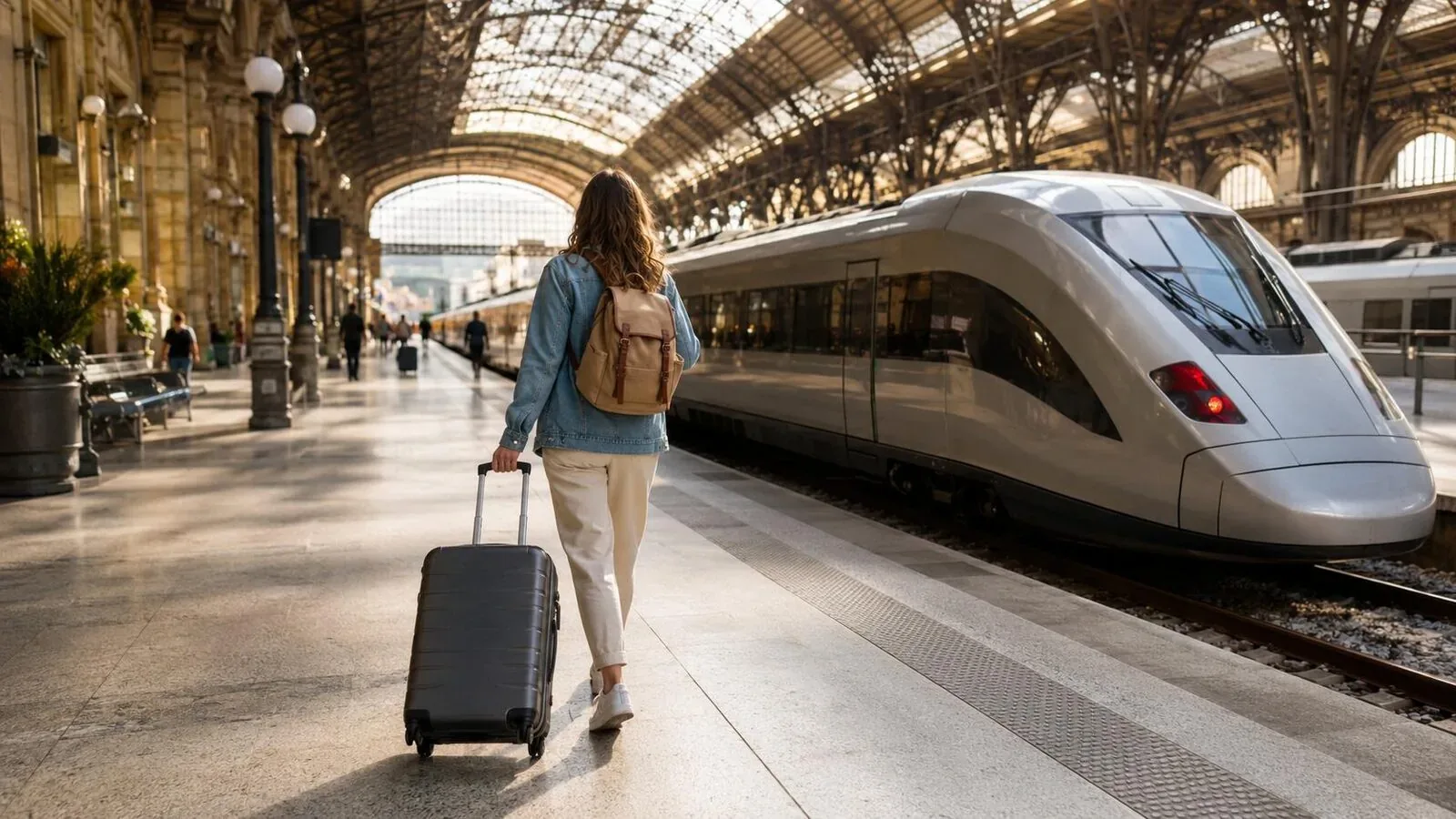
How to Choose Hotel Locations
You do not need a neighbourhood degree for nine cities. You need one repeatable method, applied to each base. The Wanderess principle is simple: location first, hotel second. A merely fine room in the right place beats a beautiful room that adds an hour of commuting to every single day.
For each base, weigh the same handful of things: the station or airport you arrive at and the one you leave from; how many nights you are staying; where your main sights cluster; the evening atmosphere and noise; how easy it is to move luggage to and from the door; the daily transport you’ll actually use; and whether an early departure argues for being nearer the station on the last night. Add those up and you have your answer — without ever claiming a whole district is uniformly “safe” or “unsafe,” which is rarely true and never that simple.
One concise example per route. In Paris, a central, well-connected arrondissement near a Métro hub saves more time than any single “best” street, because the flat metro fare makes distance matter less than connections. In Venice, staying inside the historic centre — rather than on the mainland at Mestre — means you walk home over bridges instead of catching a late train, so pack light and value proximity over square metres. In Prague, a base within walking distance of the Old Town and a tram line gives you atmospheric evenings without paying the very top of the square’s prices. The method is the same everywhere; only the specifics change.
The cheapest hotel that adds an hour of commuting each day is not, on reflection, the cheapest hotel.
Not sure a hotel location will make your first trip easier — or quietly add an hour of commuting every day?
The wrong area can cost you time on every single day of the trip. Check the location before you book, not after.
Use the free Hotel Location Check
What a First Europe Trip Costs
These are The Wanderess Travels planning estimates for two people sharing, in euros, with international flights excluded. They assume shoulder-season travel, booking reasonably ahead, central-but-not-luxury hotels, and they include intercity trains, local transport, headline attractions, airport transfers and practical costs (an eSIM, laundry, incidentals). Figures were checked on 27 July 2026 and are given as ranges, because hotel and rail pricing move constantly — treat them as planning brackets, not quotes. Where a route uses a non-euro currency, we convert to euros for comparison; your actual rate on the day will differ slightly.
| Category (couple, whole trip) | London–Paris–Amsterdam | Rome–Florence–Venice | Prague–Vienna–Budapest |
|---|---|---|---|
| Accommodation | €1,750–2,400 | €1,350–2,000 | €950–1,600 |
| Food & drink | €1,000–1,500 | €800–1,300 | €600–1,050 |
| Local transport | €120–200 | €100–180 | €60–120 |
| Intercity trains | €220–400 | €80–170 | €55–110 |
| Attractions | €200–350 | €250–400 | €150–280 |
| Airport transfers | €40–90 | €40–90 | €30–70 |
| Practical (eSIM, laundry, incidentals) | €80–160 | €80–160 | €70–150 |
| Total (approx.) | €3,400–5,100 | €2,700–4,300 | €1,900–3,400 |
The totals are rounded from the component ranges, so treat them as planning estimates rather than exact quotes. Broadly, London–Paris–Amsterdam carries the highest cost pressure — London and Amsterdam hotels and food do most of the lifting, and the Eurostar legs are the priciest rail on any route. Rome–Florence–Venice sits in the middle, with Venice (rooms and the vaporetto) as the clear pressure point and cheap Italian high-speed rail pulling the total down. Prague–Vienna–Budapest is the best value across almost every line — and stays the cheapest even though it runs one night longer than the others.
Every one of these numbers moves with your choices. Dates matter, event calendars matter (a trade fair or festival can blow past the top of the accommodation range), hotel location matters, booking lead time matters, and exchange rates matter for the non-euro cities. Use the ranges to sanity-check a plan, not to hold anyone to the cent.

A First Europe Trip for Couples
For couples, the “best” route depends less on romance-brochure clichés and more on the kind of time you like to spend together. All three work well; they simply suit different pairs.
If you want iconic, landmark-heavy days and don’t mind spending more for them, London–Paris–Amsterdam delivers the postcard trip. If you’d rather have atmospheric evenings, art and food with the least logistical friction, Rome–Florence–Venice keeps the admin low so your attention stays on each other. If you want better value and beautiful, walkable capitals for slow shared mornings in cafés, Prague–Vienna–Budapest stretches the budget furthest. For couples with different energy levels, the flexible day built into each route is the pressure valve: one of you can go hard on a museum while the other takes the café.
A note on money, because it is often oversold: couples do not generally save on public transport, rail tickets or meals — two people still buy two train seats and two dinners. What genuinely lowers cost per person is sharing one room, and occasionally splitting a taxi or a private airport transfer. Plan around those real savings rather than imagined ones.
Landmark-focused couple
CLASSIC FIRST TRIP
London, Paris & Amsterdam
Advantage: the most recognisable, iconic days of the three, with direct trains between them. Main compromise: the highest budget, and two entry systems to prepare for.
Art, food & easy logistics
LOWEST FRICTION
Rome, Florence & Venice
Advantage: one country and one currency keep the admin low, so attention stays on the trip. Main compromise: timed-entry sights to book, and Venice nudges the budget up.
Better value & slow mornings
BEST VALUE
Prague, Vienna & Budapest
Advantage: atmospheric capitals that stretch a shared budget furthest. Main compromise: three currencies and a few new local systems to learn.
A First Europe Trip on a Budget
If value is the priority, Prague–Vienna–Budapest is the strongest starting point of the three — subject, as always, to your dates and how far ahead you book. It is not that these cities are permanently “cheap”; it is that they offer better value across hotels, food, local transport and rail than the Western Europe route, on the same three-base shape.
The levers that actually move a budget, in rough order of impact: keep hotel changes low (all three routes already do, at two); book advance rail fares once your dates are firm; and choose a well-located hotel over a falsely cheap one, because a bargain that adds a daily commute is not a bargain. Watch event dates that spike prices, lean on the free and low-cost sights (historic centres, riverside walks and viewpoints cost nothing) alongside the paid headliners, and use local transport passes rather than taxis. On the multi-currency route, pay in the local currency rather than accepting the “pay in your home currency” prompt, which usually carries a poor rate. A sensible food strategy — casual lunches, one proper dinner a day — keeps the biggest flexible cost in check. None of this requires treating discomfort as authenticity; comfortable and good-value are not opposites.

Luggage and Station Confidence
This is the section most first-timers wish they had read first. Stations and trains are where nerves show up, and almost all of it is solved by packing and preparation rather than courage.
Start with the bag. High-speed trains provide overhead shelves and larger luggage racks, but operator rules and available space differ, so bring luggage you can lift and move yourself rather than treating the train like checked airline baggage. A case you can carry up a flight of stairs — because there will be stairs, and not every platform has a working lift — changes the whole trip. On the Italy route this matters most in Venice, where the charm comes precisely from the absence of cars, which also means your wheels will meet a great many bridges and steps.
At the station, the departure board is information, not an interrogation. Find your train by its final destination and departure time; platform (or “binario” / “Gleis” / “nástupiště”) numbers can appear only a little before departure, and a last-minute platform change is an inconvenience, not a character assessment. For the reserved high-speed routes, board the coach that matches your ticket; on the turn-up intercity trains through Central Europe, any unreserved seat in your class is fair game unless a seat is marked as reserved.
A few habits carry across all three routes: save your tickets offline and keep a screenshot as backup; save each hotel’s address (and a nearby landmark) offline too; carry a second payment method in case one card is declined; keep your phone charged with a small power bank; and stay quietly aware of your bag in crowded stations without tipping into fear — pickpockets rely on distraction, not on stealth. On London–Paris–Amsterdam, arrive at St Pancras in good time for the border checks. On Prague–Vienna–Budapest, the route uses Czech koruna, euros and Hungarian forints. Cards are widely accepted, but keep a small amount of local cash where useful and always decline dynamic currency conversion. And everywhere, note that hotel check-in is usually mid-afternoon — most will store your bag if you arrive early, so an early train needn’t strand you and your suitcase.
What to Book First and What Can Stay Flexible
Booking in the right order removes most first-trip stress. The sequence that works:
Booking order
- First: confirm your route and your open-jaw airports (arrive in the first city, depart from the last).
- Second: book the international flights, ideally on a multi-city search.
- Third: book all your hotels — there are three per route, and once the route is set they should normally all be booked; use flexible rates where the price is reasonable.
- Fourth: book the high-demand timed attractions (for example the Colosseum, the Vatican, the Uffizi, the Van Gogh Museum, Schönbrunn).
- Fifth: book the intercity trains once your dates are firm, to catch lower advance fares.
- Then: confirm airport transfers.
- Leave flexible: low-stakes sightseeing, cafés and restaurants — the parts of a trip that are nicer decided on the day.
On timed sights, book as soon as your date is released rather than guessing a universal window. For the Colosseum, for instance, tickets typically release around 30 days before: book as soon as your preferred date and time appear, because popular slots can disappear quickly after release. Other attractions run their own schedules, so check each official site rather than assuming they all work the same way.
Book the famous things. Leave the long lunches to chance.
Entry Requirements
Entry rules depend on your nationality, your passport, your residence status and the specifics of your trip, so treat what follows as orientation rather than personalised advice — and always confirm official requirements before you book. Two of these routes sit entirely within the Schengen area; the London route adds a separate UK system.
For relevant short-stay travellers from outside the EU, Schengen rules generally require a passport issued within the previous 10 years that remains valid for at least three months beyond your intended departure from the Schengen area. Where the visa-free allowance applies, short stays are limited to 90 days within any rolling 180-day period across the Schengen countries combined. Italy (Rome–Florence–Venice) and both the France and Netherlands portions of the Western route are in Schengen; on the Central route, Czechia, Austria and Hungary are all Schengen members too. There are normally no routine immigration checks when travelling between them, although temporary controls can occur.
The Entry/Exit System (EES) became fully operational at participating external border crossings on 10 April 2026. It generally applies to non-EU nationals entering for a short stay who either hold a short-stay visa or are visa-exempt, registering your entry and exit at the Schengen border.
ETIAS is not currently operational. No applications are being accepted and no action is required now; the specific start date will be announced officially, so recheck before you travel rather than acting on any third-party “apply now” prompts.
The United Kingdom (the London leg) is outside the Schengen area and has its own entry requirements. Depending on your nationality you may need a visa or an Electronic Travel Authorisation (ETA); the ETA currently costs £20, generally allows stays of up to six months and is valid for two years or until your passport expires. Because the UK is not in Schengen, days you spend there do not count toward your Schengen 90/180 allowance — the two are tracked separately.
Travel insurance is strongly recommended. It may also be a formal requirement for travellers applying for a Schengen visa, depending on their circumstances; it is not universally required for visa-exempt visitors. Checked 27 July 2026. Reconfirm through official EU, UK and destination authorities before travel.

Best Time for a First Europe Trip
There is no single best month, but there is a reliable pattern: the shoulder seasons usually offer the best balance of weather, crowds and price, with the specifics shifting by route.
Spring (roughly April–May) and early autumn (September–October) tend to be the sweet spots almost everywhere — comfortable temperatures, lighter crowds than midsummer, and hotel prices below their peak. Early summer brings long daylight and lively cities but rising prices and queues. Peak summer (July–August) means the biggest crowds and the most heat, which matters most in Rome and Venice, where midday can be genuinely draining and attraction queues are longest. Winter is quietest and cheapest, with two route-specific upsides: Central Europe’s Christmas markets in Prague, Vienna and Budapest are a highlight in December, while London wears winter well if you don’t mind rain and short days. Venice in the cooler months is atmospheric but can see high water, so check conditions. Whichever route you choose, confirm that the specific sights you care about keep their normal opening schedule in your month, as some run reduced winter hours.
Common First-Trip Mistakes
Most first-trip regrets come from a small, predictable set of missteps. Knowing them is most of the cure:
- Choosing countries before counting transfer days — the map looks generous until the travel days are subtracted.
- Adding a fourth base because the train “only” takes two hours; with luggage and check-in, that is still half a day gone.
- Booking a return flight from the first city without pricing the open-jaw alternative.
- Choosing a cheap but poorly located hotel, then paying for it in daily commuting time.
- Putting a headline attraction on an arrival or transfer afternoon, when you’re tired and the day is already half spent.
- Carrying luggage you cannot lift up a flight of stairs.
- Not pre-booking the high-demand sights, then finding them sold out.
- Relying on a single payment method with no backup.
- Assuming every train ticket works the same way — reserved high-speed and turn-up intercity have different rules.
- Ignoring airport-transfer time when planning the first and last days.
- Treating any one route as universally “best” instead of the one that fits you.
Which Route Should You Choose?
Here is the honest short version. If you want the classic, landmark-heavy first trip and have the budget for it, take London–Paris–Amsterdam. If you want the simplest possible logistics — one country, one currency, no internal borders — take Rome–Florence–Venice. If you want the best value and are happy to handle a few currencies and new systems, take Prague–Vienna–Budapest. Match the route to your budget, your comfort with borders and the kind of days you enjoy, and you will not choose wrongly.
Once you know how long you can travel, the rest of the Wanderess cluster maps the detail:
Keep planning your trip
- Only have a week? See the realistic 7-day Europe itinerary.
- Around two weeks? See the realistic 2-week Europe itinerary.
- More time to spare? Compare the 3-week Europe itinerary and the one-month Europe itinerary.
- Unsure whether a hotel is well placed? Run the free Hotel Location Check.
- Want a route built around you? Ask about custom itinerary planning.
Frequently Asked Questions
What is the best first-time Europe itinerary?
There isn’t one universal best. London–Paris–Amsterdam is the classic landmark trip, Rome–Florence–Venice has the simplest logistics, and Prague–Vienna–Budapest offers the best value. Choose by budget, comfort with borders and the kind of days you enjoy.
How many days do I need?
Around eleven or twelve days suits these three-base routes comfortably. Seven days is better spent on one or two bases; two weeks lets you either add one careful fourth base or slow the same three down.
How many countries should a first-time traveller visit?
One country is an excellent default for an 11-day first trip. Two or three can also work when the cities are close, transport is direct and the schedule still allows at least three nights in most bases.
Is Italy easy by train?
Yes. Rome to Florence is about 1h25–1h40 and Florence to Venice about 2 hours, both on direct high-speed trains (Trenitalia and Italo). Your reserved seat is your ticket, with no separate validation step.
Do I need a rail pass?
Probably not for these routes, unless the exact pass price and reservation conditions beat individual tickets for your dates. Compare before buying.
What should two people budget?
For 10–11 nights excluding international flights: roughly €1,900–3,400 for Central Europe, €2,700–4,300 for Italy, or €3,400–5,100 for Western Europe, depending heavily on dates and booking lead time.
Can I take a large suitcase?
You can, but you’ll be happier with luggage you can lift yourself. Trains have racks and overhead shelves rather than checked baggage, and stations and cities like Venice involve stairs and bridges.
What should I book first?
Route and open-jaw airports, then flights, then all three hotels, then high-demand timed attractions, then intercity trains once your dates are firm, then airport transfers. Leave casual sightseeing and restaurants flexible.
Do I need cash?
Cards are widely accepted in all nine cities, but carry a little local cash for small vendors, markets and tips — and remember the Central Europe route uses three different currencies. Pay in the local currency rather than accepting a home-currency conversion.
Do I need a visa or ETIAS?
It depends on your nationality. ETIAS is not currently operational and no applications are being accepted, so no action is required now — recheck before travel. Schengen short-stay and, for the London route, UK entry rules still apply. Confirm official requirements before booking.
Is travel insurance required?
It is strongly recommended and may be a formal requirement for travellers applying for a Schengen visa, depending on circumstances. It is not universally required for visa-exempt visitors, but it remains a sensible purchase.
What changes with seven days?
Choose one or two bases rather than compressing one of these three-route itineraries. See the 7-day guide for a realistic sequence.
What changes with two weeks?
Either add one carefully chosen fourth base or keep the same three and slow the trip down. The 2-week guide covers both approaches.
Sources and References
- Eurostar. London to Paris train. Checked 27 July 2026. eurostar.com
- Eurostar. When to arrive at the station. Checked 27 July 2026. eurostar.com
- Eurostar / NS International. Travel to Belgium and France with Eurostar. Checked 27 July 2026. nsinternational.com
- Heathrow Airport. Getting to Central London. Checked 27 July 2026. heathrow.com
- Transport for London. Pay as you go caps. Checked 27 July 2026. tfl.gov.uk
- Île-de-France Mobilités. Simplification of transport fares in Île-de-France. Checked 27 July 2026. iledefrance-mobilites.fr
- Île-de-France Mobilités. Tickets and fares (Navigo Easy). Checked 27 July 2026. iledefrance-mobilites.fr
- GVB. OVpay: check in and out with your debit card. Checked 27 July 2026. gvb.nl
- Musée du Louvre. Hours & admission. Checked 27 July 2026. louvre.fr
- Van Gogh Museum. Tickets and ticket prices. Checked 27 July 2026. vangoghmuseum.nl
- Italo (Italotreno). Train from Rome to Florence. Checked 27 July 2026. italotreno.com
- Italo (Italotreno). Train from Florence to Venice. Checked 27 July 2026. italotreno.com
- Venice Marco Polo Airport. From the Airport to Venice. Checked 27 July 2026. veneziaairport.it
- Parco archeologico del Colosseo. Official ticketing portal. Checked 27 July 2026. ticketing.colosseo.it
- Vatican Museums. Official Ticket Office. Checked 27 July 2026. museivaticani.va
- Uffizi Galleries. Tickets. Checked 27 July 2026. uffizi.it
- Basilica di San Marco. Official visitor and ticketing information. Checked 27 July 2026. basilicasanmarco.it
- Doge’s Palace (Palazzo Ducale). Visitor information. Checked 27 July 2026. palazzoducale.visitmuve.it
- ÖBB. Travelling to Prague by train. Checked 27 July 2026. oebb.at
- ÖBB. Travelling to Budapest by train. Checked 27 July 2026. oebb.at
- Václav Havel Airport Prague. Public transport buses. Checked 27 July 2026. prg.aero
- Dopravní podnik hl. m. Prahy (DPP). Cashless payment of fare. Checked 27 July 2026. dpp.cz
- Wiener Linien. Tickets. Checked 27 July 2026. wienerlinien.at
- Schönbrunn Palace. Tickets & prices. Checked 27 July 2026. schoenbrunn.at
- BKK (Centre for Budapest Transport). Airport Express (100E). Checked 27 July 2026. bkk.hu
- GOV.UK. Get an electronic travel authorisation (ETA) to visit the UK. Checked 27 July 2026. gov.uk
- European Commission. Entry/Exit System (EES). Checked 27 July 2026. travel-europe.europa.eu
- European Commission. ETIAS — official travel authorisation portal. Checked 27 July 2026. travel-europe.europa.eu
- European Commission. Schengen area and short-stay rules. Checked 27 July 2026. home-affairs.ec.europa.eu
Planning your first Europe trip and unsure which route genuinely fits your flights, budget and pace?
Get a route built around your dates, your budget and how you actually like to travel — not a generic template.