Best Day Trips From Rome: Pompeii, Ostia Antica and Beyond
So you've done the Colosseum and the cacio e pepe, and now you're wondering where else Rome can take you in a day. The best day trips from Rome fall into two camps: places with a fast,…

You have done the Colosseum and the cacio e pepe, and the question now is where else Rome can take you before dinner. Four places genuinely work: Pompeii, Ostia Antica, Tivoli and Orvieto. They are not variations on one another — they are four different days, and the one that suits you depends far more on how much travelling you are willing to do than on which ruins photograph best.
Quick Answer
Ostia Antica is the easiest: a local train, Roman ruins, no timed ticket. Orvieto is the easiest town: about an hour and a quarter by train, then a funicular. Tivoli is the gardens day, simple if you visit one villa and fiddlier if you want both. Pompeii is the big one and the long one — high-speed train to Naples, then a local line — and it is worth it if the archaeology is the point of your day rather than an item on it.
Key Takeaways
- Pompeii tickets run €20 to €30 depending on category, and since 15 November 2025 the park caps entry at 20,000 a day on named tickets — so a summer visit is booked, not decided on the morning.
- Ostia Antica costs €18 on the integrated ticket, valid eight days, with no cap and no time slot. It is the lowest-effort Roman archaeology within reach of the city.
- Villa d'Este opens on seasonal hours and is closed on Monday mornings, so the day of the week matters more here than anywhere else on this list.
- Orvieto is roughly an hour and a quarter by train plus a €1.30 funicular, and the appeal is that the day itself is slower than Rome.
- Choose by travel effort first. Every one of these is a good day; only some of them are a good day for you.
NOT SURE WHICH DAY TRIP FITS YOU?
Pompeii, Tivoli, Orvieto and Ostia are four very different days. Answer five quick questions and I will narrow it down.
In This Article
- The four days, side by side
- What makes a good day trip from Rome
- Ostia Antica: the easiest ruins
- Orvieto: the easiest town
- Tivoli: gardens and villas
- Pompeii: the long day, and the good one
- Train, coach or driving to Pompeii
- Which day suits which trip
- Sample costs
- Before You Book
- Common mistakes
- Frequently Asked Questions: Best Day Trips From Rome
The four days, side by side
| Destination | Travel effort | Best for | Ideal time | Main downside |
|---|---|---|---|---|
| Ostia Antica | Very low | Families, ruins, an easy day | Half or full day | Less dramatic than Pompeii |
| Orvieto | Low | Atmosphere, couples, a slower pace | Full day | Fewer headline sights |
| Tivoli | Medium | Gardens, villas, architecture | Full day | Moving between the two main villas |
| Pompeii | High | Bucket-list archaeology | Long full day | The Rome–Naples–Pompeii chain |
Which Rome day trip is right for you?
Pompeii, Tivoli, Orvieto and Ostia Antica are four genuinely different days. Five questions, and nothing here is a live timetable — it is the same judgement as the table above, applied to your answers.
Answer the questions and the options sort themselves.
Editorial judgement, not live data. The comparison table above carries the same reasoning, so with JavaScript off you lose the shortcut and none of the information.
What makes a good day trip from Rome
Three things: a connection you can rely on, enough opening hours to make the journey worth it, and a ticket you can hold before you travel. These four all clear that bar, and each publishes its own timetable and ticket rules.
Sorrento, Capri and the Amalfi Coast do not, from Rome. Add a ferry or a long coastal bus and the day stops being a day. A day trip should feel like a bonus day, not a second job.
Ostia Antica: the easiest ruins
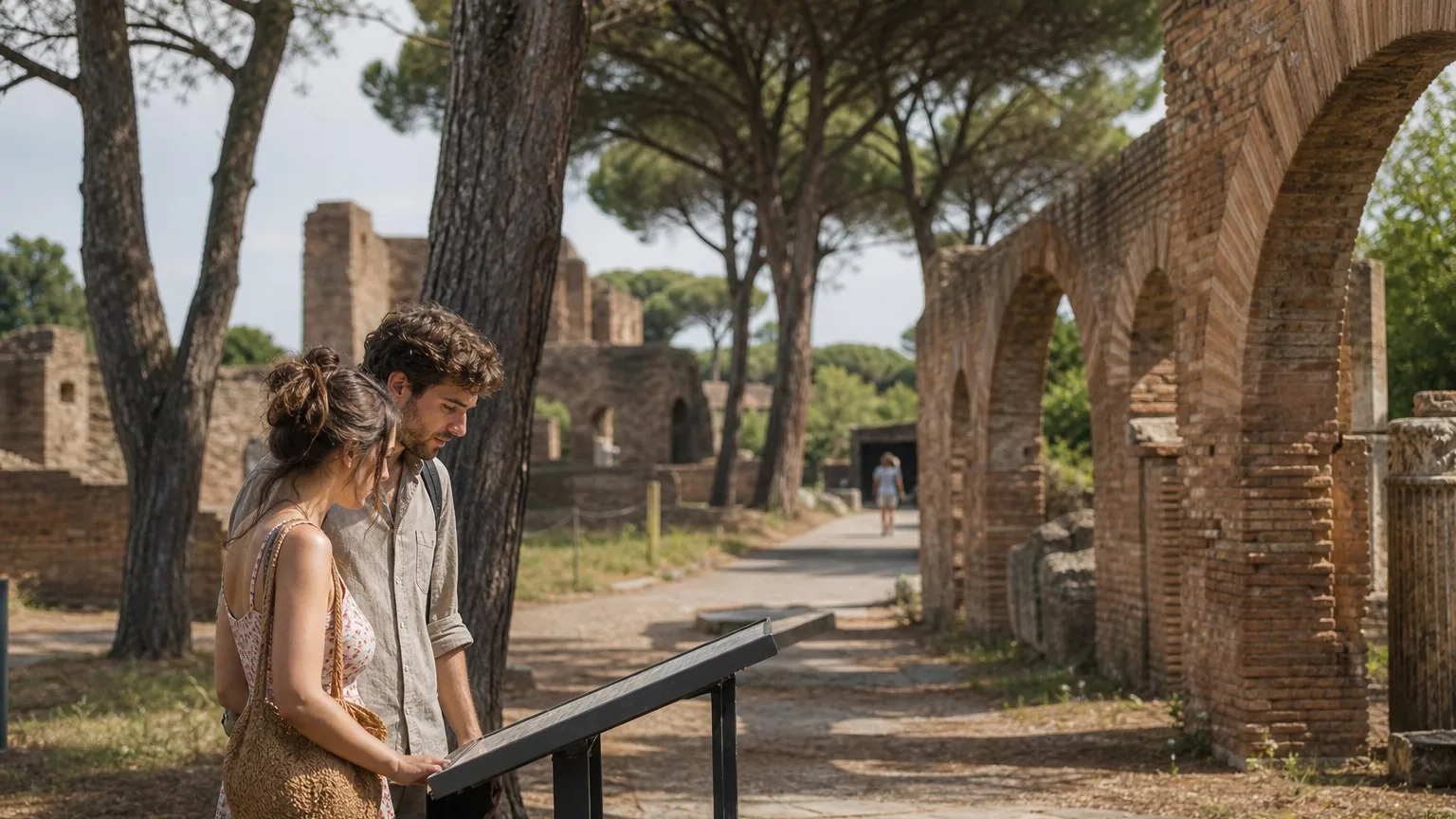
Rome's port city is a short local train from the centre, and it is the only option here with no cap, no named ticket and no time slot. Entry is €18 on the integrated ticket — valid eight days — or €2 reduced, with audioguides at €7 for the long route and €5 for the short one. The site is at Viale dei Romagnoli 717. Allow two to four hours.
What the price list does not tell you is why it works so well with children. Ostia is not a procession past headline monuments with a queue behind you. It is a street plan you walk into — houses, a theatre, baths, a bar counter — and the pleasure is wandering rather than ticking. Families routinely stay longer than they meant to, which almost never happens at a site with a timed entry.
It also takes part in Italy's free-first-Sunday scheme, so check the calendar before assuming a walk-in costs nothing.
Pick Ostia when you want Roman archaeology without a logistics chain attached to it.
Orvieto: the easiest town
Orvieto is the one to choose when you want the day itself to feel different, not simply to swap one major attraction for another. Fast services from Roma Termini run about 1 hour 15 minutes on sampled current timetables, with regionale trains nearer 1 hour 20 to 1 hour 40; check your own date, because sampled times and live timetables are not the same thing. From Orvieto Scalo a funicular climbs to the historic centre for about €1.30.
Door to door from central Rome to the Duomo is roughly an hour and three quarters, which is an easier morning than Pompeii despite Pompeii's faster train.
The Duomo is the visual payoff and the rest of the day is the point: a hill town at its own pace, with noticeably fewer people than anywhere in Rome. Do not overfill it. Orvieto rewards an afternoon spent not rushing.
Tivoli: gardens and villas
Tivoli sits about 30 km east of Rome — roughly 40 to 75 minutes by car depending on traffic, or 45 to 75 minutes by scheduled bus from Ponte Mammolo. One villa needs an hour and a half to two hours; both together need two to three.
Villa d'Este runs on seasonal opening hours, with substantially later closing in spring and summer, and it is normally closed on Monday mornings. Entry begins at 08:30 year-round, but the last exit swings from around 17:00 in midwinter to nearly 19:45 at the height of summer. Check the official Villae timetable for your exact date, and check the day of the week before you check anything else.
The friction on a Tivoli day is not getting to Tivoli. It is that Villa d'Este and Villa Adriana are not next door to each other — the gardens sit in the town, the emperor's villa sits below it — so doing both independently means solving a second local-transport problem after you have already solved the first. Visitors consistently find that step harder than the journey out. Villa d'Este alone is a straightforward independent morning.
My advice: if this is your first time and you are going independently, do Villa d'Este and stop there. Adding Villa Adriana does not just add a site, it adds a transport decision in the middle of your day — and the gardens are the thing you came for.
Pompeii: the long day, and the good one
Pompeii is doable from Rome. It is not relaxed, and the difference matters when you are planning.
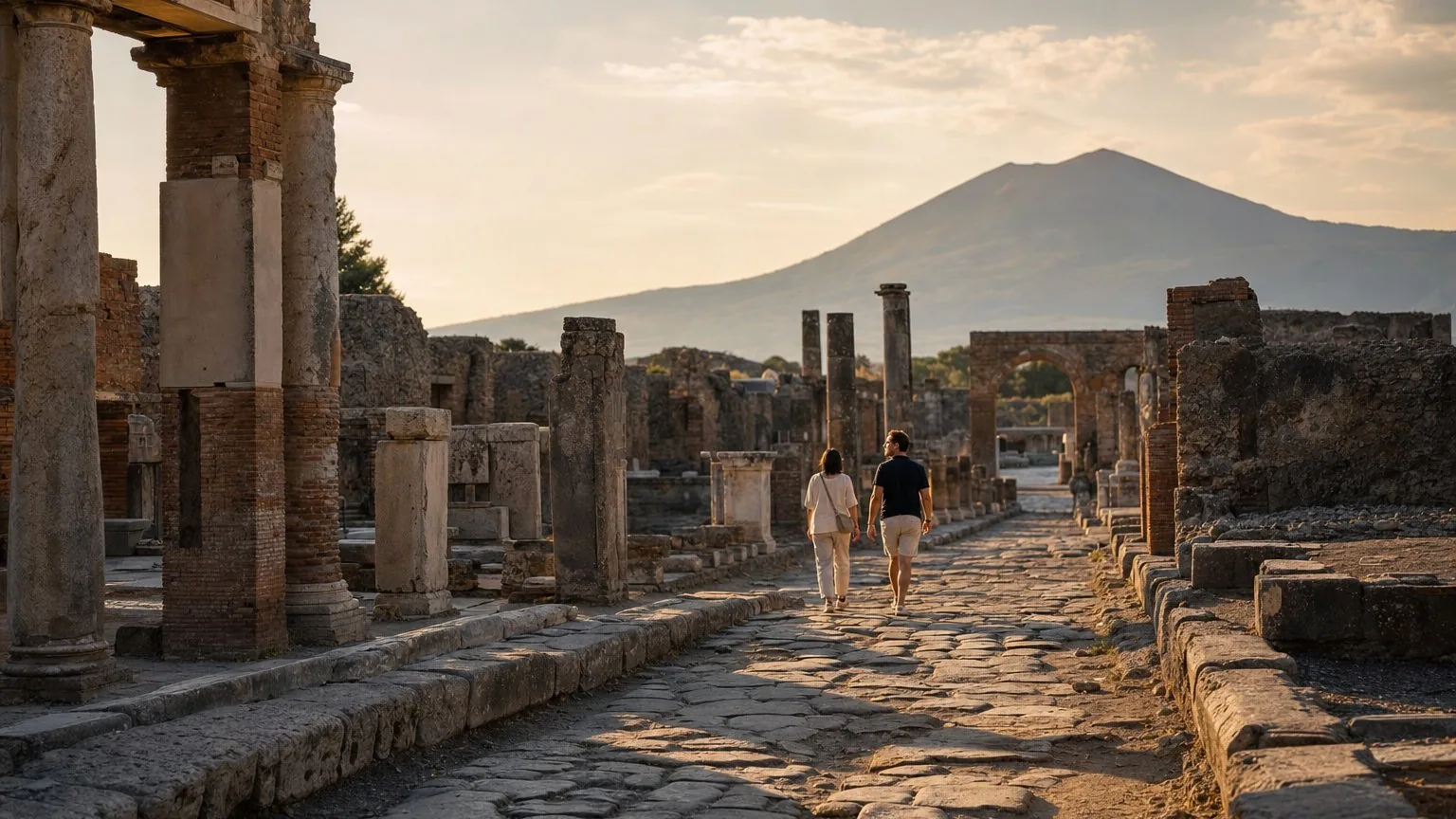
Frecciarossa links Rome and Naples in just over an hour with more than a hundred daily departures. From Naples Centrale, the final stretch runs on EAV's Circumvesuviana line — not the national network — at about 35 to 40 minutes to Pompei Scavi. The fare is low, around €3 one way, but treat that as approximate and buy at the station rather than planning around a published figure.
That second leg is where the day is decided. The high-speed train is the easy part and behaves like a high-speed train. The local line is older, busier and less forgiving of a schedule built to the minute; travellers who enjoy this trip are almost always the ones who left slack in Naples, and the ones who did not are usually describing a connection rather than a ruin.
My advice: build your buffer into Naples. The Frecciarossa leg is easy; the local connection is where a perfectly timed spreadsheet stops behaving perfectly. Half an hour of slack there costs you nothing and saves the whole day.
Tickets and rules, 2026
Single entry to the ancient city is €20; Pompeii plus the suburban villas €25; a three-day multi-site pass €30; €2 reduced for eligible EU citizens aged 18 to 25; and a MyPompeii annual card at €45, or €10 under 25. Since 15 November 2025 the park caps entry at 20,000 visitors a day on named tickets, so book a morning slot ahead between April and October — a sold-out slot cannot be negotiated at the gate.
Gates are Porta Marina, Piazza Anfiteatro and Piazza Esedra, and most ticket types do not allow re-entry. Plan your route before you walk in.
A realistic plan
- Book an early Frecciarossa to Naples in advance.
- Buy your Pompeii category and slot online, especially April to October.
- Take the Circumvesuviana to Pompei Scavi, allowing 35 to 40 minutes plus a buffer.
- Give yourself three to four hours inside, more with the suburban villas.
Train, coach or driving to Pompeii
Train wins on speed and control: just over an hour to Naples, then 35 to 40 minutes on the local line. You choose your own pace on site.
Coach tours trade that control for having nothing to plan. Full-day Rome–Pompeii coach trips typically run somewhere between eight and twelve hours door to door, and prices move around enough by season and operator that any figure quoted here would be out of date before you read it — compare inclusions on the operator's own page rather than the headline number.
Driving covers around 240 km each way, usually two to three hours. For most visitors staying in central Rome, driving adds more complexity than it removes once you count city traffic, tolls and parking at the other end.
Which day suits which trip
- An easy scenic day: Orvieto.
- Gardens and architecture: Tivoli.
- Archaeology without the Pompeii logistics: Ostia Antica.
- When Pompeii itself is the priority: Pompeii.
- Lowest effort of all: Ostia Antica.
- Happy with a long day: Pompeii.
None of these is a ranking. Ostia appears twice because low effort is genuinely its strength, not because it is the best of the four.
Sample costs
Per person, excluding food, as a planning sketch rather than a quote:
- Ostia Antica: local train each way plus €18 entry. The cheapest full day here by a clear margin.
- Orvieto: train fare each way plus €1.30 funicular each way, plus whatever you pay to go inside the Duomo.
- Tivoli: bus or car, plus entry to whichever villa or villas you choose.
- Pompeii: Frecciarossa each way — much cheaper booked early — plus about €3 each way locally, plus €20 to €30 entry.
Before You Book
- Check the day of the week against Villa d'Este's Monday-morning closure before booking anything for Tivoli.
- Book Pompeii's named ticket and slot ahead for any visit between April and October.
- Book Frecciarossa early; the walk-up fare is a different product from the advance one.
- Decide, for Tivoli, whether you are doing one villa or two — before you leave, not at the gate.
- Leave slack in Naples if Pompeii is the plan.
- Check the free-first-Sunday calendar if your date is near the start of a month.
Common mistakes
- Treating Pompeii's train time as the day's length. The Frecciarossa leg is an hour. The day is ten.
- Arriving in Tivoli on a Monday morning. Villa d'Este will be shut.
- Booking a Pompeii slot too tight against the connection. Named tickets do not flex.
- Doing two Tivoli villas because they are on the same ticket idea. They are not on the same street.
- Choosing Orvieto and then filling it like Rome. The point of Orvieto is the pace.
Not sure your Rome hotel is near the right station?
Every one of these days starts at Termini, Tiburtina, Ostiense or Piramide. A hotel that looks central can still cost you twenty minutes at each end of a day trip. Score its location in two minutes, free.
Frequently Asked Questions: Best Day Trips From Rome
Is Pompeii worth doing as a day trip from Rome?
Yes, if the archaeology is the day's purpose rather than one of its items. It is a ten-hour commitment from a Rome base and the site rewards it. If you want Roman ruins without that commitment, Ostia Antica gives you a genuine ancient city an hour from your hotel.
Which day trip from Rome is easiest?
Ostia Antica, comfortably. A short local train, no cap, no named ticket, no time slot, and you can turn back whenever you like. It is the only one on this list that works as a half day.
Pompeii or Ostia Antica?
Pompeii is the more extraordinary site and the harder day. Ostia is the easier day and, for many people, the more enjoyable visit — it is quieter, you set your own pace, and children can roam. Choose Pompeii if you would be disappointed not to have seen it; choose Ostia if you mainly want to walk around a Roman town.
Tivoli or Orvieto?
Different appetites. Tivoli is gardens, water and villa architecture, with a little local logistics attached. Orvieto is a hill town, a cathedral and a slower afternoon, with an easier journey. If you want to look at things, Tivoli. If you want a change of pace, Orvieto.
Can you visit both Villa d'Este and Villa Adriana in one day?
Yes, but it is the part of a Tivoli day people underestimate. The two are not adjacent, so doing both independently means arranging local transport between them on top of getting to Tivoli. Budget two to three hours for the pair and decide before you set off. One villa needs an hour and a half to two.
What is the best day trip from Rome with children?
Ostia Antica. It is close, it is cheap, and it is exploratory rather than a timed procession — children can walk into houses and along streets instead of filing past monuments. Families regularly stay longer than planned, which is the useful signal.
Which Rome day trips work without a car?
All four. Ostia and Orvieto are trains; Pompeii is a train plus a local line; Tivoli is a scheduled bus from Ponte Mammolo, though moving between the two villas is the step that most wants a plan.
Which day trip needs the most advance booking?
Pompeii, by a distance. Named tickets and a 20,000-a-day cap mean peak-season slots genuinely sell out, and the Frecciarossa fare rises steeply close to departure. Ostia Antica needs essentially none.

Further Reading
- Italy 7 day itinerary: Rome, Florence, Venice — if Rome is one stop on a longer route.
- Europe by train itineraries — how these rail days fit a bigger trip.
- Best gelato in Rome — for the evening you come back to.
Sources and References
- Parco Archeologico di Pompei — official tickets and visitor rules, 2026. pompeiisites.org
- Parco Archeologico di Ostia Antica — integrated ticket and tariffs. ostiaantica.cultura.gov.it
- Villa Adriana e Villa d'Este (VILLÆ) — Orari e Biglietti, official seasonal timetable, 2026. villae.cultura.gov.it
- Trenitalia — Rome–Naples Frecciarossa services and Rome–Orvieto timetables. trenitalia.com
- EAV — Circumvesuviana Naples–Pompei Scavi line and timetables. eavsrl.it
- Destinazione Orvieto — funicular fares and operation. orvietoviva.com
Part of Destinations & Itineraries.