Safari Packing List: What to Pack for an African Safari
What actually goes in the bag, and what has to be arranged before you fly: the baggage limit that really governs your trip, the documents with long lead times, and a checklist that builds itself around your itinerary.
A safari packing list should start with your itinerary, not a shopping cart. Two people going to the same country in the same month can need genuinely different bags, because one is driving between lodges with a boot to fill and the other is getting into a twelve-seat aircraft where the allowance is fifteen kilograms and the hold is a narrow pod behind the seats.
So this is a list about logistics rather than style: what your bag has to be, what has to be arranged weeks before you fly, what you will actually want in the vehicle at six in the morning, and what is not worth carrying. Clothing is a small part of it, and it has its own guide.
Quick Answer
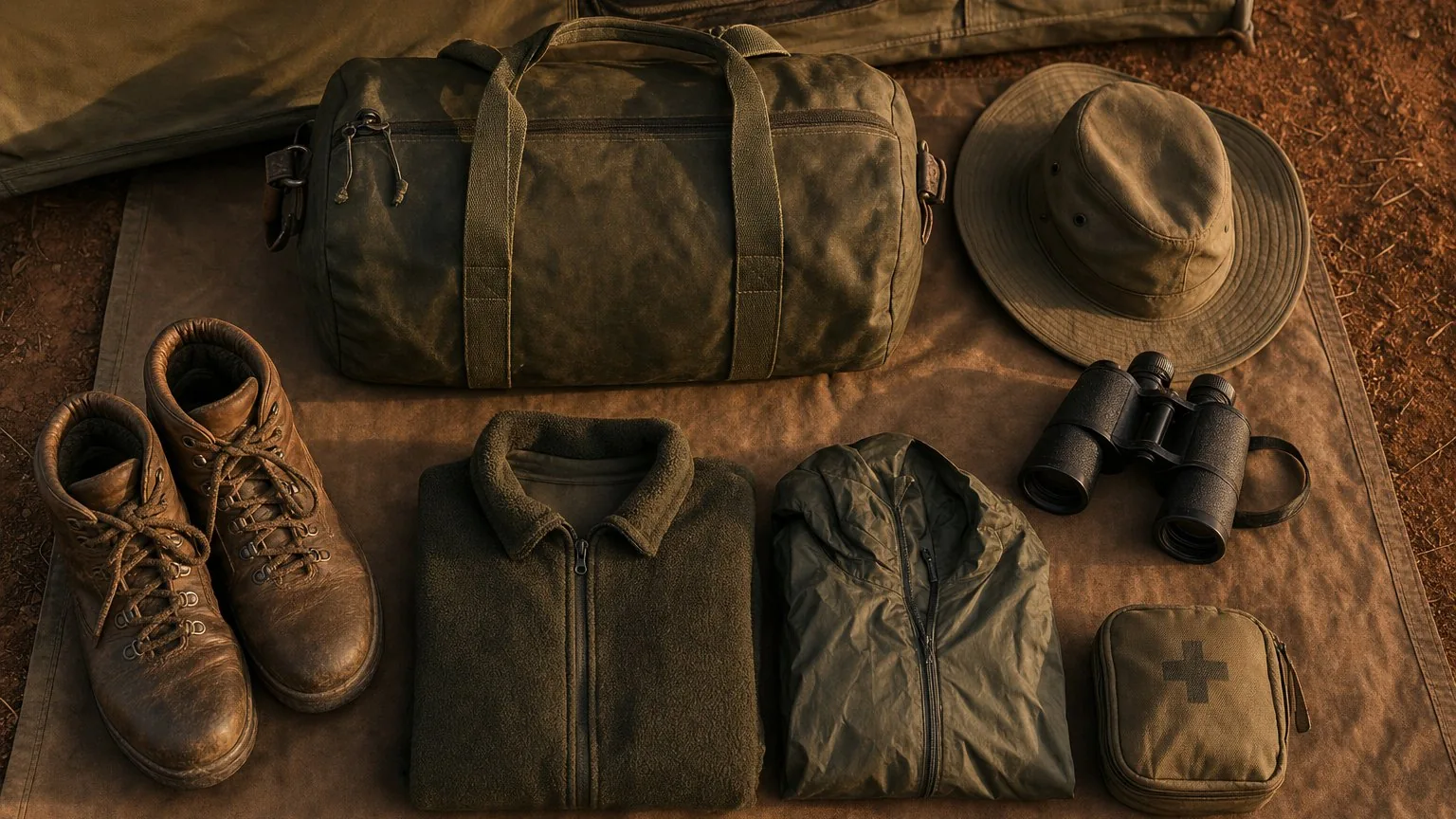
Pack to the smallest baggage allowance on your itinerary, which on East African bush flights is usually 15kg including hand luggage. Get the bag right first: soft-sided if your carrier requires it, and one you can carry yourself. Arrange the things that are not objects at all — visa or travel authorisation, insurance, a travel-health appointment — weeks ahead. Then binoculars, a day bag, chargers and a small first-aid kit, and a short list of clothes rather than a wardrobe.
PACKING FOR SAFARI?
Build a checklist around your actual trip rather than somebody else's suitcase. Answer a few questions about your itinerary, luggage and camera setup and I'll give you a personalised list.
Key Takeaways
- The smallest baggage allowance on your itinerary is the real packing list. Everything else is negotiable.
- Safarilink publishes 15kg per person including hand baggage in soft bags, rising to 20kg on seven named routes. Coastal Aviation publishes 15kg including carry-on.
- Soft bags are not universal. Coastal says they are "strongly recommended but are not obligatory" and publishes a size for hard cases; Federal Air in South Africa permits them within limits. Check your own carrier.
- Several carriers sell the problem away: Coastal has an XL seat carrying 30kg, Safarilink a freight seat carrying an extra 75kg.
- Laundry changes how much you carry more than any other single question. Published turnarounds run from the same evening to 72 hours, some operators charge, and several decline to wash underwear — so ask before you pack.
- Binoculars are the thing people most often wish they had brought, and the thing most often left out of a list.
In This Article
- How Your Safari Style Changes What You Pack
- Bush Flights and the Bag That Fits
- Clothing, Briefly
- Documents and What to Arrange First
- Health and Personal
- Electronics, Charging and Cameras
- What Lives in the Day Bag
- Laundry, and How Much It Changes
- What Not to Pack
- Do You Need a Printable Safari Packing List PDF?
- FAQ
How Your Safari Style Changes What You Pack
Four itineraries, four different bags. On a road or self-drive safari the constraint is the vehicle, which is generous, and the enemy is dust: everything you care about wants a liner or a dry bag. On a fly-in safari the constraint is the aircraft, and it is severe — the allowance is a hard number including whatever you are carrying, and the shape of your bag matters as much as its weight. A mixed itinerary is governed by its tightest leg, which is almost always the light aircraft. On a walking safari the constraint moves to your feet and shoulders: broken-in footwear, a day pack you can wear for three hours, and water.
Before you buy anything, work out which of those four you are doing and what the smallest allowance on the route is. Then pack to it.
Build My Safari Packing List
Six questions about your actual trip. Everything is worked out in your browser — nothing is sent anywhere and there is no email to give.
Quantities assume you are packing for yourself. Check the baggage rules on your own booking before you buy anything: the allowance printed on your ticket is the one that counts.
Bush Flights and the Bag That Fits
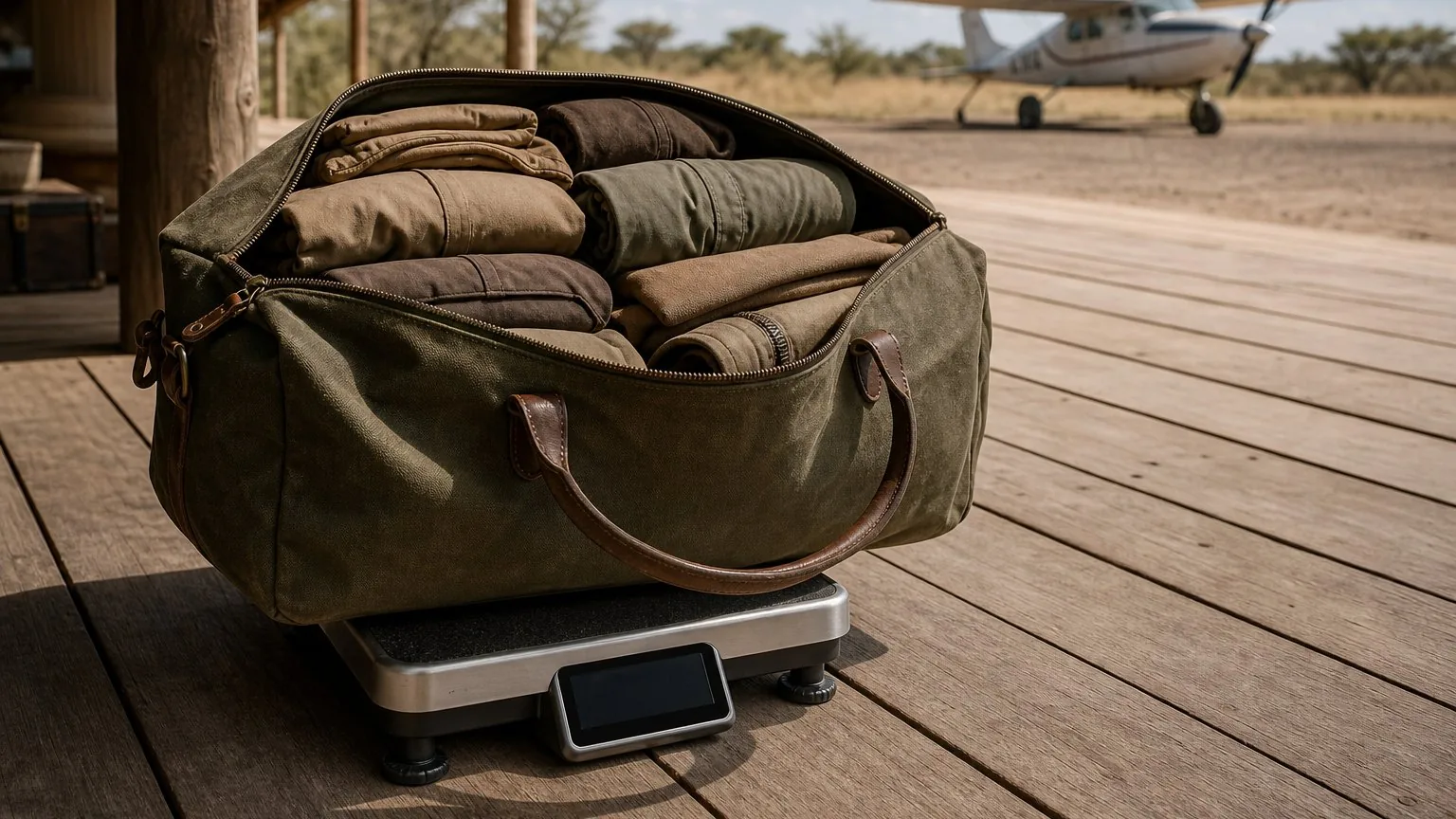
The smallest baggage allowance on your itinerary is the real packing list. Everything else is negotiable.
On the East African circuit that number is usually fifteen kilograms. Safarilink's published policy is "strictly limited to 15 kgs per person", except for Zanzibar, Kisumu, Diani, Lamu, Malindi, Entebbe and Mombasa, where it is 20kg — "inclusive of hand baggage and in soft bags". Coastal Aviation in Tanzania publishes "a maximum luggage allowance of 15kgs (33lbs) per person including carry-on luggage".
Two things follow that most packing guides get wrong.
Hand luggage is usually inside the number, not on top of it. On a normal international flight your cabin bag is extra. On these aircraft it is part of the fifteen. Coastal's conditions of carriage go further and count "cameras, filming equipment, and any other personal items" inside the allowance, which is worth knowing if you were planning to carry a long lens separately.
The soft-bag rule is not universal. For many fly-in itineraries a rigid suitcase causes more difficulty than the clothing inside it, because small aircraft often require soft-sided baggage — but "often" is doing real work in that sentence. Safarilink does require soft bags, and explains why: its luggage compartments have "limited volume and are of an irregular shape". Coastal says soft bags are "strongly recommended but are not obligatory", and publishes two sets of dimensions, one for a duffel and one for "a small suitcase or hard-shell style bag". In South Africa, Federal Air states plainly that "hard shell bags are permitted; however, they must adhere to specific size, shape, and weight restrictions". The constraint is the aircraft, not the continent — so read the rule for the carrier printed on your own ticket rather than a general one.
Southern Africa is not simply more generous, either. Wilderness Air's light-aircraft allowance is 20kg including hand luggage and camera equipment, but its bag rule changes by country: rigid-based bags with wheels are accepted in Botswana and Zimbabwe, while in Namibia and Zambia only soft duffels are. Scheduled regional jets into safari gateways, such as Airlink, carry an ordinary 20kg with no soft-bag rule at all. One itinerary can cross all three of those regimes.
My advice: pack to the most restrictive leg on the whole trip, not to your international allowance. It is the only number that cannot be argued with at a grass airstrip, and it is often less than half of what the long-haul flight let you bring.
If your bag genuinely will not fit the number, most carriers would rather sell you space than leave it behind. Coastal publishes an XL seat class allowing 30kg; Safarilink suggests booking a freight seat at an adult fare, which carries an extra 75kg. Both beat discovering the problem at check-in, where excess is carried at the pilot's discretion if there is room. Safarilink publishes that its staff will usually allow "a leeway of up to 2 kgs" — a kindness, not a plan.
Clothing, Briefly
This is a packing article, so clothing gets quantities rather than theory. For a week with laundry available, most people are comfortable with two or three breathable tops, two pairs of trousers, one genuinely warm layer for the first hour of a morning drive, and one light windproof shell. Add a sun hat, sunglasses and closed, comfortable shoes. Underwear and socks are the one category worth over-packing slightly, because they are the one camps most often exclude from laundry.
Without laundry, or on a trip past a fortnight, add a top or two and plan to rinse things yourself rather than carrying fourteen of everything. On a walking safari the footwear is the decision that matters, and it needs to be broken in at home.
That is deliberately all. For colours, fabrics, shoes and what actually works on a game drive, see my complete what to wear on safari guide, which covers the whole wardrobe question properly.
Documents and What to Arrange First
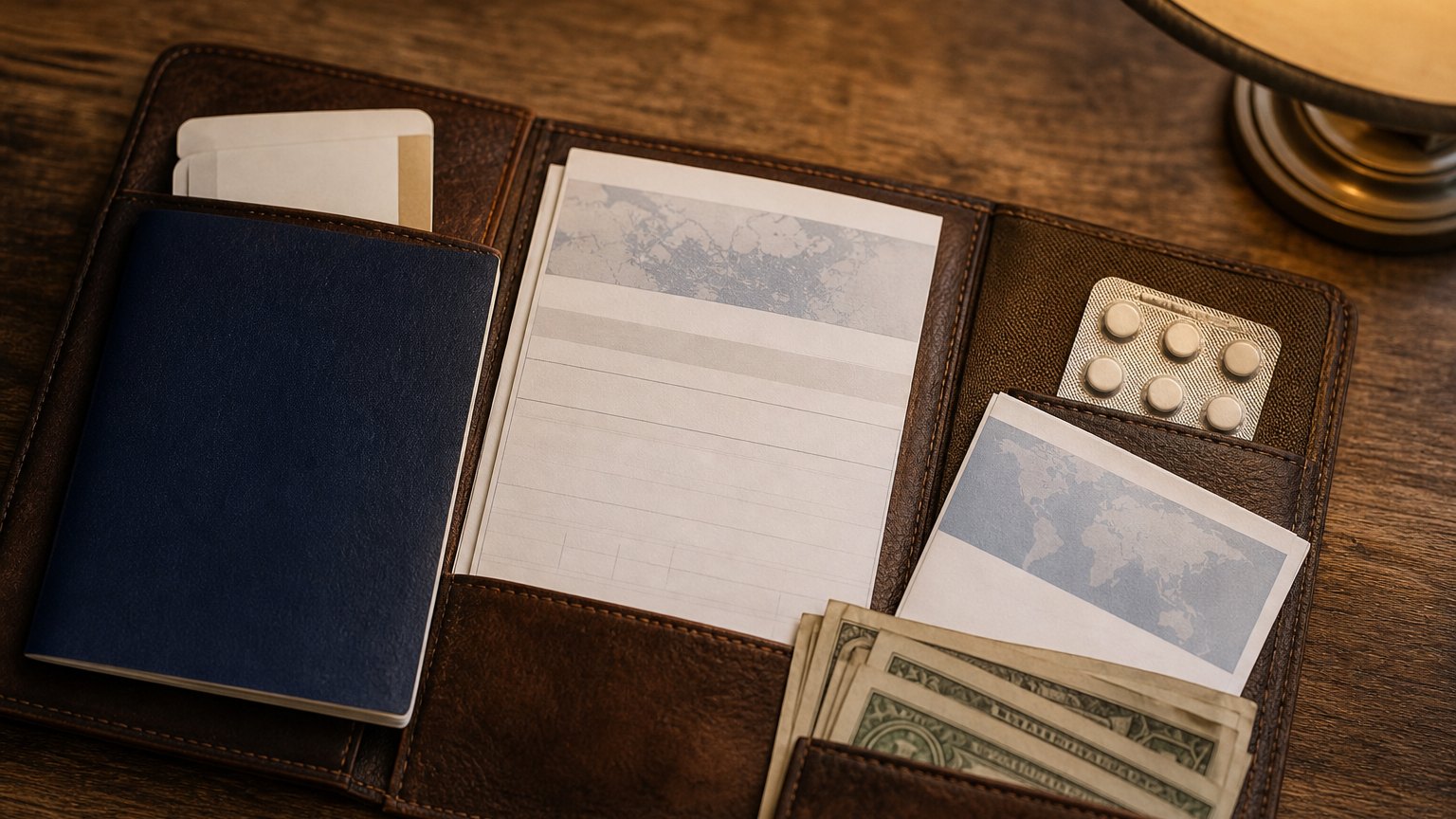
The items that take longest are not objects. Start them weeks before you think about a duffel.
Entry permissions. Kenya requires an electronic travel authorisation, applied for through the government's own eTA portal rather than a reseller; the official fee starts at $30 and the stated processing time is up to 72 hours, though the UK government's advice is to apply at least two weeks before departure. Tanzania offers both an online visa and a visa on arrival at official entry points, and recommends the online route; the ordinary visa is $50, and US passport holders are directed to the $100 multiple-entry category. Tanzania's own guidance says applications are processed within ten days, which is considerably longer than most blogs suggest, and it asks visitors to show a return ticket on arrival.
If Zanzibar is on the itinerary, note that inbound travel insurance from the Zanzibar Insurance Corporation is mandatory and that other international policies are not accepted in its place. That is a separate purchase from your own travel insurance, not a substitute for it.
Everything else. A passport with comfortable validity and blank pages; travel insurance with the policy number saved where you can reach it without signal; camp confirmations; the light-aircraft legs written down separately, because they are the ones that change; and emergency numbers for your operator, insurer and embassy. Keep copies offline as well as in the cloud — the places this article is about are the places your phone stops working.
Health and Personal
Two things belong on a packing list here, and one does not.
What belongs: prescription medication in its original packaging, carried in your hand luggage rather than the hold; a small first-aid kit with plasters, antiseptic, painkillers and rehydration salts; insect repellent; sunscreen and lip balm with sun protection; and your own toiletries, in a size chosen for the bag rather than the bathroom shelf.
What does not: the decisions. Malaria prevention and vaccination are medical questions for a travel-health clinician, and the appointment wants to happen weeks ahead, because some things need a course or a schedule. What is useful to know before that conversation is how the official guidance is framed. The US CDC describes malaria risk in Kenya as all areas below 2,500 metres, including the game parks, and in Tanzania as all areas below 1,800 metres; the UK's TravelHealthPro describes both as high risk. Risk is expressed by altitude rather than by park, so the answer depends on where your itinerary actually goes.
On yellow fever, the common misreading is worth correcting: the certificate requirement usually depends on the countries you have travelled from, not on Kenya or Tanzania as destinations. Both require it for arrivals from countries with transmission risk, from age one. Check the current position for your own routing, including any stopover.
Electronics, Charging and Cameras
Binoculars first, because they are the thing people most often wish they had brought and the thing most often missing from a list. A camera shows you what you saw afterwards; binoculars decide how much you see at all.
For power, the honest answer is that it varies and is worth asking about. Many camps run on solar with a generator as backup, and the pattern several publish is low-draw charging in the room — phones, camera batteries — with anything high-draw handled at a central point, if at all. Almost none publish generator hours, so do not plan around a schedule you found online. Take a power bank, check your airline's rules for carrying it, and bring more charging cables than devices.
Plugs are the small thing that ruins an evening. Kenya runs on roughly 240V with UK-style three-pin sockets; Tanzania is nominally 230V and lists both the UK-style three-pin and the older round-pin type, so an adapter that only covers the former is not guaranteed to be enough.
If you are travelling with a serious camera, the pattern that works is spare batteries charged before you leave camp, several smaller memory cards rather than one large one, something dust-protective to keep it in, and a lens-cleaning kit. Dust is the real adversary on a road safari, not rain. And remember Coastal counts camera equipment inside its fifteen kilograms.
What Lives in the Day Bag
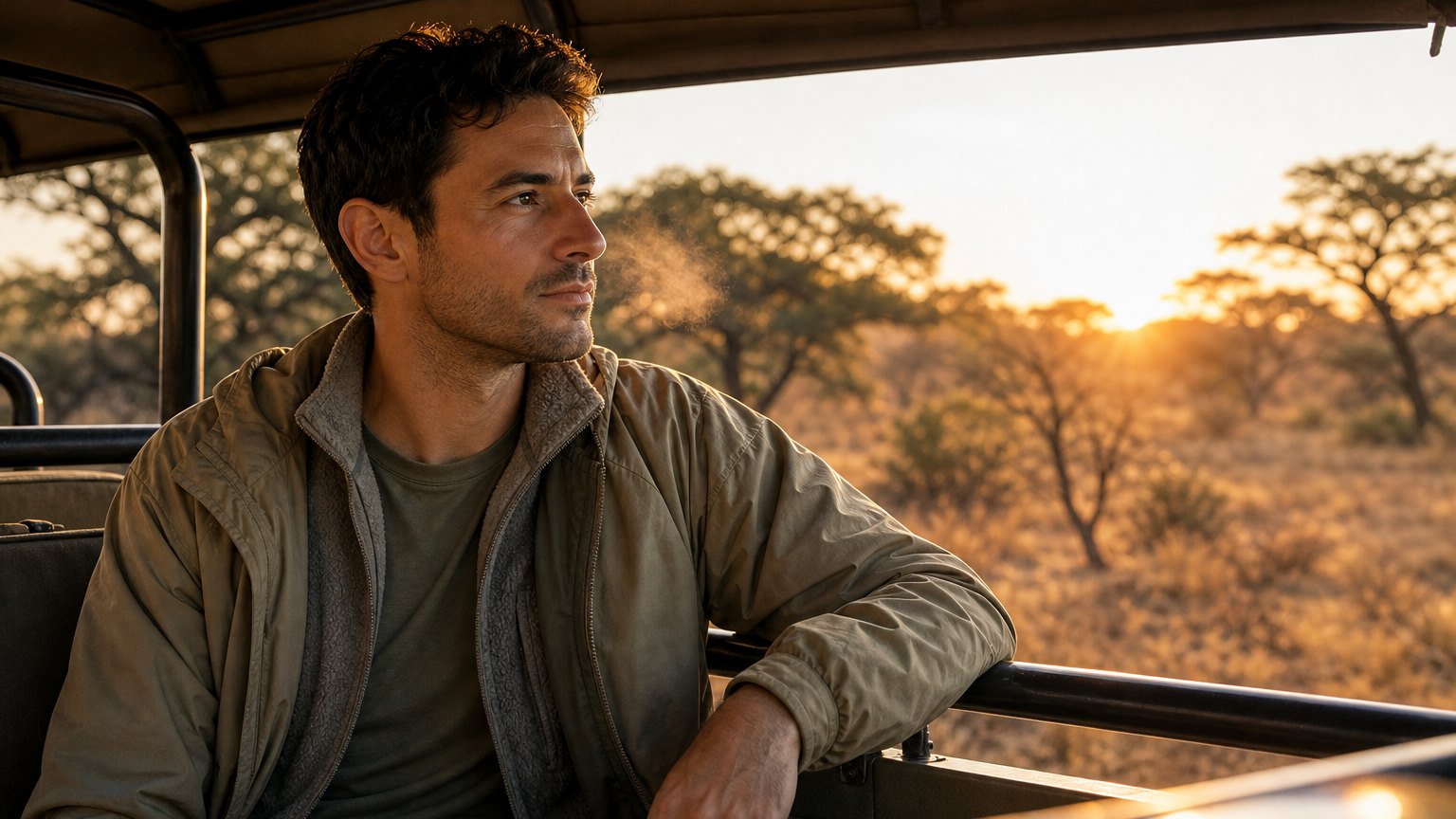
A game drive is three or four hours away from your room, starting in the cold and ending in the heat. The bag that matters is the small one on your lap: water, sunglasses, hat, sunscreen, repellent, binoculars, camera, tissues, any medication you need during the day, and the warm layer you will be glad of for the first hour and carrying by nine.
On a walking safari that bag has to be worn rather than set down, which is the argument for something compact with a proper strap.
Laundry, and How Much It Changes
This single question changes how much you carry more than any other, and the published answers vary more than you would expect. Complimentary laundry is genuinely common at the higher end and is usually bundled into an all-inclusive rate — Governors' Camp Collection publishes a 24-hour turnaround, Cottar's a daily service — but it is not a rule. Serena excludes laundry from its safari packages as a personal item. Wilderness makes it complimentary on one rate basis and chargeable on another. Asilia calls its own service "limited", done by hand and dried outdoors, so "turnaround time is weather-dependent". Singita's Mara River camp publishes 24 hours for small amounts and 72 for large ones. And some well-known operators publish nothing about laundry for the region at all.
The second question is the one that decides your underwear count. Several operators state plainly that they do not wash it: Asilia says it does not "out of respect for local culture and customs", Wilderness cites "prevailing local cultural traditions", and both provide washing powder in the bathroom instead. It is not universal — most camps publishing laundry terms do not mention it, and Wilderness describes properties where underwear is washed in a supplied mesh bag — but it is common enough that packing for the full trip is the safe assumption.
My advice: ask three questions before you pack — is laundry included, how long is the turnaround, and is underwear excluded. The answers are the difference between a week's clothes and three days' worth, and they take one email to get.
The practical position: pack underwear and socks for the full trip regardless, and let the answer decide everything else.
What Not to Pack
Most over-packing on safari is one of four things. Too many clothes, usually because nobody asked about laundry. Anything formal — camps are not dressing for dinner, and the one smart-ish outfit people carry is almost always for a city night at either end, not the safari itself. A large rigid suitcase on a restricted fly-in route, which is a real problem where the carrier requires soft bags and a non-problem where it does not, so check rather than assume. And camera equipment you will not realistically use: a second body and a third lens are weight you are paying for twice, once in the allowance and once carrying it.
One thing to add rather than remove: cash. US dollars are widely accepted alongside local currency, small denominations matter because tipping is done in cash, and older notes are often refused — one major operator publishes a post-2006 cutoff, though no authoritative year exists, so bring recent, clean notes. On amounts there is no official guideline: operator guidance runs roughly $8 to $20 per guest per day for guides and $5 to $15 for camp staff, and one large Kenyan camp group publishes no figure at all and tells guests to ask the manager.
Do You Need a Printable Safari Packing List PDF?
A generic one is only moderately useful, and for the reason this whole article has been making: the list for a fly-in trip with no laundry and a long lens is not the list for a self-drive fortnight, and a single PDF cannot be both. Most downloadable templates are written for the average safari, which nobody takes.
The tool above does the same job better, because it asks about your itinerary first and then builds the list. It runs entirely in your browser, remembers what you have ticked off, and prints — so the personalised version becomes your printable packing list, without an email address or a download in between.
Before You Pack
- Have you found the smallest baggage allowance on the whole itinerary, including every light-aircraft leg?
- Have you checked that carrier's own bag rule, rather than assuming soft bags are compulsory everywhere?
- Have you asked whether laundry is included, how long it takes, and whether underwear is excluded?
- Is your travel authorisation or visa applied for, allowing more time than the stated processing?
- If Zanzibar is on the route, have you bought the mandatory inbound insurance separately?
- Have you booked the travel-health appointment far enough ahead for anything that needs a schedule?
- Do you have an adapter that covers the sockets in every country on the trip?
- Have you weighed the packed bag at home?
Where you stay decides how much of the day you spend driving to the wildlife rather than watching it, which is the other half of this planning problem. If you are still choosing between camps, our free two-minute Hotel Location Check scores a property's location and access before you book, with no email required.
Not Sure Your Camp Is in the Right Part of the Park?
A cheaper lodge an hour from the gate costs you the best two hours of every day. Score its location in two minutes, free.
Score your hotel's location in 2 minutes →Frequently Asked Questions
How much luggage can I take on a bush flight?
Usually 15kg per person on the East African circuit, including hand luggage. Safarilink publishes 15kg, rising to 20kg on seven named routes, and Coastal Aviation publishes 15kg including carry-on. Southern African light-aircraft operators are often 20kg. The allowance on your own ticket is the one that counts, and it is frequently less than half your international allowance.
What size bag should I take on safari?
One you can lift yourself, matching your tightest carrier's rule. Where dimensions are published they are specific: Coastal lists roughly 40 x 40 x 80cm for a duffel and 76 x 48 x 29cm for a hard case, Wilderness Air 30 x 35 x 70cm. Check yours rather than buying to a generic "safari duffel" spec.
Can I take a hard suitcase on safari?
Sometimes, which is not the answer most guides give. Safarilink requires soft bags because of the shape of its holds. Coastal calls soft bags "strongly recommended but not obligatory" and publishes a hard-case size. Federal Air permits hard shells within stated limits. If any leg requires soft-sided luggage, that leg decides for the whole trip.
What should I keep in my safari day bag?
Water, sunglasses, hat, sunscreen, repellent, binoculars, camera, tissues, any daytime medication, and the warm layer for the first hour. A game drive is hours from your room, and the drive back for a forgotten thing does not happen.
What electronics should I pack for safari?
Phone, a power bank that complies with your airline's rules, more cables than devices, offline maps and documents, and a head torch. Take an adapter that covers every country on the route: Kenya uses UK-style three-pin sockets, and Tanzania lists both those and an older round-pin type.
How many camera batteries should I bring?
More than you expect, and charge them whenever you are in the room rather than when they are flat. Many camps run on solar with generator backup, and while several publish in-room charging for low-draw devices, almost none publish generator hours — so treat overnight charging as likely rather than guaranteed. Several smaller memory cards beat one large one.
Do safari camps provide laundry?
Often, and often free — but it is not standard. Published turnarounds run from the same evening to 72 hours, several operators describe their own service as "limited", and at least one large group charges for it as a personal item. Several also decline to wash underwear, citing local cultural traditions, and provide washing powder instead. Ask your camps whether it is included, how long it takes and what is excluded, then pack to the answer.
How do I pack for a safari and beach trip?
Pack the safari to the light-aircraft allowance and add the beach as a small, light supplement: swimwear, one lightweight set of clothes, sandals, and a waterproof pouch. The mistake is packing two full trips and then meeting a 15kg limit at the airstrip. If Zanzibar is the beach half, buy the mandatory inbound insurance before you fly.
Sources and References
- Safarilink. Baggage Allowance, including the excess and freight-seat provisions. flysafarilink.com
- Coastal Aviation. Luggage policy and bag dimensions, and Conditions of Carriage. coastal.co.tz
- Wilderness Air. Luggage allowance and per-country bag rules. wildernessdestinations.com
- Federal Air. Safari flight luggage restrictions. fedair.com
- Airlink. Baggage allowances. flyairlink.com
- Directorate of Immigration Services, Kenya. Official eTA portal and FAQs. etakenya.go.ke
- Tanzania Immigration Services. Visa guidelines and categories. visa.immigration.go.tz
- Zanzibar Insurance Corporation. Mandatory inbound travel insurance. inbound.visitzanzibar.go.tz
- UK Foreign, Commonwealth and Development Office. Kenya and Tanzania travel advice. gov.uk
- US Centers for Disease Control and Prevention. Travellers' health: Kenya and Tanzania. wwwnc.cdc.gov
- TravelHealthPro (NaTHNaC). Kenya and Tanzania country pages. travelhealthpro.org.uk
- Governors' Camp Collection. Helpful travel information, including laundry and power. governorscamp.com
- Elewana Collection. Travel information, including power and tipping guidance. elewanacollection.com
- Asilia Africa. FAQs, camp rate inclusions and published tipping guidance. asiliaafrica.com
- Cottar's Safaris, Singita, Wilderness and Serena Hotels. Published laundry terms and rate inclusions. cottars.com, singita.com, wildernessdestinations.com, serenahotels.com
- Expert Africa. Published tipping guidance. expertafrica.com
Part of Safari.