Western Europe Itinerary 2 Weeks: A Realistic, Unrushed Route
Two weeks is genuinely enough time for a great Western Europe trip, provided you resist the urge to visit every capital you have ever seen on a postcard. A spreadsheet with fourteen cities on it is not an
By Cyrielle · Travel planner & private-aviation professional · Updated 24 August 2026 · 14 min read
Two weeks is genuinely enough time for a great Western Europe trip, provided you resist the urge to visit every capital you have ever seen on a postcard. A spreadsheet with fourteen cities on it is not an itinerary; it is a cry for help.
This guide walks through what actually fits in fourteen days, a flagship route with a full day-by-day plan, two shorter alternatives, and the way the plan changes for a couple versus a first-timer. You will also find a stop-count table, a route comparison, a decision checklist and answers to the questions people actually type into Google before booking.
Quick Answer
For a two-week Western Europe itinerary, plan around four bases across two or three countries at three to four nights each. Fly into your first city and out of your last so you never double back, keep train legs under about four hours, and choose a central base in each city over a fancier room further out.
Key Takeaways
- Four bases in fourteen days is the pacing sweet spot, with five as the practical maximum; six or more stops collapses average stay length and adds fatigue between cities.
- Schengen’s ninety day allowance is rarely the binding constraint at two weeks; the UK and Ireland sit outside it entirely.
- A rail pass rarely beats point-to-point tickets on short flat corridors like Paris to Amsterdam, but pays off on longer, mixed routes.
- Spain and Portugal, often grouped under the popular Western Europe label, run noticeably cheaper than the UK, France or Switzerland.
- Couples-oriented routes cut stop count further to buy longer stays; first-timer routes work well sticking to the same four-base structure with slightly more even pacing.
- Late May and September beat the July to August peak for crowds, weather and price across the region.
In This Article
- Definition of Western Europe for itinerary planning
- Is two weeks enough?
- How many countries?
- The flagship route and shorter alternatives
- Couples versus first-timer planning
- Schengen rules and borders
- Costs and budgeting
- Rail pass or point-to-point?
- Best time of year
- Common mistakes
- Building your western europe itinerary 2 weeks plan
- FAQ

Definition Of Western Europe For Itinerary Planning
Geographers keep “Western Europe” narrow: the UK, Ireland, France, the Benelux countries, Germany, Switzerland and Austria. Travel searches are looser, routinely folding in Italy, Spain and Portugal, and this guide follows that broader, real-world usage rather than the textbook boundary.
That broader definition has one consequence worth planning around. The core Western European countries sit near the top of Europe’s cost tables, and reaching the continent from the UK adds a Eurostar or short flight rather than just another train, which shapes both your budget and your first travel day.
Is Two Weeks Enough For Western Europe?
Yes, provided the stop count stays honest. Thirteen nights split at three to four per base comfortably supports four cities, still works at five, and starts to hurt at six. Every extra city quietly borrows a night from all the others, and at two weeks there is no slack left to lend.
| Stops | Nights per stop (avg) | Feel |
|---|---|---|
| 4 stops | 3 to 4 nights | Ideal, relaxed pacing with real time in each place |
| 5 stops | about 2.5 nights | Maximum recommended, still workable on short, train-connected legs |
| 6 stops | about 2 nights | Tight, fatigue starts to show |
| 7+ stops | Under 2 nights | High fatigue, the classic overpacking mistake |
For context, a well-planned week in Europe realistically covers two to four cities. Two weeks roughly doubles that ceiling, which is exactly why four bases fit and eight do not.
Nobody on their deathbed regrets skipping a fifth city; plenty regret the blur of the four they did see.
How Many Countries Should You Visit In Two Weeks?
Two to four countries is the honest range for fourteen days. One country can go deep; France or Italy alone fills two weeks easily. Four is the ceiling before borders and transfers start eating the trip, and more than four rarely buys more travel, only more packing.
A three-week trip stretches comfortably to six or so stops; two weeks does not, which is the whole reason this route stops at four.
The Flagship Western Europe Route And Shorter Alternatives
There is no single perfect two-week route, but if you are only taking one trip, build it around the classic loop below. It is the flagship plan here: four bases, short train legs and a full day-by-day breakdown. The Alpine-to-Mediterranean traverse and the Iberian budget route further down are leaner alternatives once you know what each one trades away.
The classic Western Europe route: the flagship plan
London to Paris to Amsterdam, finishing in Bruges or Brussels, then home from the final stop. Every leg runs under about four hours by train, so the travel-day tax stays low and each base keeps real time. The trade-off: these are among the most crowded, most expensive cities on the continent in peak season.
The full day-by-day sits below. The shape is simple: fourteen days, thirteen nights, four bases, split three nights in London, four in Paris, four in Amsterdam and two in Bruges or Brussels. In real trip reports, that final two-night stop is the one travellers most often wish they had traded for a third night earlier, so treat it as a graceful wind-down rather than a city to conquer.
Day-by-day: 14 nights across four bases
| Day | Base | What the day looks like |
|---|---|---|
| Day 1 | London | Arrive, settle in, an easy first walk along the river |
| Day 2 | London | Full day: Westminster, the South Bank or a museum |
| Day 3 | London | Full day, then an early night before travelling |
| Day 4 | Paris | Eurostar to Paris, afternoon around the Seine |
| Day 5 | Paris | Full day: the Louvre or Musee d’Orsay, Montmartre in the evening |
| Day 6 | Paris | Full day: the Eiffel Tower, the Latin Quarter |
| Day 7 | Paris | Full day, unhurried, a day trip or a slow morning |
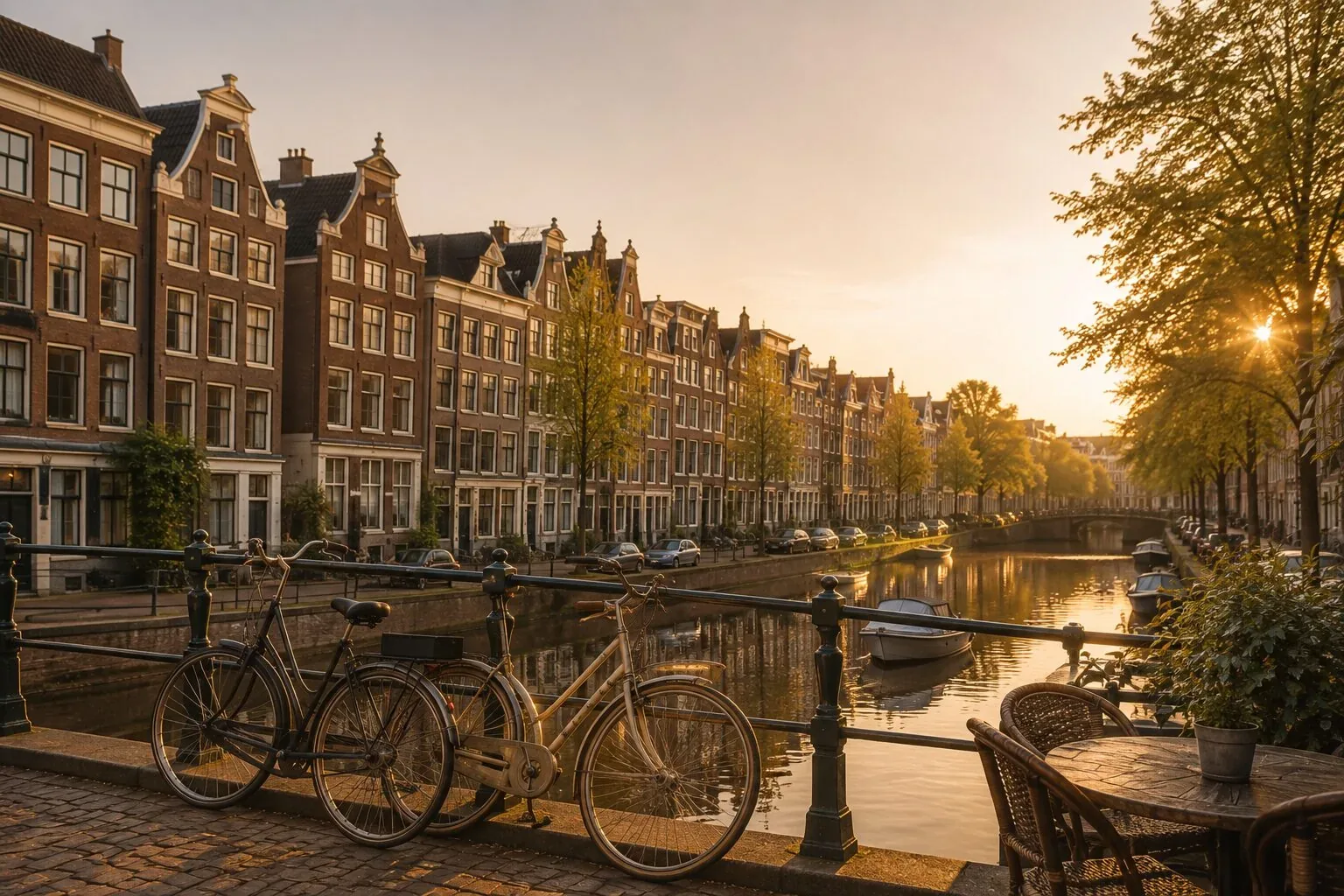
| Day 8 | Amsterdam | Train to Amsterdam, afternoon by the canals |
| Day 9 | Amsterdam | Full day: the Rijksmuseum or Anne Frank House, a canal cruise |
| Day 10 | Amsterdam | Full day: the Jordaan neighbourhood, a bike ride |
| Day 11 | Amsterdam | Full day, or a half-day trip to Haarlem or Zaanse Schans |
| Day 12 | Bruges or Brussels | Train onward, afternoon exploring on foot |
| Day 13 | Bruges or Brussels | Full day: the canals or the Grand Place, a final long dinner |
| Day 14 | Bruges or Brussels | Slow morning, then depart for home or an onward flight |
The two routes below make good shorter alternatives when the classic loop does not suit your season, budget or interests.
The Alpine to Mediterranean traverse
Zurich or Geneva into the Swiss Alps, down into northern Italy, finishing in Venice or Florence. It trades some pace for scenery, and Switzerland will stretch a budget, but the Alpine legs are the whole point.
The Iberian budget route
Madrid, Seville and Lisbon, sometimes looping in Porto or Barcelona. Spain and Portugal run noticeably cheaper than the core, so this is the route to choose when budget matters more than ticking the marquee capitals.
| Route style | Best for | Verdict |
|---|---|---|
| Classic Western Europe route | First trips, short train hops, broad exposure | Flagship two-week route, see day-by-day above |
| Alpine to Mediterranean | Scenery lovers, slower travel pace | Fewer stops fit; worth it for the views |
| Iberian budget route | Value-focused travellers, warmer climate | Cheapest daily costs of the three |
| Couples honeymoon route | Depth over breadth, splurge experiences | Fewer cities, more memorable evenings |
The best route is the one with the fewest goodbyes, not the most stamps.

Want this route built around your actual dates and budget?
The flagship loop is a strong starting point, but the best version is the one shaped to how you travel. That is what a custom Wanderess itinerary does.
Explore custom itinerary planning
How Is A Couples Itinerary Different From A First-Timer One?
A couples itinerary trims the stop list to buy longer, better stays; a first-timer route keeps the same four bases but spreads the nights more evenly. It is a pacing choice, not a different set of cities.
A couples-paced version might drop to three bases across the same thirteen nights, say five in Paris, four around Lake Como and four in Florence, spending the freed time on a long lunch, a private tour, or a morning with nowhere to be.
First-timers, by contrast, tend to under-budget the small recurring costs, the transfers and the occasional splurge, then feel the squeeze mid-trip. A little built-in slack beats rationing your last few days.
Choosing where to stay is often the hardest part, and it matters more than the star rating. A recurring complaint on this loop is booking beside the main station for “convenience” and then commuting into the centre every day; in all four of these cities, a central base beats a station-side one for the time it quietly saves.
Schengen Rules And Border Logistics
Most non-EU or non-EEA visa-exempt nationalities do not need a visa for a two week Western Europe trip. The Schengen Area rules allow stays of up to ninety days within any rolling one-hundred-eighty-day period, and fourteen days uses well under a fifth of that allowance.
Two scenarios still deserve a check. A trip starting in London means your UK and Ireland days do not count toward the Schengen ninety, so leave them out when tallying your allowance. And a second Europe trip within the same 180-day window shares one running total, since the cap applies across all Schengen countries combined.
Two EU systems are worth knowing for 2026. The Entry/Exit System (EES) became operational at external Schengen borders on 10 April 2026; it records your entry and exit and needs nothing from you in advance. The ETIAS travel authorisation is not yet in force as of August 2026, so you cannot and need not apply for it now. Check the official EU travel portal for its launch before you travel, but for this trip a valid passport is what counts.
Check your government’s current travel advisory for every country on your route before you fly. The UK FCDO travel advice pages and the US State Department travel advisories are updated regularly and cover entry requirements, local safety notes and any border scheme changes that might affect a UK-inclusive itinerary.
What Does A Western Europe 14-Day Trip Cost?
Core Western European countries, the UK, France, Switzerland, the Netherlands and Germany, consistently rank among Europe’s higher-cost destinations for accommodation, food and transport. That daily cost gap compounds faster over two weeks than it would over a long weekend, since even a moderate difference multiplies across twelve to fourteen travel days.
Western Europe does cost more than Eastern Europe, and the gap is widest in Switzerland, London and Paris. The table below is a planning range, not a quote; your real number swings with the season and how many nights land in the pricey cities.
A cheap flight to an expensive city is still an expensive trip; the airfare was never the budget’s biggest enemy.

Should You Get A Rail Pass For A 2-Week Trip?
It depends on your route. Short, flat corridors such as London to Paris to Amsterdam to Brussels are often cheaper booked as individual advance tickets than covered by a multi-day pass, because those legs are frequent, competitively priced and easy to book weeks ahead.
A fourteen day trip with four or five stops typically needs only four to six total train travel days, which sits near the lower end of most Eurail or Interrail Global Pass day tiers. Passes earn their keep on longer or more varied routes instead, the Alpine to Mediterranean traverse being a good example, where cross-border high-speed legs booked closer to travel carry a higher point-to-point price.
One less obvious cost is seat reservations. Several high-speed lines now require a paid reservation even with a valid pass, which quietly erodes the savings a flexible pass promises on paper, so price those fees in before assuming the pass wins. Our Europe by train guide goes deeper on passes and reservations.
Best Time Of Year For A 2-Week Western Europe Itinerary
Late spring, especially May, and early autumn, September into early October, are the sweet spots: mild weather, thinner crowds, and prices below the summer peak across the region.
Shoulder-season weather across the UK, France, Benelux and northern Italy is usually mild rather than guaranteed, so pack a layer and a small umbrella. July and August bring the heat, the crowds and the steepest prices, especially in Paris and the Italian cities.
Common Mistakes When Planning A 2-Week Western Europe Trip
Overpacking the stop list is the single biggest mistake. Adding cities faster than thirteen nights can absorb collapses average stay length below two nights per stop, and it is consistently cited as the top regret in first-timer trip retrospectives.
Underestimating the UK-to-continent transition is a close second. Travellers building a route that starts in London often treat the Eurostar or flight leg as a simple train hop, when it is a distinct, separately priced, separately timed segment with its own check-in window.
Leaving accommodation to the last minute in peak-season capitals is the quiet budget-killer: the central, well-reviewed rooms go first, and what is left is either far out or overpriced. Book the anchor cities early and keep the smaller stops flexible.
Before You Book
- Count your stops. Four bases is the ideal, five at the most, for thirteen nights, not eight.
- Confirm whether your route includes the UK or Ireland, and account for the separate non-Schengen entry rules.
- Price point-to-point train tickets before buying a rail pass.
- Pick a shoulder-season month, May or September, if your dates are flexible.
- Check your government’s current travel advisory for every country on the route.
- Book accommodation in high-demand capitals well ahead of peak season.
- Score your hotel’s location before you commit, a central booking in the wrong neighbourhood costs more than it saves.
Building Your Western Europe Itinerary 2 Weeks Plan Step By Step
Where most two-week plans go wrong is not the route but the fiddly parts: the neighbourhood you booked, the transfer you underestimated, the half-day you lost to a mid-trip flight. Get those right and an unremarkable-looking itinerary travels beautifully.
Not Sure Your Hotel Is In The Right Area?
A great itinerary can still be undone by a hotel in the wrong neighbourhood. Score your hotel’s location in two minutes, free, no email required.
Score your hotel’s location in 2 minutes →
Frequently Asked Questions: Western Europe Itinerary 2 Weeks

Is 2 weeks enough for Western Europe?
Yes. Thirteen nights comfortably supports four bases, five at the most, at three to four nights each across two or three countries, provided you avoid trying to fit in every major capital on one trip.
How many countries should you visit in Western Europe in 2 weeks?
Two to four countries is the range most planners settle on. Stop durations typically drop under two nights each beyond four countries, and travel days start eating into your actual stay time.
Is Western Europe more expensive than Eastern Europe for a 2-week trip?
Generally yes. Core countries like the UK, France, Switzerland and the Netherlands sit near the top of Europe’s cost tables, though Spain and Portugal, often grouped under the same label, cost noticeably less per day.
Do I need a visa for a 2-week Western Europe trip?
Most non-EU or non-EEA visa-exempt nationalities do not, since the Schengen Area allows stays up to ninety days within any rolling one-hundred-eighty-day period. The UK and Ireland have separate, non-Schengen entry rules worth checking independently.
Should I get a rail pass for a 2-week Western Europe trip?
Only if your route includes longer or varied legs. Short, flat corridors like London to Paris to Amsterdam are usually cheaper with advance point-to-point tickets than with a multi-day pass.
What is the best time of year for a 2-week Western Europe itinerary?
Late May or September to early October work best, since both sit outside the July and August peak and offer milder crowds and generally better accommodation availability across the region.
How is a couples 2-week itinerary different from a first timers one?
Couples itineraries trim the stop list further to buy longer stays and room for splurge experiences. First-timer itineraries usually stick to the same four-base structure, prioritising enough time in each place over extra stops.
Can first timers combine the UK with continental Europe in 2 weeks?
Yes, but budget an extra logistics layer for the Eurostar or flight crossing, since it is a separately priced, separately timed segment rather than a simple train hop like Paris to Brussels.
Further Reading
[Itinerary
3 Week Europe Itinerary: The Sweet Spot Trip](/3-week-europe-itinerary/)[Itinerary
2-Week Europe Itinerary, Day by Day](/realistic-2-week-europe-itinerary/)[Planning
First-Time Europe: Which Route to Choose](/first-time-europe-itinerary/)[Rail
Europe by Train: Realistic Rail Itineraries](/europe-by-train-itineraries/)
Sources and References
- European Commission. Schengen Area rules and the ninety-days-in-one-hundred-eighty rule. home-affairs.ec.europa.eu.
- UK Government. Foreign travel advice. gov.uk.
- US Department of State. Travel advisories. travel.state.gov.
- Rick Steves. Trip-planning guidance for first-time Europe travellers. ricksteves.com.
- Lonely Planet. Trip-planning framework. lonelyplanet.com.
- Eurostar. UK to continental Europe rail crossing information. eurostar.com.
- Eurail. Global Pass structure and day-tier system. eurail.com.
- Interrail. Pass structure for European rail travel. interrail.eu.