Best Gelato in Rome: The Award Winners, the Icons, and What You'll Pay
Rome's most famous gelaterie and its most decorated ones are almost entirely different shops. The current award winners, the historic icons, and what you actually pay — by size, and by street.
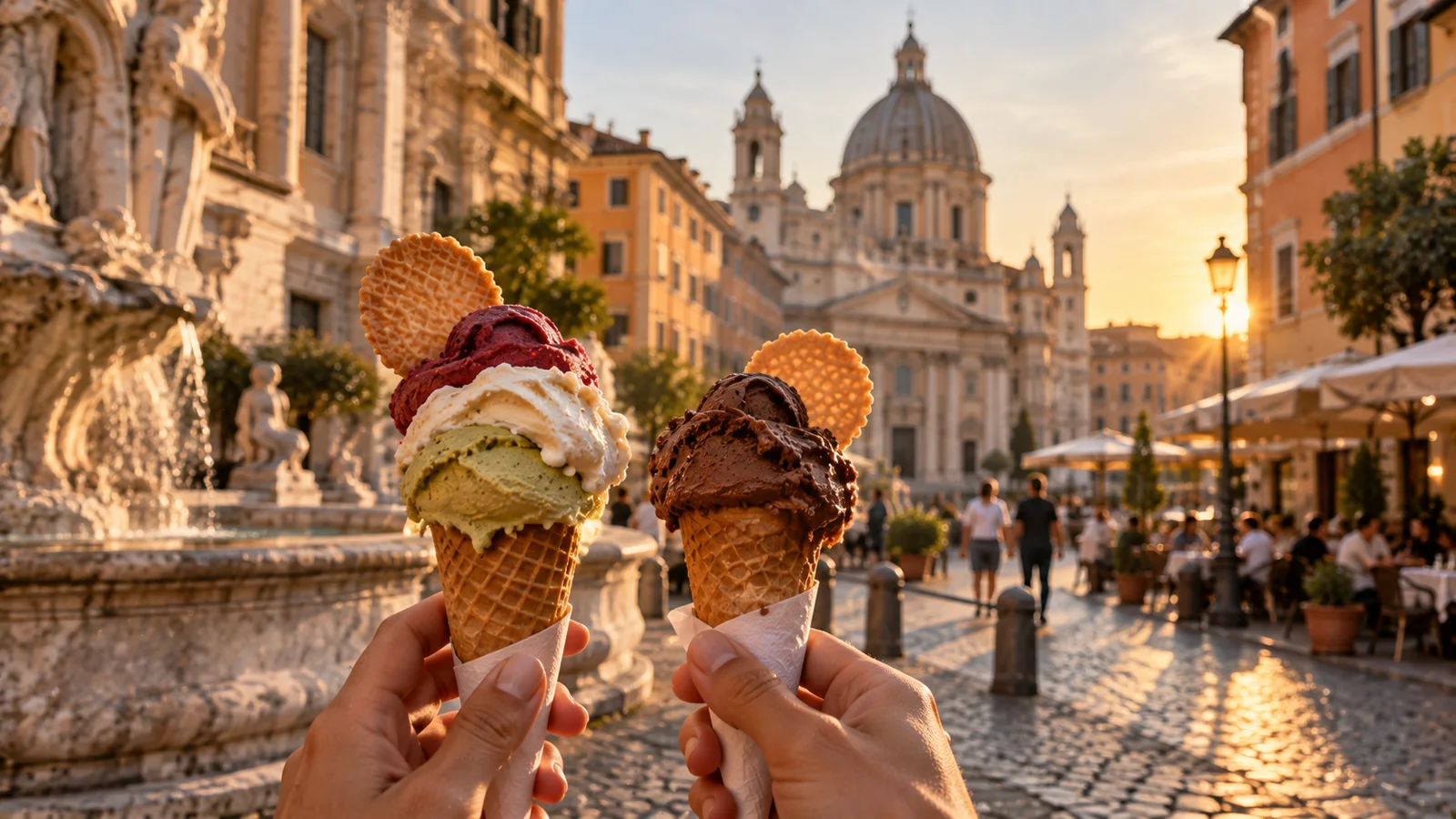
Rome's most famous gelaterie and Rome's most decorated gelaterie are almost entirely different sets of shops. Of the names that turn up on nearly every English-language list, exactly one holds the top rating in the current Italian guide. That is not a scandal, and it does not make the famous ones bad. It does mean that "best" has to be answered twice: best by craft, and best for the afternoon you are actually having.
The second thing worth knowing before you queue anywhere is that in Rome the price depends more on the street than on the shop. The same size cup runs about €2.50 in a residential neighbourhood and €6 to €8 within sight of the Colosseum. And Roman gelaterie do not really sell scoops: they sell a size, with the number of flavours built into it.
Quick Answer
Near the Pantheon, Günther on Piazza di Sant'Eustachio is the serious maker two minutes from the columns, with Gelateria del Teatro the equivalent on the Piazza Navona side; Giolitti, round the corner on Via Uffici del Vicario, is the historic room rather than the craft pick, open 07:30 to midnight every day of the year. For the current award winners you have to leave the centre: Otaleg in Trastevere, then Torcè, La Gourmandise, Il Cannolo Siciliano and Stefano Ferrara's Formaessenza. For a big family stop, Fassi's 1928 Palazzo del Freddo in the Esquilino sells takeaway gelato at €20 a kilo. Budget €2.50 to €3.50 for a small or medium cup away from the monuments, and expect to pay roughly double in the tourist centre.
Key Takeaways
- Gambero Rosso's current edition is Gelaterie d'Italia 2027, presented on 19 June 2026. There was no 2026 edition — the guide moved from January in Rimini to June in Naples.
- Five Rome shops hold Tre Coni in that edition: Otaleg!, Torcè, La Gourmandise, Il Cannolo Siciliano and Stefano Ferrara – Formaessenza.
- Fatamorgana, which appears on virtually every English-language Rome list, is no longer among the Tre Coni in the 2027 guide.
- Rome sells gelato by size, not by scoop: a piccolo is normally two flavours, a medio three, a grande four.
- Location sets the price more than quality does. Expect roughly €2.50 to €3.50 in a neighbourhood shop and €4.50 to €8 beside a major sight.
- Rome's critically ranked gelato sits almost entirely outside the tourist centre — not one of Dissapore's top ten Rome shops for 2026 is within walking distance of the Pantheon, Trevi, the Colosseum or the Vatican. Günther by the Pantheon and Gelateria del Teatro towards Piazza Navona are the exceptions worth knowing.
- Giolitti's business dates to 1890 but began as a dairy; the gelateria you queue at opened in 1900. Fassi's business dates to 1880; the Palazzo del Freddo opened in 1928.
In This Article
What the Current Guide Actually Says
Gambero Rosso's Gelaterie d'Italia is the closest thing Italy has to an agreed craft ranking, and its top award is Tre Coni, three cones. The current edition is the 2027 guide, its tenth, presented in Naples on 19 June 2026. It reviewed 583 gelaterie and gave Tre Coni to 77 of them. If you are wondering why there is no 2026 edition to look up, there isn't one: the guide moved from a January launch at Rimini to a June launch in Naples, and skipped a year number in the process.
Lazio took seven Tre Coni, five of them in Rome proper: Otaleg! in Trastevere and Monteverde, Torcè at Viale dell'Arte in EUR and three other addresses, La Gourmandise in Monteverde Vecchio, Il Cannolo Siciliano at Piazza Malatesta, and Stefano Ferrara – Formaessenza in the Marconi district. Claudio Torcè also took one of the guide's seven career awards for gelatai who shaped the trade.
One change matters more than the list itself. Fatamorgana, the shop that appears on practically every English-language guide to Rome gelato, is no longer among the Tre Coni in the 2027 edition; it sits a band lower. That is movement within a very small elite rather than a verdict that the gelato went bad — the short, additive-free ingredient lists it is known for have not changed. But it does explain why a list assembled from English blogs and one assembled from the Italian guide barely overlap.
The Award Winners, and What Each One Is For
Otaleg is the one you can reach on a normal sightseeing day, and the only shop in the English-language canon holding a current Tre Coni. Marco Radicioni opened it in 2012 and rebuilds the flavour list daily — its own site heads the menu "today's flavours" and warns the two branches may differ on the same day. Roughly thirty at a time, fruit sorbets following the season and made without dairy, everything gluten-free including the cones.
Torcè is the veteran. Claudio Torcè has been building unusual savoury and vegetable flavours since long before it was fashionable, which is what the 2027 career award recognises. The Viale dell'Arte shop is in EUR, well south of the centre, with further addresses including Viale Aventino and Viale Marconi.
La Gourmandise in Monteverde Vecchio and Stefano Ferrara's Formaessenza in Marconi are both residential-neighbourhood shops that Italian critics rate highly and English guides mostly miss — Formaessenza took Puntarella Rossa's top Rome award in 2025. Il Cannolo Siciliano, at Piazza Malatesta, is Eugenio Morrone's Sicilian pastry-and-gelato hybrid.
Four of those five are genuinely out of the way, and that is the pattern rather than the exception. Dissapore's 2026 ranking of Rome puts its top seven in Portuense, Magliana, San Lorenzo, Marconi, San Giovanni, Centocelle and Monteverde — not one of its top ten is walkable from the Pantheon, Trevi, the Colosseum or the Vatican. Roman gelato that critics rate is made where Romans live.
If You Only Have the Centre: What's Actually Near the Sights
Most people are not going to cross Rome for a cone, so here is the honest map of the middle.
Pantheon. Günther Gelato Italiano, Piazza di Sant'Eustachio 47, is about two minutes away and is the find of this guide: an Alto Adige maker working with Dolomite spring water and organic microfiltered milk, with a mugo-pine flavour as its signature. It appears in Dissapore's 2026 Rome ranking and Puntarella Rossa's. There are exactly two Rome shops, this one and Via dei Pettinari 43 — older articles claiming four branches, or one at the Trevi Fountain, are out of date.
Piazza Navona and Castel Sant'Angelo. Gelateria del Teatro has been going since 2006 and sits at Via dei Coronari 65/66, with a counter opening straight onto the street and a second site on Lungotevere dei Vallati. Skip the cone here and ask for a soft brioche filled with Vecchia Roma — their rework of the Jewish Ghetto's ricotta and sour-cherry tart, with a butter crumble through it. It is the most Roman thing on this page.
Colosseum. Nothing good is beside it. The closest credible shop is Mavè at Via Gallia 56 in San Giovanni, about fifteen minutes' walk, opened in 2024 and named by Dissapore as making the best winter cream in Rome for 2026. Expect €6 to €8 for the same cup at counters in sight of the arches.
Santa Maria Maggiore. Terra Gelato, on the piazza at number 9, is the practical choice if you need to sit down rather than walk: three rooms with large tables and sofas, some looking onto the square, and vegan, gluten-free and low-sugar options across about thirty flavours. Its Tre Coni belong to the group's Milan shops rather than this one, which is worth knowing before you read the window.
Trevi. No shop beside the fountain is endorsed by current Italian critics. Walk the six or seven minutes to Günther instead.
Spanish Steps, Monti and Campo de' Fiori. Fatamorgana has branches at all three, including Piazza degli Zingari in Monti, the nearest decent option to the Colosseum quadrant. Everything is gluten-free and the flavours run to fennel, liquorice and rose petal. No longer a Tre Coni holder, but still the most reliable central name.
The Famous Three: Giolitti, Fassi and Otaleg
Giolitti, Via Uffici del Vicario 40, is the Pantheon institution. Its own history is more interesting than the shorthand suggests: the family business began in 1890 as a dairy in Monti, eventually supplying the royal household. Gelato came later, and this venue has been running since 1900 — which is the date on the shop's own sign. It opens 07:30 to midnight, and the operator's wording is "every day of the year, without exception". There is one Giolitti gelateria, despite what older listings say. You pay the cashier for a size first, then take the receipt to the counter and choose flavours. It holds no Tre Coni, it is not on any Italian critical list, and it is still worth going once if what you want is a marble-and-brass room that has been doing this for 125 years.
Fassi, formally Palazzo del Freddo Giovanni Fassi, is the big one in the Esquilino at Via Principe Eugenio 65/67. The business dates to 1880, founded by Giacomo Fassi from Turin and his wife Giuseppina; Giovanni, whose name is on the sign, was born that year rather than founding it. The Palazzo del Freddo itself opened in 1928 in a converted carriage stable, 700 square metres with the production laboratory visible from the floor. Its own site gives hours of midday to midnight Monday to Saturday and from 10:00 on Sunday. Takeaway tubs are €20 a kilo. It is also the one shop here that can turn gelato into an actual activity: the Palazzo del Freddo runs a guided visit of about an hour, booked in advance, that takes you into the laboratory with a gelatiere and finishes with a cone or cup of three flavours, cream and one of the house Sanpietrini — €29.90 a head, €15 for children aged six to fifteen, free below that. Note that Fassi's second address on Via Piave is not a gelateria: it sells the historic semifreddi, takes cards only, and does not scoop cones.
What Gelato Costs in Rome
Roman gelaterie price by container size, and the size determines how many flavours you get: a piccolo is normally two, a medio three, a grande four. Asking for "one scoop" is not how the menu is built, which is why English-language price guidance so often fails to match the board in front of you.
Otaleg is one of the few Rome shops that publishes a full price list, and it makes a useful yardstick: €2.50 for one scoop, €3.50 for two, €4.50 for three, €5.50 for four, rising to €6.50 for five, with takeaway tubs from €16 for 500g to €30 for a kilo. Fassi sells takeaway gelato at €20 a kilo.
Across the city, a small cup or cone in a neighbourhood shop runs about €2.50 to €3.50 and a medium around €3.50 to €4. Beside a major monument the same thing costs roughly €4.50 to €8 — the gap between a residential street and the Colosseum is close to double. If a counter quotes you €5 or €6 for a single scoop, that is the signal to walk.
A usable rule: look for a large cup at no more than about €5 with cream included in the price, and be wary of anything added to your cup that was not priced first.
The cautionary tale is worth knowing because it is recent and specific: in June 2026 a couple near Piazza Navona were charged €44 for two "maxi" portions at €12 each, after staff added whipped cream, macarons and a cannoli. When The Times sent a correspondent to the same shop, he ordered a three-flavour cone, had a wafer, a macaron, cream and a chocolate cannolo added — labelled as extras that time — and paid €22. The lesson is not that Rome is a rip-off; it is to name your size, refuse the additions you did not ask for, and look at the price of what is being built before it reaches you.
Telling Craft Gelato from Tourist Gelato
A great deal of the advice circulating about this is folklore. Three signals are backed by people who actually make gelato, and several popular ones are not.
Colour. Real mint is white to pale sage, not neon green; pistachio is a dull, slightly grey green, not bright. Vivid colour means dye, and dye tends to travel with everything else you would rather not eat.
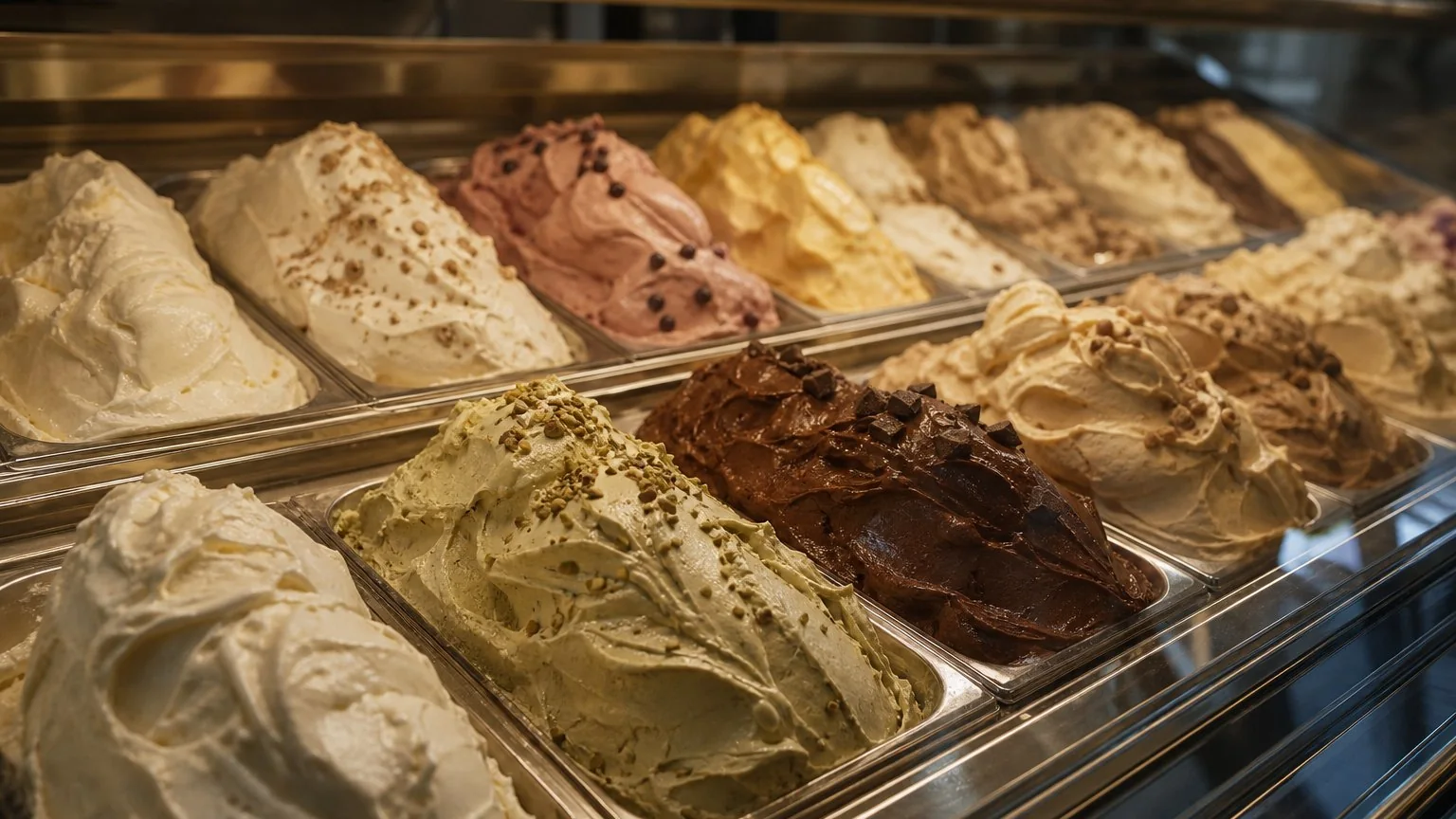
Volume. Gelato piled into tall, fluffy, overflowing mounds has had air whipped into it, usually with the help of stabilisers and powders. Craft gelato is denser and sits lower in its tub. The best shops go further and keep it in pozzetti, covered stainless tins, where you cannot see it at all — which is the opposite of a sales display and a good sign.
The ingredient list. Shops that make their own are usually happy to show you what is in it. A list studded with E-numbers is a list of additives.
A short counter. Gambero Rosso's own guidance is that a serious shop keeps somewhere around eighteen to twenty-two flavours going at once. A counter advertising 150 of them is making a different promise.
Signals that do not reliably work: a visible laboratory, which is pleasant to see and proves nothing by itself; and the melting-speed, water and ice-crystal tests that circulate endlessly online, for which no one credible is cited. Treat pozzetti as a strong hint rather than a pass-fail rule — excellent shops do use open trays.
Our Picks by Kind of Stop
These are our editorial picks, based on what each shop is set up to do rather than on anyone's survey.
| If you want | Go to | Because |
|---|---|---|
| The best gelato near the Pantheon | Günther, Piazza di Sant'Eustachio | Two minutes from the columns and the only centro storico shop current Italian critics rate |
| The best craft gelato you can reach on a sightseeing day | Otaleg, Trastevere | Current Tre Coni, open daily to midnight, and the flavour list is rebuilt every morning |
| The historic Roman room | Giolitti, Pantheon | Serving on the same street since 1900, open 07:30 to midnight every day of the year |
| A stop with children in tow | Fassi, Esquilino | A 700-square-metre hall rather than a pavement queue, and a bookable hour in the laboratory that ends in a tasting |
| Flavours you will not get at home | Torcè | Four decades of savoury and vegetable gelato, and a 2027 career award for exactly that |
| To eat where Romans do | La Gourmandise or Formaessenza | Neighbourhood shops with Tre Coni that English-language guides almost never mention |
| To spend the least | Any of the above, away from the monuments | The same cup costs roughly half in a residential street compared with a monument forecourt |
Common Mistakes
Reading a queue as a verdict. The longest queues in Rome are outside the shops with the best addresses, which is a fact about rent and footfall rather than about gelato.
Quoting an award without its year. Tre Coni is reissued with each edition and shops move between bands — Fatamorgana's drop out of the top tier in the 2027 guide is the current example.
Planning around a specific flavour. Otaleg rebuilds its list daily and its two shops can differ on the same day, so the cacio e pepe you read about may not exist on the afternoon you turn up.
Letting the counter build something you did not order. Name the size, refuse the extras, check the price before the cream goes on.
Before You Decide
- Decide which question you are answering: the award list and the famous names point to different shops.
- Check the shop's own site for hours on the day — several Rome gelaterie open at midday, not in the morning.
- If you want a Tre Coni shop, check where it actually is: three of the five Roman winners are well outside the centre.
- Do not plan around a named flavour at a shop that rotates its list daily.
If you are still choosing where to stay, it is worth doing that first: Trastevere, the Pantheon and the Esquilino are three different cities as far as an evening walk is concerned, and the neighbourhood you sleep in decides which of these shops you can reach on foot.
Not Sure Your Rome Base Is in the Right Place?
Trastevere, the Pantheon and the Esquilino put very different evenings within walking distance. Score your hotel's location in two minutes, free, no email required.
Score your hotel's location in 2 minutes →Frequently Asked Questions
Is Giolitti worth the queue?
Once, and for the room rather than the ranking. Giolitti has been on Via Uffici del Vicario since 1900, opens 07:30 to midnight every day of the year, and is the most convenient historic stop near the Pantheon. It holds no Tre Coni in the current Italian guide and does not appear on Italian critics' lists, so if you are choosing on craft alone there are better uses of an afternoon.
Which Rome gelaterie hold Tre Coni right now?
Five, in Gambero Rosso's Gelaterie d'Italia 2027 guide presented in June 2026: Otaleg!, Torcè, La Gourmandise, Il Cannolo Siciliano and Stefano Ferrara – Formaessenza. Two more Lazio winners, Tonka and Gretel Factory, are outside the city. Fatamorgana, which held Tre Coni in the previous edition, no longer does.
How much does gelato cost in Rome?
Rome prices by size, not by scoop: a small cup or cone is normally two flavours at about €2.50 to €3.50, a medium three flavours at €3.50 to €4. Next to a major monument the same thing runs €4.50 to €8. Otaleg publishes its own ladder, from €2.50 for one scoop to €6.50 for five. A counter asking €5 or €6 for a single scoop is one to walk away from.
What is the best gelato near the Pantheon?
Günther Gelato Italiano, on Piazza di Sant'Eustachio about two minutes from the columns — an Alto Adige maker using Dolomite spring water and organic milk, and the one centro storico shop current Italian critics rate. Walk towards Piazza Navona instead and Gelateria del Teatro on Via dei Coronari is the other genuine option. Giolitti is round the corner on Via Uffici del Vicario if what you want is the historic room; it holds no award and Italian critics do not list it. The Tre Coni winners are all further out, in Trastevere, Monteverde, Marconi and EUR.
Where should I go for gelato in Trastevere?
Otaleg, at Via di San Cosimato 14/a, open daily from midday to midnight. It is the only shop that appears both on the English-language consensus lists and in the current Tre Coni list, which makes it the least compromised choice in the neighbourhood.
Is Fassi worth visiting?
If you are travelling with children, it is the best answer in Rome. The Palazzo del Freddo opened in 1928 and runs to 700 square metres with the laboratory visible from the floor, and beyond simply being a room rather than a pavement queue it runs a bookable hour-long visit into that laboratory, ending with a tasting — €29.90 an adult, €15 for six to fifteens. It sells cakes and semifreddi alongside gelato. It is in the Esquilino, a short walk from Termini rather than from the classical sights.
How do I avoid tourist gelato?
Look at the colour and the shape. Neon mint and bright pistachio mean dye; real versions are pale and dull. Gelato piled into tall fluffy peaks has been whipped full of air with stabilisers, while craft gelato sits lower and is often kept out of sight in covered metal pozzetti. Then walk a few streets off the sightseeing axis, which fixes the price as well as the quality.
What time do Rome gelaterie open and close?
Later than you would expect at both ends. Many open at midday rather than in the morning — Otaleg's Trastevere shop runs midday to midnight, Fassi opens at noon except Sundays — and midnight closing is normal in the centre. Giolitti is the outlier, opening at 07:30. Gelato in Rome is an after-dinner habit more than an afternoon one.
Sources and References
- Gambero Rosso, Gelaterie d'Italia 2027 and its Tre Coni announcement, 19 June 2026. gamberorosso.it
- Giolitti, company history and venue pages. giolitti.it
- Gelateria Fassi, history, Palazzo del Freddo and Via Piave pages. gelateriafassi.com
- Otaleg, flavour list, price list and locations. otaleg.com
- Il Messaggero, on Rome gelato sizes and prices. ilmessaggero.it
- Euronews, on the €44 gelato bill near Piazza Navona, June 2026. euronews.com
- Katie Parla, on reading colour, volume and ingredient lists. katieparla.com
- Puntarella Rossa, Rome gelateria rankings. puntarellarossa.it
- CiboToday, “Le migliori gelaterie di Roma nel 2026: la guida aggiornata”, Carolina Pozzi, 23 June 2026. cibotoday.it
Part of Destinations & Itineraries.